

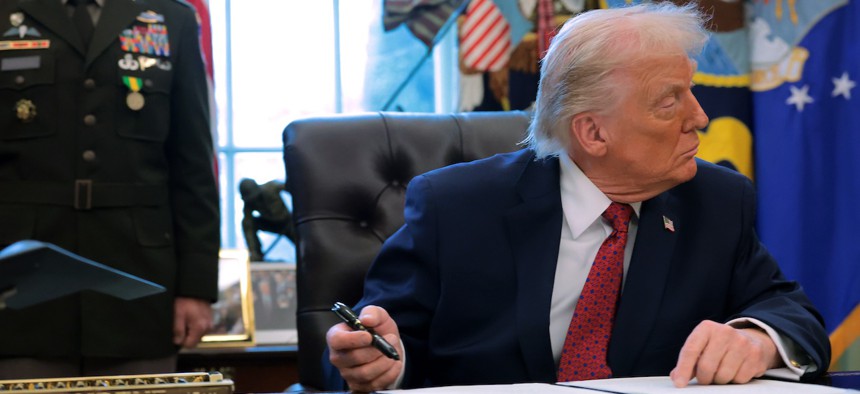
President Trump signing an executive order on Dec. 15. Earlier executive orders stripped two-thirds of the federal workforce of their collective bargaining rights. Anna Moneymaker/Getty Images





Appellate judges mull challenge to Trump’s efforts to bust most federal labor unions
Much of the discussion in oral arguments for three separate lawsuits revolved around whether an administrative board could hear unions’ legal claims and whether President Trump used a faulty definition of 'national security' when he devised two executive orders banning unions at most federal agencies.

Federal appellate judges asked lawyers for three federal employee unions and the Trump administration to submit new legal briefs following a murky discussion Monday of the outer limits of presidential power and the utility of an obscure Federal Labor Relations Authority petition in labor groups’ quest to defang a pair of executive orders banning their existence at most federal agencies.
A three-judge panel on the U.S. Court of Appeals for the D.C. Circuit heard oral arguments in three cases challenging President Trump’s executive orders that stripped two-thirds of the federal workforce of their collective bargaining rights. Signed in March and August, the edicts cite a seldom-used provision of the 1978 Civil Service Reform Act to bar unions at nearly 40 agencies on national security grounds.
The edicts have produced a dozen preliminary injunctions citing “retaliatory animus” against unions by U.S. district court judges, though most of those decisions have since been stayed by appellate courts. Monday’s hearing covered lawsuits brought by the National Treasury Employees Union, the American Foreign Service Association, and the Federal Education Association, which represents K-12 teachers at U.S. military bases, who all additionally argued that President Trump acted “ultra vires,” or exceeding his authority, when issuing the executive orders.
Josh Koppel, an attorney with the Justice Department, argued that the district court judges lacked jurisdiction to hear the cases and that unions should instead issue their complaints to the FLRA, whose decision could then be appealed to U.S. courts of appeal. And he defended the process used to formulate the executive orders, which he said remained on solid ground even if the jurists agreed with their lower court colleagues that the president acted with animus against the labor groups.
“I think that here, though, the question is whether the president’s determination met the requirements of the statute,” Koppel said. “And if the president made the two [national security] determinations that are laid out in [the statute], then whether he was also motivated by animus, which we certainly dispute, but even if he was, you know, as the district court found he was, that doesn’t rebut the requirements of the statute were met.”
But U.S. Circuit Judge Brad Garcia, a Biden appointee, questioned whether President Trump properly made those national security determinations. He pointed to the fact that the Justice Department in September seemed to errantly cite an over-broad definition of “national security” from a 1980 FLRA decision, only to abandon that definition in subsequent legal briefs.
“The government argued based on this Oak Ridge case, which the government read to define national security to define any work that affects the productivity or economy of the United States,” Garcia said. “That argument is noticeably absent from later appellate briefs. Do you think that’s an unreasonable reading of the ‘national security’ term?”
“I don’t think it’s necessarily an unreasonable reading, but as our briefs make clear, we don’t think this court has to get there,” Koppel responded. “Under any reasonable reading of the term ‘national security,’ the president was acting within his discretion and reasonably.”
“What if the claim was that the president used a definition of ‘national security’ that is facially overbroad?" Garcia asked. “That sounds like exactly what ultra vires review is for. We would be asking, ‘Do we know what definition he applied, and can we tell if it’s obviously beyond the terms of the statute.”
Circuit judges Naomi Rao and Douglas Ginsburg, Trump and Reagan appointees, respectively, grilled attorneys for the three unions on whether any avenues exist to challenge the edicts via the FLRA prior to coming to federal court. Trump’s executive orders strip the FLRA of jurisdiction over proceedings at the impacted agencies; in unfair labor practice complaints and other cases already before the FLRA when the edicts were issued, the adjudicative agency issued “show cause” orders instructing unions to explain why those cases should not be dismissed.
At issue is a provision of the federal sector labor statute allowing parties to submit a unit clarification petition—that is, a request for the FLRA to examine whether to include or exclude particular segments of an agency’s workforce in a union bargaining unit—or “a matter relating to representation.”
“There are two problems with [the petition for unit clarification]: one is that it would just be passing strange for Congress to intend your route of review to kind of misplead and abuse the unit certification petition,” said Jason Walta, an attorney representing FEA. “There’s no dispute about which specific employees are in and which are out of the bargaining unit.”
“I don’t know what the mispleading would be,” Rao said. “You’d say that there’s an executive order that purports to exempt these agencies and subdivisions, and we want to see if that’s valid.”
“But it’s not a general clarification petition, it’s a unit clarification petition, specifically regarding which employees are in or out of the specific bargaining unit,” Walta said. “Here, there’s no dispute between the parties about what the constitution of the unit is.”
Paras Shah, representing NTEU, and Richard Hirn, representing AFSA foreign service officers, both agreed that they read the provision as question being solely related to disputes over who is included or excluded from bargaining units.
“So you’re saying the statute’s got an extra clause in it that doesn’t add anything?” said an exasperated Ginsburg. “’Or a matter relating to representation.’ It can’t be that that’s just the same thing, to clarify the unit or amend the unit . . . You’re saying ‘A or B’ is what the statute says, and they both mean A.”
In a joint order Tuesday, the three judges requested supplemental legal briefs regarding whether unit clarification petitions could be used to obtain “further administrative or judicial review” in this case. Those filings are due in January.
Share your news tips with us: Erich Wagner: ewagner@govexec.com; Signal: ewagner.47
NEXT STORY: Air traffic controllers calling out sick during shutdown may have acted illegally, FAA chief says