

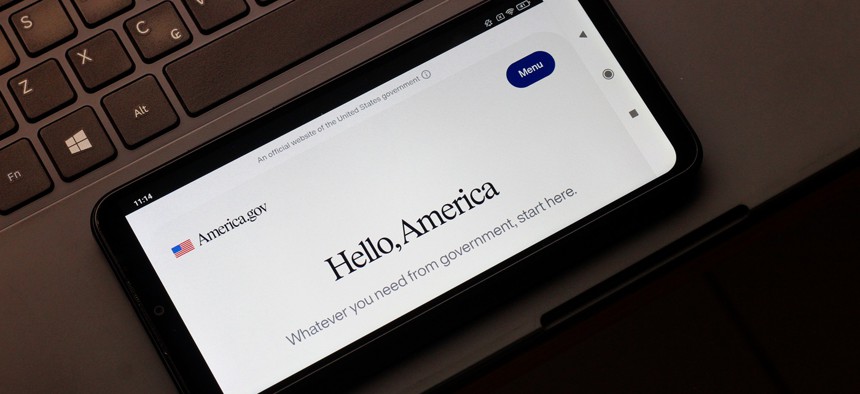
The proposal reflects a broader push to rethink how people interact with government services online. Thomas Fuller/SOPA Images/LightRocket via Getty Images



Ex-government tech leaders pitch new vision for America.gov
The proposal goes beyond a single online portal, calling for changes to the underlying systems that determine eligibility and enroll people in federal and state benefit programs.

A group of civic technologists is urging the next administration to automate benefits enrollment rather than just build a one-stop shop for residents to apply for them.
New administrations have long promised to build one-stop shops Americans can use to navigate government programs such as Social Security. The Trump administration’s version of that vision is America.gov, an artificial intelligence-powered chatbot that provides Americans with information about government programs and will allow Americans to apply for certain programs next year.
But one-stop shops don’t solve all of the challenges Americans face in navigating the social safety net, according to a Tech Viaduct paper released Friday.
“We can only go so far, even with AI, at band-aiding over and piecing together a really broken and really inconsistent safety net,” Marina Nitze, former CTO of the Veterans Affairs Department under President Barack Obama and lead paper author, told Nextgov/FCW.
The next administration should fix the technical back end of the social safety net, in addition to offering a digital front door like America.gov, the paper argues.
By doing so, Americans would be able to use America.gov, as well as any AI agent, company or nonprofit, to assess whether they qualify for a government program and submit the necessary data, the paper envisions.
There are four steps to fix the back end of the social safety net, according to the paper.
The first step is for the administration to document the eligibility criteria for benefits administered by agencies such as the Social Security Administration.
The second step is to establish one authoritative source for each eligibility criterion — such as income and citizenship status — that benefit programs must accept as the truth for eligibility determination.
The third step is to rewrite program eligibility criteria so that the authoritative sources can actually serve as the basis for eligibility determinations. Tech Viaduct previously urged Congress to take the lead in standardizing technical definitions used for eligibility determinations such as disability, homelessness and income.
The final step is to validate that benefit programs pass standardized test scenarios to prove they are following the law.
The four-step process is simple on paper but has multiple complexities.
For example, some data will not have authoritative sources, such as a common SNAP question about whom someone regularly prepares food with, according to Nitze. In those cases, government officials should determine whether the question should be eliminated, streamlined or replaced with self-attestation, she said.
States may need financial incentives to determine how authoritative sources integrate with existing information technology systems for programs like SNAP and Medicaid, Nitze added.
To advance the four-step process, there needs to be a “commanding presidential directive to hold agency heads accountable” and collaboration with Congress in rewriting statutes as needed, according to the paper.
Pitching the vision
Tech Viaduct is a project of Democratic think tank Searchlight Institute that is preparing day one plans for the next administration.
Project staffers will attend the “What’s Next” conference in Denver in a few weeks to pitch 2028 campaigns on the new paper titled “Integrated Benefits: Our Vision for America.gov,” according to the Searchlight Institute.
Mikey Dickerson, the first administrator of the U.S. Digital Service and a senior Tech Viaduct advisor, is slated to speak at the event along with 2028 hopefuls such as former Transportation Secretary Pete Buttigieg.
The Tech Viaduct team plans “to make the case that Integrated Benefits is a precondition to any future Democratic trifecta being able to enact its most ambitious plans — from universal health care to a reformed tax system and more,” the think tank told Nextgov/FCW.
But the paper argues that its new vision for benefits delivery is bipartisan.
“For conservatives who are more concerned about waste and fraud, adjudicating the same facts independently in every program is maddeningly expensive for federal, state, and local budgets alike,” the paper states. “Done well, [the four steps] will combat fraud by making honest mismatches disappear, so the real fraud stands out.”