

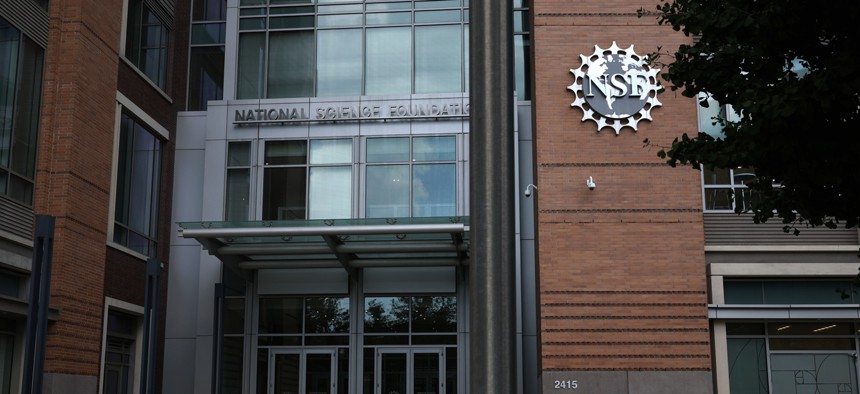
The agency is moving beyond the early stages of a government-backed effort. Alex Wong/Getty Images




The National Science Foundation is building out the government’s AI research infrastructure
A new center will help the agency expand access to the computing power and other resources researchers need to develop artificial intelligence.

The National Science Foundation unveiled a new “backbone” for its artificial intelligence research resource on Tuesday, called the National Artificial Intelligence Research Resource Operations Center.
The NAIRR Operations Center will support the broader program offering researchers access to data and other computational resources for their advanced AI research. The operations center will coordinate efforts between research resource partners and offer support and training to users working with the NAIRR.
The NAIRR itself was initially launched in January 2024, linking private sector partners like NVIDIA, OpenAI and Microsoft with NAIRR researchers. It was set to expire in January 2026, and is now transitioning to a permanent part of NSF’s AI research infrastructure, in part with the help of the new operations center.
“The NAIRR pilot has demonstrated both the demand for and the impact of a national approach to AI infrastructure,” the NSF press release reads. “NAIRR-OC will build on this progress by transforming successful elements of the pilot into a sustained national capability.”
Two academic institutions, the San Diego Supercomputer Center at UC San Diego and the Texas Advanced Computing Center at The University of Texas at Austin, will lead the operations center.
The Trump administration has prioritized fortifying the U.S. scientific research apparatus with AI technologies. President Donald Trump’s AI Action Plan, debuted in July 2026, called for investments in AI-enabled scientific discovery, charging NAIRR with continuing to build inroads for public-private sector partnerships.
In May of this year, U.S. Chief Technology Officer Ethan Klein underscored the administration’s focus on leveraging new AI systems for scientific advancement.
“Across a broad swath of applications, but specifically for scientific discovery, I think agentic AI will be transformational,” Klein said at the Special Competitive Studies Project’s AI+ Expo.
NSF has also been at the center of the Trump administration’s massive government overhaul by conducting a mass termination of select grants beginning in April 2025 as a result of investigations conducted by the Department of Government Efficiency that deemed them too heavily focused on diversity, equity and inclusion. Among the terminated grants were topics that focused on deepfake detection and aspects of AI advancement.