

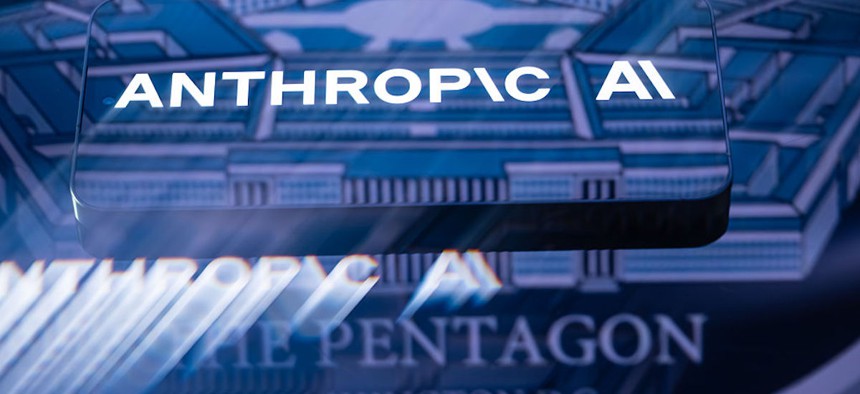
The Pentagon labeled Anthropic as a supply chain risk earlier this year — and the White House later ordered a governmentwide phaseout of its technology — after the AI company declined to ease restrictions on its products being used in domestic surveillance and fully autonomous weapons. Jonathan Raa/NurPhoto via Getty Images



White House is drafting plans to permit federal Anthropic use
The move suggests the Trump administration is easing its stance on the AI company, which faced a Pentagon supply chain risk designation and phaseout directive.
The White House is crafting guidance that would allow federal agencies to bypass a supply chain risk designation on Anthropic and clear the way for government use of its tools, including the cyber-focused Mythos AI model, according to an industry source familiar with the matter.
The move is notable because it suggests the Trump administration may be softening its stance on Anthropic. The Pentagon labeled Anthropic as a supply chain risk earlier this year — and the White House later ordered a governmentwide phaseout of its technology — after the AI company declined to ease restrictions on its products being used in domestic surveillance and fully autonomous weapons.
The administration is also drafting an AI executive order that could, in part, address how the government uses Anthropic's tools, a second person familiar with the matter said.
Both sources spoke on the condition of anonymity to communicate non-public details. Nextgov/FCW has asked Anthropic for comment.
"The White House continues to proactively engage across government and industry to protect our country and the American people, including by working with frontier AI labs," a White House official told Nextgov/FCW. "The collective effort of all involved will ultimately benefit our economy and country. However, any policy announcement will come directly from the President and anything else is pure speculation."
Axios first reported on the White House's plans.
Mythos, unveiled earlier this year, has become a tipping point for cybersecurity and AI practitioners because it demonstrates how advanced models can be purpose-built for real-world cyber operations, including those planned inside the intelligence community. In the wrong hands, it could be used to carry out sophisticated cyberattacks against government networks, critical infrastructure or other key U.S. systems.
As soon as Mythos was unveiled, the company launched Project Glasswing, a private coalition of firms that aims to use the model to patch critical vulnerabilities across the global internet before AI-assisted cyber threats become widespread.
Last week, Joint Chiefs Chairman Dan Caine said at a national security event in Nashville that autonomous weapons will be a “key and essential part of everything we do,” pointing to a broader military push to integrate AI into defense operations.
“I want our nation using all of our best [AI] models,” retired Gen. Paul Nakasone, who led NSA and Cyber Command, told reporters in a briefing at that same event hosted by Vanderbilt University.
“I don’t think it was accurate that Anthropic is a supply chain risk,” added Nakasone, who also serves on the board of OpenAI. “I feel uncomfortable with the fact that part of our nation’s capability is not being used by our government.”
The dispute between Anthropic and the Trump administration has rattled Washington’s AI vendor landscape over the last couple of months, with companies scrambling for clarity on contracting requirements as uncertainty grows over how the government will handle how much use of Anthropic products is permissible.
The company has legally challenged the supply chain risk label. A federal judge issued a temporary injunction on the designation and ban in late March, which the government has said it intends to appeal.
Last week, President Donald Trump said in a CNBC interview that the company is “shaping up” and can “be of great use” in the future, a sign that tensions between Anthropic and the government may be easing.
Editor's note: This article has been updated to include comment from the White House.