

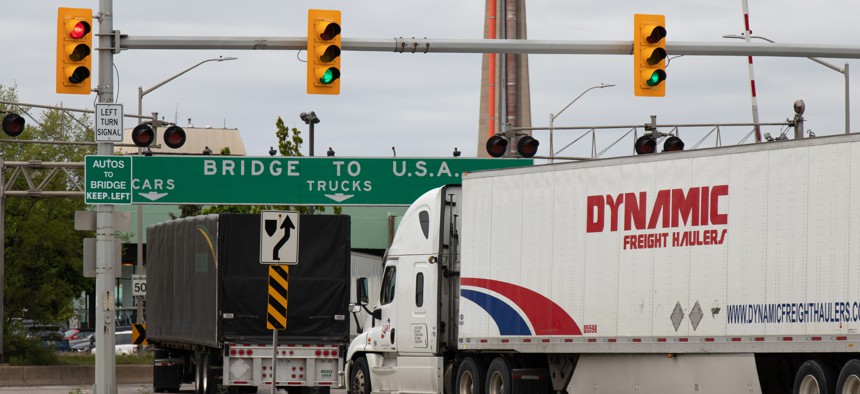
Tractor-trailers pass under a "Bridge To USA" sign at the entrance to the Ambassador Bridge at the US-Canada border crossing. Gettyimages.com/ The Bold Bureau

CBP seeks AI solutions to keep pace with rising volumes of border scans
A new sources sought notice seeks artificial intelligence tools to help agents sift through tens of thousands of X-ray images at ports of entry.

Customs and Border Protection is facing a volume problem as it expands the scanning of cars and trucks at ports of entry.
The so-called non-intrusive inspection scanning technology that CBP is deploying greatly increases the number of vehicles scanned.
“The sheer volume of data generated by increased scanning can be overwhelming for human operators, necessitating innovative solutions to maintain efficiency and effectiveness,” the agency writes in a sources sought notice posted Wednesday.
CBP uses X-rays to scan full-size vehicles – commercial trucks, cargo containers, and privately owned cars – without physically opening or unloading them. The agency's systems generate tens of thousands of images a day across multiple types of scanners.
To address this volume challenge, CBP wants to use more artificial intelligence and machine learning solutions. But the agency does not want a proprietary data platform, data pipeline or case management system.
Instead, the agency wants algorithmic components that can be integrated with existing and planned CBP-owned data platforms.
CBP is looking for help with using a human-in-the-loop approach. AI will serve as a tool as “CBP’s frontline personnel remain the most critical asset to thwarting illicit goods crossing our borders,” the request for information states.
While the agency emphasizes in the notice that employees are its most valued resource, “CBP recognizes that technology is a vital element to mission success.”
The agency wants information on algorithm products, including performance metrics related to:
- Anomaly detection
- Manifest/commodity verification
- Identifying modifications, such as concealment locations
- Contraband detection.
Responses are due May 30.