

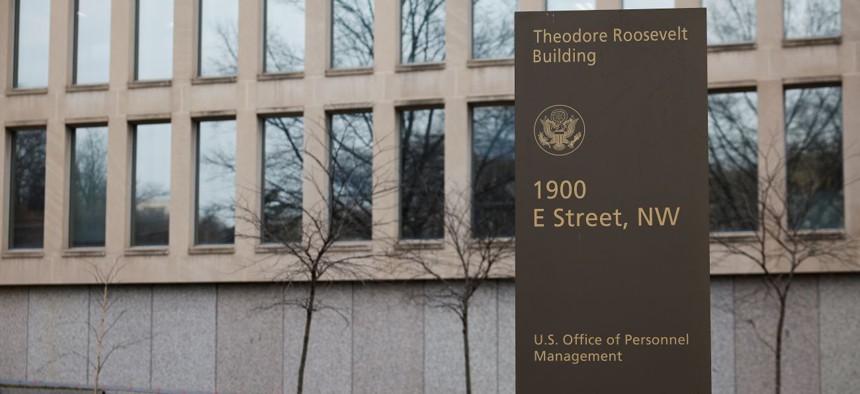
A group of transgender federal employees have asked a federal judge to halt the Office of Personnel Management's policy banning coverage of gender-affirming care via agencies' employer-sponsored insurance programs. Kevin Dietsch/Getty Images





Feds urge judge to block OPM’s gender affirming care ban
Experts say between 40,000 and 60,000 transgender federal workers have been or will be impacted by the Trump administration's effort to ban coverage of hormone therapies and other gender-affirming treatments.

A group of transgender federal employees have asked a federal judge to halt the Trump administration’s bid to ban coverage of gender-affirming care by the federal government’s two employer-sponsored insurance programs, in advance of the new plan year in January.
On President Trump’s first day in office in 2025, he issued an executive order requiring federal agencies to cease acknowledging the concept of gender identity as well as the existence of transgender and other nonbinary individuals.
In the intervening months, the Trump administration has sought to purge transgender Americans from the military service branches, halt gender affirming care for federal prisoners and house them based upon their sex assigned at birth, as well as pressure private sector health care providers from offering gender affirming care.
And the Office of Personnel Management instructed insurance carriers last year to cease covering gender affirming medical care, including hormone replacement therapy and surgical interventions, through the Federal Employees Health Benefits Program and Postal Service Health Benefits Program. A case-by-case exception policy was in place during 2026 provided an enrollee was “mid-treatment,” but OPM ended that policy for the 2027 plan year and instituted a categorical ban.
In August, a group of transgender federal workers filed a class-action lawsuit aiming to roll back the insurance coverage policy and require FEHB and PSHB insurers to cover treatments like HRT and gender-affirming surgeries as they did prior to Trump’s return to office. Last week, the plaintiffs asked a federal judge in Washington, D.C., to certify the class in their case and to issue a preliminary injunction blocking the ban ahead of its full implementation next year.
“In a deeply cruel and discriminatory manner, OPM has issued a blanket ban on insurance coverage for transgender beneficiaries’ hormonal and surgical care for gender transition in Plan Year 2027,” attorneys for the employees wrote. “This court’s intervention is necessary to prevent certain harm to plaintiffs and other class members.”
The federal workers allege that the ban on hormone therapy and gender-affirming surgical interventions violate Title VII of the 1964 Civil Rights Act, which bans workplace discrimination on the basis of sex. That’s in part because hormone therapies, like testosterone injections and surgeries like penile prostheses and breast augmentations remain covered under FEHBP and PSHBP for cisgender beneficiaries.
The plaintiffs warned that the cost of hormone replacement therapy is prohibitive without insurance coverage, and that feds will be forced to ration their medication or forgo it altogether, something that can have dire consequences.
“Rationing can cause debilitating symptoms, such as intrusive thoughts, mental and emotional upheaval and withdrawal,” they wrote. “Moreover, both plaintiffs no longer produce sex hormones. Going without hormone replacement therapy therefor harms plaintiffs’ physiology in many ways, including the risk of loss of bone density.”
And in some cases, the ban on gender affirming care has prevented employees from receiving needed follow-up treatments from prior to the ban. One plaintiff described a painful lesion that developed following her gender-affirming surgery, but her FEHBP insurer won’t cover the procedure that would allow it to permanently heal due to OPM’s ban.
“Ms. Coe’s treating surgeon diagnosed the problem and recommended surgery to permanently correct it,” the plaintiffs wrote. “She has been unable to obtain that treatment because his practice will not perform the surgery without insurance coverage. She understands that the procedure could cost tens of thousands of dollars, and she ahs no means in place to cover that expense. The result is continued pain from ordinary activities while the condition her doctor recommends repairing remains untreated.”
The motion to block OPM’s ban on gender-affirming care noted that the administration has not relied on any medical reasoning or studies in its decision. And it highlights a litany of studies that conclude both hormone therapy and gender-affirming surgical procedures improve transgender people’s lives.
“In a randomized clinical trial of adults seeking testosterone therapy, those who began treatment immediately experienced significantly greater reductions in gender dysphoria, depression and suicidality within three months than those assigned to wait,” they wrote. “[And a] study of nearly 20,000 transgender adults who desired surgery found that those who had undergone one or more gender-affirming procedures at least two years earlier had significantly lower adjusted odds of severe psychological distress and suicidal ideation than those who had not received surgery.”
If you have a tip that can contribute to our reporting, Erich Wagner can be securely contacted at ewagner.47 on Signal.
NEXT STORY: Walkinshaw to push for federal pay raise in lame duck spending talks