

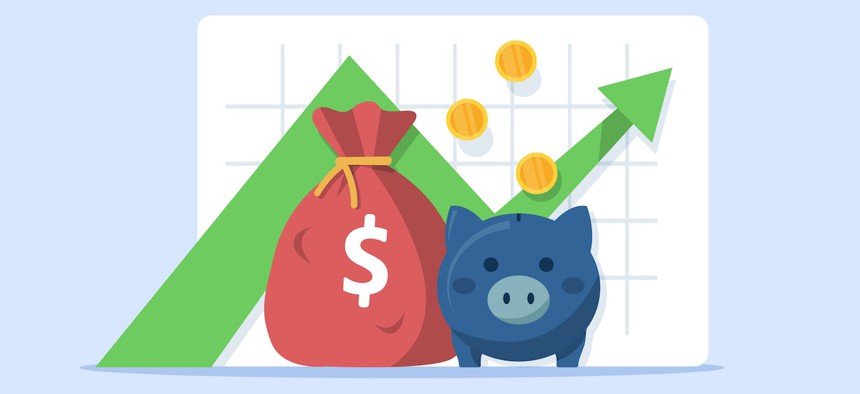
Eakkasit Nimprasert/Getty Images



Why time, not timing, is the biggest retirement advantage for federal employees
A look at decades of market shifts and TSP data shows the biggest driver of retirement wealth isn't picking the right stock. It's starting early, contributing consistently and letting compounding do its work.

As most federal employees covered by the Federal Employees Retirement System (FERS) know, a comfortable retirement cannot rely on the FERS basic retirement benefit alone. FERS is built on three parts working together to produce a financially comfortable retirement: the basic retirement benefit, Social Security and the Thrift Savings Plan (TSP). Of those three, the TSP is the part employees can most directly influence through payroll contributions, investment choices and time in the market. That is why understanding compounding is not just a financial concept. It is a practical career-long strategy.
It is amazing to learn that the largest TSP account balance was $10,820,000 as of the end of June. However, at the Federal Retirement Thrift Investment Board's July board meeting, the reported average TSP account balance for June was $157,412, with the average participant contributing for nearly 11 years. Yet most accounts — 4,095,134 of them — were still under $50,000, with an average contribution history of a little more than six years.
The contrast is important: Balances tend to grow most visibly after years of steady saving, reinvested earnings and market participation.
- For accounts between $500,000 and $749,000, the average number of years contributed was 21.96 years.
- For accounts between $750,000 and $999,000, the average number of years contributed was 23.85 years.
- For accounts of $1,000,000 or more, the average number of years contributed was 27.25 years.
Note: Values include FERS, CSRS and uniformed services accounts.
These numbers are a practical reminder that retirement wealth is built through repeated contributions, agency matching dollars, long-term investment discipline and the compounding of earnings over many years. Compounding is the process of earning money not only on contributions but also on prior earnings. In a retirement account, that means the earliest dollars have the longest runway. A contribution made in the first decade of a federal career can potentially benefit from decades of market returns, reinvested growth and additional agency contributions.
For eligible FERS employees, the agency contribution makes early and consistent saving even more powerful. FERS employees receive an automatic 1% agency contribution to the TSP, along with dollar-for-dollar matching contributions on the first 3% of basic pay they contribute and an additional 50 cents on the dollar on the fourth and fifth percent of employee contributions. Setting your savings at 5% or higher is the key to receiving the full available agency match. Missing that match means giving up retirement money today and the future growth that money could have produced.
As of May 31, the C Fund held more than $500 billion of the TSP's total assets, representing a 43.9% share of all TSP fund assets.
As of June 30, 2026, the top companies in the S&P 500 Index, which the TSP's C Fund is designed to track, were dominated by technology and communication services companies, including Nvidia, Apple, Microsoft, Amazon, Alphabet, Broadcom, Micron, Meta and Tesla.
Sector weightings showed information technology at 38.0%, followed by financials at 11.8%, communication services at 9.7%, consumer discretionary at 9.3%, industrials and health care at 8.9% each and smaller allocations across consumer staples, energy, utilities, materials and real estate.
The lesson is to participate consistently through a diversified strategy that can benefit as market leaders shift over time. According to S&P Global, the S&P 500 currently represents approximately 83% of total U.S. market capitalization. This broad coverage enables it to closely track the performance of the overall U.S. equity market. The largest companies in the index account for a substantial share of its total market capitalization, giving them the greatest influence on the index's performance.
Consider the performance of the following investments over time:
-
A $1,000 investment in the S&P 500 made 20 years ago would be worth more than $8,500 today. In 2006, the maximum elective deferral limit was $15,000. Investing $15,000 in the C Fund 20 years ago would be worth around $127,500 today.
-
A $1,000 investment in Nvidia 20 years ago would be worth more than $560,000 today. Interestingly, Nvidia officially joined the S&P 500 on Nov. 29, 2001, replacing Enron.
-
A $1,000 investment in Apple 20 years ago would be worth about $130,000 today.
-
A $1,000 investment in Microsoft at its 1986 initial public offering would be worth roughly $6.46 million today. A $1,000 investment made 20 years ago would be worth approximately $20,088.
-
A $1,000 investment in Amazon 20 years ago would be worth roughly $90,000 to $135,000 today.
-
A $1,000 investment in Broadcom 20 years ago would be worth approximately $254,613 today.
These examples are not recommendations for buying individual stocks, as past performance cannot predict future results. Buying individual stocks for retirement is risky because it lacks diversification, demands intensive research and introduces high emotional volatility. In the TSP, most federal employees pursue this kind of long-term growth through diversified funds, such as the C, S, I, F and G Funds, or through Lifecycle Funds that adjust allocations across all five core funds over time.
Looking back to 1980 — a year that was personal for me because I got married, moved to Washington, D.C., and was just beginning my career at age 22 — the leading companies looked very different:
-
IBM, then the index heavyweight in information technology. If you put $1,000 into IBM stock 20 years ago, it would be worth about $5,700 today.
-
AT&T, the pre-divestiture telecommunications monopoly.
-
Exxon, now part of ExxonMobil.
-
Standard Oil of Indiana, later Amoco and eventually part of BP.
-
Schlumberger, an energy and oil field services company.
-
Shell Oil, part of the energy sector.
-
Mobil, later merged with Exxon.
-
Standard Oil of California, later Chevron.
-
Atlantic Richfield, known as ARCO, was later acquired by BP.
-
General Electric, an industrial leader.
The point is not that one sector is always best. In 1980, energy and oil service companies dominated the top 10. Today, technology and communication services carry much more weight. Federal employees who save steadily in diversified TSP funds do not have to know in advance which companies will lead the next generation. They simply need a contribution plan, an allocation appropriate for their age and risk tolerance and the patience to let compounding work.
Here are some things you can do to prepare for your future retirement:
-
Contribute at least 5% if you are eligible for the full FERS match. The match is part of your compensation and can compound along with your own contributions. The May TSP Activity Report indicated that 86.6% of FERS employees contributed at least 5% of their basic pay to receive the full match.
-
Increase contributions when pay increases. Even small increases can become meaningful over a full federal career.
-
Know the annual limits. For 2026, the TSP elective deferral limit is $24,500. FERS employees age 50 and older may make up to $8,000 in additional catch-up contributions, with a higher catch-up opportunity of $11,250 for those ages 60 through 63.
The following two things can be done automatically by investing in the TSP Lifecycle Fund that matches your time horizon (an investment time horizon is the period during which an investment is expected to be held to achieve financial goals):
-
Stay diversified. Market leadership changes. Diversification helps reduce the risk of relying too heavily on one company or sector.
-
Review your allocation periodically. Your investment mix should reflect your time horizon, risk tolerance and retirement income needs.
Do not wait for the perfect time. The most valuable ingredient in compounding is time, and time cannot be replaced later.
Federal service comes with a valuable retirement framework, but the strength of that framework depends in part on the actions you take throughout your career. The FERS annuity and Social Security provide important foundations. The TSP gives employees the opportunity to build personal retirement wealth through disciplined saving, agency contributions, diversified investing and compounding.
A trip down memory lane shows that markets evolve, leaders change and time rewards consistency. For federal employees, the most important step may be the simplest: Start saving, keep saving and give compounding enough years to do the heavy lifting.
Headline
Why time, not timing, is the biggest advantage in building a FERS retirement
Dek
The biggest gains in the Thrift Savings Plan often come after decades of steady saving. Here's what today's balances and yesterday's market leaders reveal about building long-term retirement wealth.
Keywords: FERS, Thrift Savings Plan, TSP, retirement planning, federal retirement, federal employees, compounding, investing, C Fund, lifecycle funds, agency match, Social Security, retirement savings, financial planning
A trip down memory lane: What federal employees can learn about saving for retirement under FERS
As most federal employees covered by the Federal Employees Retirement System (FERS) know, a comfortable retirement cannot rely on the FERS basic retirement benefit alone. FERS is built on three parts working together to produce a financially comfortable retirement: the basic retirement benefit, Social Security and the Thrift Savings Plan (TSP). Of those three, the TSP is the part employees can most directly influence through payroll contributions, investment choices and time in the market. That is why understanding compounding is not just a financial concept. It is a practical career-long strategy.
It is amazing to learn that the largest TSP account balance was $10,820,000 as of the end of June. However, at the Federal Retirement Thrift Investment Board's July board meeting, the reported average TSP account balance for June was $157,412, with the average participant contributing for nearly 11 years. Yet most accounts — 4,095,134 of them — were still under $50,000, with an average contribution history of a little more than six years.
The contrast is important: Balances tend to grow most visibly after years of steady saving, reinvested earnings and market participation.
For accounts between $500,000 and $749,000, the average number of years contributed was 21.96 years.
For accounts between $750,000 and $999,000, the average number of years contributed was 23.85 years.
For accounts of $1,000,000 or more, the average number of years contributed was 27.25 years.
Note: Values include FERS, CSRS and uniformed services accounts.
These numbers are a practical reminder that retirement wealth is built through repeated contributions, agency matching dollars, long-term investment discipline and the compounding of earnings over many years. Compounding is the process of earning money not only on contributions but also on prior earnings. In a retirement account, that means the earliest dollars have the longest runway. A contribution made in the first decade of a federal career can potentially benefit from decades of market returns, reinvested growth and additional agency contributions.
For eligible FERS employees, the agency contribution makes early and consistent saving even more powerful. FERS employees receive an automatic 1% agency contribution to the TSP, along with dollar-for-dollar matching contributions on the first 3% of basic pay they contribute and an additional 50 cents on the dollar on the fourth and fifth percent of employee contributions. Setting your savings at 5% or higher is the key to receiving the full available agency match. Missing that match means giving up retirement money today and the future growth that money could have produced.
As of May 31, the C Fund held more than $500 billion of the TSP's total assets, representing a 43.9% share of all TSP fund assets.
As of June 30, 2026, the top companies in the S&P 500 Index, which the TSP's C Fund is designed to track, were dominated by technology and communication services companies, including Nvidia, Apple, Microsoft, Amazon, Alphabet, Broadcom, Micron, Meta and Tesla.
Sector weightings showed information technology at 38.0%, followed by financials at 11.8%, communication services at 9.7%, consumer discretionary at 9.3%, industrials and health care at 8.9% each and smaller allocations across consumer staples, energy, utilities, materials and real estate.
The lesson is to participate consistently through a diversified strategy that can benefit as market leaders shift over time. According to S&P Global, the S&P 500 currently represents approximately 83% of total U.S. market capitalization. This broad coverage enables it to closely track the performance of the overall U.S. equity market. The largest companies in the index account for a substantial share of its total market capitalization, giving them the greatest influence on the index's performance.
Consider the performance of the following investments over time:
-
A $1,000 investment in the S&P 500 made 20 years ago would be worth more than $8,500 today. In 2006, the maximum elective deferral limit was $15,000. Investing $15,000 in the C Fund 20 years ago would be worth around $127,500 today.
-
A $1,000 investment in Nvidia 20 years ago would be worth more than $560,000 today. Interestingly, Nvidia officially joined the S&P 500 on Nov. 29, 2001, replacing Enron.
-
A $1,000 investment in Apple 20 years ago would be worth about $130,000 today.
-
A $1,000 investment in Microsoft at its 1986 initial public offering would be worth roughly $6.46 million today. A $1,000 investment made 20 years ago would be worth approximately $20,088.
-
A $1,000 investment in Amazon 20 years ago would be worth roughly $90,000 to $135,000 today.
-
A $1,000 investment in Broadcom 20 years ago would be worth approximately $254,613 today.
These examples are not recommendations for buying individual stocks, as past performance cannot predict future results. Buying individual stocks for retirement is risky because it lacks diversification, demands intensive research and introduces high emotional volatility. In the TSP, most federal employees pursue this kind of long-term growth through diversified funds, such as the C, S, I, F and G Funds, or through Lifecycle Funds that adjust allocations across all five core funds over time.
Looking back to 1980 — a year that was personal for me because I got married, moved to Washington, D.C., and was just beginning my career at age 22 — the leading companies looked very different:
-
IBM, then the index heavyweight in information technology. If you put $1,000 into IBM stock 20 years ago, it would be worth about $5,700 today.
-
AT&T, the pre-divestiture telecommunications monopoly.
-
Exxon, now part of ExxonMobil.
-
Standard Oil of Indiana, later Amoco and eventually part of BP.
-
Schlumberger, an energy and oil field services company.
-
Shell Oil, part of the energy sector.
-
Mobil, later merged with Exxon.
-
Standard Oil of California, later Chevron.
-
Atlantic Richfield, known as ARCO, was later acquired by BP.
-
General Electric, an industrial leader.
The point is not that one sector is always best. In 1980, energy and oil service companies dominated the top 10. Today, technology and communication services carry much more weight. Federal employees who save steadily in diversified TSP funds do not have to know in advance which companies will lead the next generation. They simply need a contribution plan, an allocation appropriate for their age and risk tolerance and the patience to let compounding work.
Here are some things you can do to prepare for your future retirement:
-
Contribute at least 5% if you are eligible for the full FERS match. The match is part of your compensation and can compound along with your own contributions. The May TSP Activity Report indicated that 86.6% of FERS employees contributed at least 5% of their basic pay to receive the full match.
-
Increase contributions when pay increases. Even small increases can become meaningful over a full federal career.
-
Know the annual limits. For 2026, the TSP elective deferral limit is $24,500. FERS employees age 50 and older may make up to $8,000 in additional catch-up contributions, with a higher catch-up opportunity of $11,250 for those ages 60 through 63.
The following two things can be done automatically by investing in the TSP Lifecycle Fund that matches your time horizon (an investment time horizon is the period during which an investment is expected to be held to achieve financial goals):
-
Stay diversified. Market leadership changes. Diversification helps reduce the risk of relying too heavily on one company or sector.
-
Review your allocation periodically. Your investment mix should reflect your time horizon, risk tolerance and retirement income needs.
Do not wait for the perfect time. The most valuable ingredient in compounding is time, and time cannot be replaced later.
Federal service comes with a valuable retirement framework, but the strength of that framework depends in part on the actions you take throughout your career. The FERS annuity and Social Security provide important foundations. The TSP gives employees the opportunity to build personal retirement wealth through disciplined saving, agency contributions, diversified investing and compounding.
A trip down memory lane shows that markets evolve, leaders change and time rewards consistency. For federal employees, the most important step may be the simplest: Start saving, keep saving and give compounding enough years to do the heavy lifting.
NEXT STORY: NARFE still has concerns with OPM’s plan to collect employee health care records