

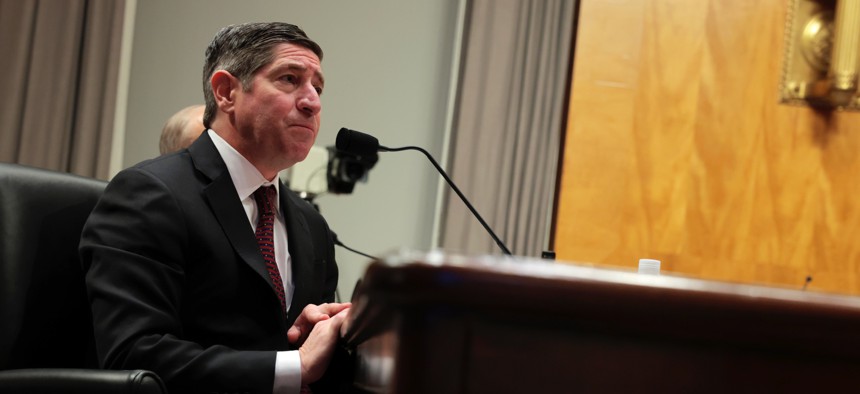
OPM Director Scott Kupor outlined the creation of a special pay rate for law enforcement jobs in a Dec. 31 memo. Anna Moneymaker / Getty Images




OPM finalizes 3.8% raise for federal law enforcement
The additional 2.8% pay increase set aside for law enforcement personnel takes the form of a special pay rate.

The Office of Personnel Management last week finalized plans to grant federal law enforcement a 3.8% across-the-board pay increase this January, an increase over the 1% raise set aside for the rest of the federal workforce.
President Trump initially authorized the additional pay bump for feds in law enforcement in an alternative pay plan issued in August. Trump’s December executive order finalizing the 1% across-the-board raise for most feds tasked OPM Director Scott Kupor with evaluating how to disperse the additional 2.8% supplemental raise.
In a Dec. 31 memo to agency heads, Kupor announced the creation of a special pay rate for law enforcement jobs, citing “mission critical” hiring needs to justify the additional pay raise.
“These new special rates support ongoing agency hiring efforts for mission-critical law enforcement positions essential to implementing the administration’s priorities to secure the border, enforce federal laws and protect public safety,” Kupor wrote. “Without these special rates, agencies may face challenges in recruiting and retaining the personnel needed to carry out these missions effectively.”
Kupor’s memo confirms that federal workers in positions covered by the special pay rate will receive a total raise of 3.8% beginning with the first full pay period of 2026. The pay rate is subject to the federal pay cap, which in 2026 sits at $197,200 per year.
A full list of jobs covered by the supplemental pay raise is as follows:
Agriculture Department: law enforcement officers and criminal investigators within the Forest Service, and Office of Safety, Security and Protection employees who provide “personal protection services.”
Justice Department: FBI special agents; Bureau of Prisons correctional officers; Drug Enforcement Administration special agents; deputy U.S. marshals, federal enforcement officers, aviation enforcement officers, detention enforcement officers and special agents within the U.S. Marshals Service; and special agents within the Bureau of Alcohol, Tobacco, Firearms and Explosives.
Homeland Security Department: aviation enforcement agents, criminal investigators, Customs and Border Protection officers, Border Patrol agents and air and marine interdiction agents within Customs and Border Protection; Immigration and Customs Enforcement special agents, deportation officers, detention and deportation officers and technical enforcement officers; U.S. Secret Service special agents and some physical security specialists, investigative protection officers, technical security investigators, protective armored specialists, protective support technicians and special officers; and criminal investigators and employees with “arrest authority” within the Federal Protective Service.
Interior Department: employees who meet the legal definition of a law enforcement officer across five occupational series, excluding workers within the Office of the Inspector General.
State Department: Diplomatic Security Service criminal investigators.
Also due for the larger raise, albeit in jobs outside of the General Schedule, are U.S. Secret Service Uniformed Division officers, nuclear materials couriers at the National Nuclear Security Administration, U.S. Park Police and diplomatic security agents at the State Department’s Diplomatic Security Service.
Kupor wrote that agencies may ask his agency to include additional jobs within the special pay rate “at any time.”
Share your news tips with us: Erich Wagner: ewagner@govexec.com; Signal: ewagner.47
NEXT STORY: FEHB and Medicare Part B: Do FEHB plans reduce coverage if you don't sign up for Medicare?