

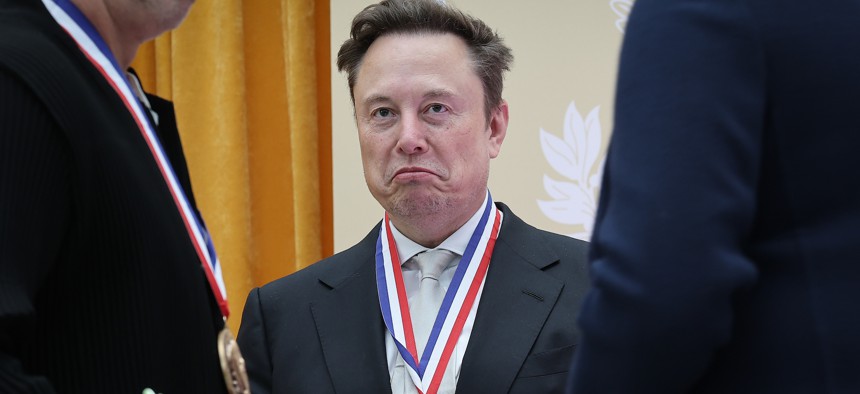
Elon Musk reacts after being awarded the National Medal of Science at the Institute of Peace on Oct. 8 in Washington, D.C. Musk's companies have received billions in federal contracts. Win McNamee / Getty Image




Musk is the target of a new Democratic bill to curtail political donations from federal contractors
While government contracting companies are already barred from making campaign contributions, a new measure would extend that prohibition to the corporations’ leaders.

A House Democrat and a Senate Democrat last week said they would introduce legislation to expand a prohibition on government contractors from making political contributions to include Elon Musk.
“We need to end the rotten political system that allows individuals like Elon Musk to spend unlimited sums of money to elect candidates who turn around and vote to send your tax dollars to their corporations through huge federal contracts,” Sen. Chris Van Hollen, D-Md., said in a statement. “This legislation will close that corrupt campaign cash-for-contracts loophole.”
It is currently illegal for federal contracting companies to contribute funds to political parties, committees or candidates. But the Close the Campaign Cash-for-Contracts Loophole Act — from Van Hollen and Rep. Robert Garcia, D-Calif., ranking member of the House Oversight and Government Reform Committee — would also bar donations from officers of contracting corporations and their affiliates as well as anyone with at least 5% interest or share in the company.
Musk, whose companies have received billions in federal contracts, has spent nearly half-a-billion dollars supporting Republican candidates in the upcoming midterm elections, according to The New York Times. The world’s first trillionaire also led the Trump administration’s Department of Government Efficiency cost-cutting initiative, which congressional Democrats and government watchdogs have criticized for failing to ensure that DOGE staffers appropriately accessed and protected government systems, overstating its purported savings and spearheading agency staff cuts that, in some cases, were reversed.
The bicameral Democratic legislation is endorsed by several good government groups, including the Brennan Center for Justice, Public Citizen and Citizens for Responsibility and Ethics in Washington.
“Right now, millionaires and billionaires who own or control companies that contract with the federal government can evade protections meant to prevent federal contractors from engaging in pay-to-play schemes,” said Debra Perlin, vice president for policy at CREW, in a statement. “The Close Campaign Cash-for-Contracts Loophole Act would fix a gap in the law that allows executives, major shareholders and corporations affiliated with federal contractors to make contributions to political parties and candidates in an effort to gain an unfair advantage in securing or maintaining federal contracts.”
The bill would, specifically, bar contractors and their officers from making political contributions between when contract negotiations start and one year after the contract terminates. It also would require politicians to hand over any contributions that are made in violation of these prohibitions to the government rather than refund the donor.
A spokesperson for the National Defense Industrial Association, a trade association for defense contractors, declined to comment, saying the organization generally doesn’t comment on pending legislation.
SpaceX, Musk’s primary company that receives federal contracts, and the Professional Services Council, a trade association for government contractors, did not respond to requests for comment.
If you have a tip that can contribute to our reporting, Sean Michael Newhouse can be reached securely at seanthenewsboy.45 on Signal.
NEXT STORY: ‘Life-and-death implications’: Former IG warns ICE’s detention oversight is masking unsafe conditions