

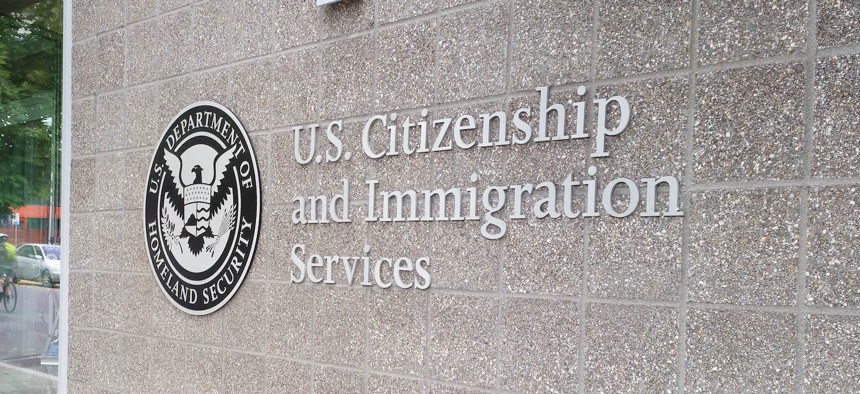
The inspector general recommended that U.S. Citizenship and Immigration Services reevaluate the employees in national security positions without eligibility or a clearance. SweetBabeeJay / Getty Images


Dozens of federal immigration employees stayed in sensitive positions despite security concerns, inspector general reports
Homeland Security Department officials pushed back on the report, contending that “[i]t is simply incorrect to suggest that these employees occupied national security positions for years without appropriate vetting.”

U.S. Citizenship and Immigration Services let dozens of its employees stay in national security positions even after they were determined to be ineligible for the roles due to security concerns or damaging information about them was uncovered, according to a new watchdog report. The Homeland Security Department, however, countered that the inspector general overstated its conclusions.
“Employees found to have criminal records, financial instability or anti-government ideologies may be more susceptible to coercion, blackmail or foreign influence,” auditors wrote. “Allowing employees whom USCIS deemed a security risk to remain in positions where they may access highly sensitive information undermines USCIS’ mission. Further, such employees could make immigration decisions that gravely damage national security.”
In total, the IG reported that, as of April 2025, 10 USCIS staffers held national security positions for an average of about seven years after they were disqualified from holding a sensitive position or a security clearance. For example, one individual stayed in such a position for more than a dozen years after their security clearance was denied.
But Jeffrey M. Bobich, a senior DHS official, asserted in a letter attached to the report that USCIS employees without a security clearance were barred from accessing classified information or conducting sensitive work while they appealed their clearance revocation. The IG, however, said that it could not verify this because the agency did not provide documentation.
Auditors also found 13 USCIS employees working in national security positions without a decision on file regarding their suitability for the role. A suitability determination is a step in the federal government’s personnel vetting process to gauge, after an investigation, if a staffer’s “character or conduct” is appropriate for the position.
“These employees were left in place despite USCIS possessing derogatory information [about them] such as marriage fraud, tax evasion, potential money laundering and ongoing contact with individuals illegally residing in the United States,” they wrote.
The Office of Personnel Management this year finalized a rule expanding suitability determinations, which previously only applied to federal job applicants, to current civil servants. Under the regulation, the HR agency can fire feds for post-appointment conduct.
While the IG included details about the security clearance denial cases in the report, some of the information is blacked out. Investigators included a note on the report’s front page that: “OIG determined that some of the department’s requested redactions lacked adequate justification and we were unable to resolve the matter with the department. To avoid further delay of the report, we have redacted the contested material pursuant to the department’s request and marked it with an asterisk.”
Investigators argued that DHS policy does not clearly assign roles for various officials when it comes to determining what to do when an employee is deemed ineligible for a national security position.
“USCIS’ approach reflects a pattern of giving individuals extended time and benefit of the doubt, even when the information warrants disqualification under federal adjudicative guidelines,” they wrote.
The IG made several recommendations, including that USCIS reevaluate the employees in national security positions without eligibility or a clearance and set timeframes for removing or reassigning employees after they’ve exhausted their appeal rights.
While DHS concurred with all of the recommendations, officials also contended that the report “omit[s] key information, circumstance and context.” For example, they wrote that the agency removed or reassigned 48 employees after they were determined to be ineligible for sensitive positions and an additional 52 staffers left during the appeals process.
DHS also said that the employees in the report were subject to continuous vetting under Trusted Workforce 2.0, a background check modernization initiative.
“It is simply incorrect to suggest that these employees occupied national security positions for years without appropriate vetting,” Bobich wrote.
Personnel vetting is not just a problem at USCIS. The government-wide security clearance process is on the Government Accountability Office’s high-risk list of federal programs “with serious vulnerabilities to fraud, waste, abuse and mismanagement or in need of transformation.”
If you have a tip that can contribute to our reporting, Sean Michael Newhouse can be reached securely at seanthenewsboy.45 on Signal.
NEXT STORY: Watchdog won’t discipline agencies over partisan shutdown posts but warns against ‘derogatory’ messaging