

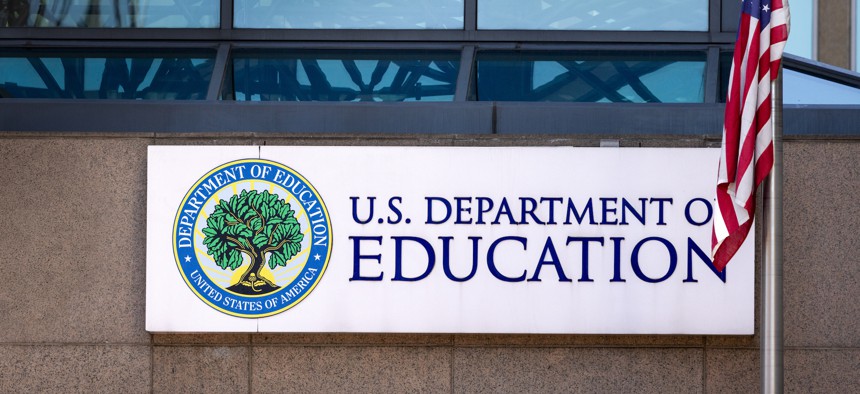
The Education Department's workforce has been roughly halved since the start of President Donald Trump's second term. Greggory DiSalvo / Getty Images




Former civil servants and union request IG investigation into transfer of Education program to Labor
House Republicans recently introduced a package of bills that would codify the Trump administration’s interagency agreements that move Education offices to other agencies.

Updated at 2:55 p.m. ET July 14
As the Trump administration continues to move federal education programs to other agencies as part of an effort to ultimately eliminate the Education Department, a federal employee union and former Education officials are asking a government watchdog to investigate the consequences of the transfers.
Specifically, the American Federation of Government Employees and ex-leaders at the Office of Career, Technical and Adult Education on Monday requested that the Education inspector general examine the interagency agreement that transferred OCTAE to the Labor Department.
OCTAE oversees programs that are related to adult education and literacy, career and technical education as well as community colleges.
The letter signers argued that the move has led to undocumented costs, such as overhauling grant infrastructure and relocating staff, and could slow decision-making due to possible jurisdictional conflicts between Labor and Education.
While the Trump administration has argued that the interagency agreements will reduce bureaucracy, the union and former officials alleged that, in certain cases, grantees now need to use several Labor grants management systems as opposed to only one Education program.
An Education spokesperson said in a statement to Government Executive that: "[T]he Trump Administration is breaking up the federal education bureaucracy and streamlining program management to ensure that all Americans are prepared for a fulfilling and meaningful career. "
An IG spokesperson said that the office hasn’t yet received the letter in question.
The Education IG recently reported that layoffs and other staff reductions at the start of Trump’s second term hindered the department’s ability to perform statutorily mandated activities. Based on federal workforce data from the Office of Personnel Management, Education’s workforce has gone from more than 4,200 in 2024 to nearly 2,300 currently.
House package
On July 9, Republicans on the House Education and Workforce Committee introduced 10 bills to codify the Education Department’s agreements with other agencies to transfer various programs.
“The legislative package reflects a simple principle: education policy should be focused on helping students succeed — not preserving a federal bureaucracy for its own sake,” said Chairman Tim Walberg, R-Mich., in a statement. “Rather than allowing unnecessary layers of Washington bureaucracy stand between families and the services they rely on, the bills would transfer key statutory authorities to agencies better equipped to carry them out while maintaining continuity for students and stakeholders."
The panel is scheduled to mark up the measures on Wednesday.
In contrast, the AFGE local for Education employees contended that the proposals would “break” the department.
“These bills are named ‘less bureaucracy,’ but they actually create many more layers of red tape for the American public and for federal employees trying to serve students and families,” said AFGE Local 252 President Rachel Gittleman in a statement. “States, grantees and taxpayers are already paying the price for education programs being unlawfully transferred to other federal agencies: funding delays, confusion and chaos for both employees and the public, wasted taxpayer dollars and no accountability or oversight.”
This story has been updated with a statement from the Education Department.
If you have a tip that can contribute to our reporting, Sean Michael Newhouse can be reached securely at seanthenewsboy.45 on Signal.
NEXT STORY: Duffy faces new ethics complaint over official social media post promoting wife’s book