

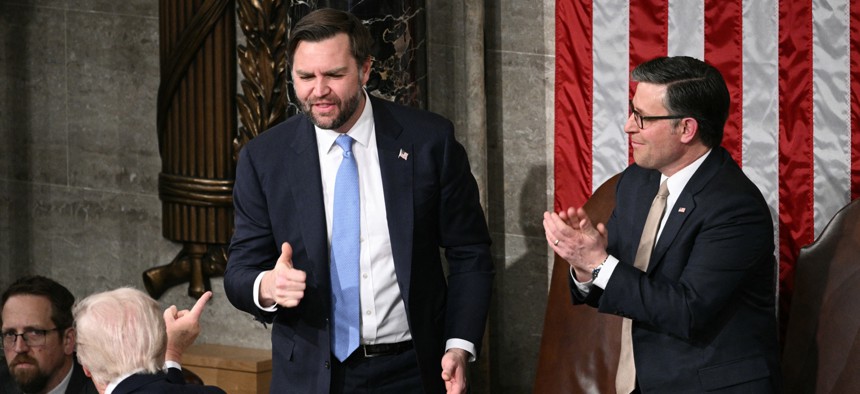
Vice President JD Vance gives a thumb's up as President Donald Trump delivers the State of the Union address in the House Chamber of the U.S. Capitol on Feb. 24, 2026. Brendan SMIALOWSKI / AFP / Getty Images





Memo to JD Vance: Fighting the War on waste
COMMENTARY | The White House's proposed war on fraud, waste and abuse is neither new nor an assured outcome for any presidential administration, but history offers some lessons that can help get started.

During President Trump’s State of the Union address, the president said, “I am officially announcing the war on fraud to be led by our great Vice President JD Vance.” And, he boldly added, “we’re able to find enough of that fraud, we will actually have a balanced budget overnight. It’ll go very quickly.”
The pledge to balance the budget by eliminating fraud is an old one. Clinton, Reagan, Obama and Biden all said they would wring out fraud and they never got close to the pot of gold at the end of that rainbow. Moreover, the idea that we could remotely come close to balancing the budget by eliminating fraud is ludicrous. The deficit at the end of fiscal 2025 was $1.8 trillion. The Government Accountability Office estimates that the amount of fraud in the federal government stands between $233 billion and $521 billion.
There are two things we can conclude. Even at the best, eliminating every possible dollar of fraud would only cut the deficit by a little more than 25%. But $521 billion ain’t chump change. We need to wish Vice President Vance godspeed in what’s surely an important mission.
So: here’s a memo to the vice president about how to start.
Dear Vice President Vance,
You stand in the shoes of many previous generals in the war on waste. The launch of their campaigns has always created great headlines, but their results have usually been disappointing.
Let’s start with two boring but important facts. One is that no one really knows how much fraud there is. Money can leak like water from an old water main—you know how much you’re putting in, you have a fair idea about what’s coming out and you can’t always tell where the leaks are along the way.
The second is that “fraud” is a deceptive label. It’s clearly wrong to create a bogus identity to milk cash from the federal government, but it’s often very hard to separate a good program poorly managed from a bad program criminally draining cash.
In the tales of rampant fraud among Minnesota day care centers, which prompted the latest headlines, some of what is presented as fraud actually is sloppy overbilling. Many of the day care centers had state licensing violations, including keeping the facilities clean and keeping records of vaccinations, but state investigators found very few instances of outright fraud. A 2025 federal report found that there were errors in 11% of the payments made to Minnesota day care centers, so there clearly are big problems. Figuring out what’s causing them is much tougher than appears on the surface.
These twin facts often sent the generals of previous wars on fraud to give up the battle and look for other wars to fight, but you can make big progress. Here’s how:
- Know the enemy. Announcing an attack on “fraud” is tempting. Delivering is a lot harder, because fraud is like fat marbled through a terrific steak. A clumsy job of trying to cut it out can miss the fat and turn the steak into expensive hamburger.
- Identify the target. The place to start is with “improper payments,” which GAO defines as “payments that should not have been made or that were made in an improper amount.” It’s a clumsy term. Not all improper payments are fraud—some are legitimate but trapped in sloppy bookkeeping. Not all fraud comes from improper payments—some people commit non-financial fraud, like illegally obtaining a passport. But improper payments are the place to start.
- Go where the money is. The bank robber Willie Sutton was right—the highest potential for recovering money must start by attacking the biggest targets. More than half of all improper payments—53%—come from just Medicare and Medicaid. Another 7% in SNAP. There are tax-related improper payments, especially in the earned income tax credit. But in general, the rest of the government accounts for $41 billion in improper payments. This suggests where to aim the war on fraud.
- Invest in the front-line troops. This means shoring up the inspectors general, who are the government’s fraud-fighting cops. It means investing in the key federal employees, since one person’s salary can leverage enormous amounts of money. The Centers for Medicare and Medicaid Services, for example, spends $252 million for every one of its employees.
- Strengthen risk management and financial control activities. Sounds boring, I know. In fact, the 1990s sitcom Seinfeld spent a whole episode getting laughs from just how boring risk management seemed, and the episode won an award from the Writers Guild of America. But the key to separating fraud from other federal activities requires knowing where to look and having the tools to poke under the blankets. Most important, it’s essential to build roadblocks to fraud before it occurs. That’s a whole lot cheaper and more effective.
- Develop new tools. Artificial intelligence seems invented to fight the way on waste. In the Medicaid program, for example, the biggest sources of fraud are billing for unnecessary services or services no one actually provides, upcoding (bumping up the level of complexity of a service to make more money), card sharing and obtaining drugs for sale on the side, among others. In a program with millions of transactions, this is a true needle-in-a-haystack problem. AI can help identify the right haystacks and find the most promising needles.
- Understand that some problems that look like fraud are actually the result of poor management capacity, that others actually are fraud and that it’s often hard to tell the difference. Billions of dollars of federal money go to small nonprofits without much experience in managing programs or keeping track of the money. On the other hand, bad actors are always working hard to bilk the federal government out of taxpayers’ dollars. An effective war on fraud requires devising separate strategies for each of these problems—and figuring out when to use which one. It’s a problem that’s been around as long as there have been wars on waste.
Finally, a word of warning. It can be tremendously tempting to use the war on fraud to target political opponents. That’s easy because, unfortunately, there’s fraud everywhere. The rate of improper payments isn’t a measure of fraud, but it does give us clues about where to go looking.
Minnesota, for example, has an improper payment rate of 2.2%, but that’s less than half of the national average of 5.9%. The blue-state average is 6.3 percent. In blue Delaware, it’s 19.6%. Connecticut’s rate is 19.8%. But it’s not a partisan problem. The red-state average is 5.7%. In red Wyoming, it’s 20.7%; it’s 20.5% in South Carolina; and it’s 18.7% in Idaho.
There’s big money to recapture from controlling fraud and improving management. Any serious campaign to rake the money back, however, will fail if it’s a partisan war on waste. Nobody has a monopoly the problem—or the solutions.
So, Mr. Vice President, you are heading down a road that many have traveled before. Many travelers in the past have gotten stuck in ruts and potholes. But if you want to make real progress in saving taxpayer dollars, this is the road forward.
Donald F. Kettl is Professor Emeritus and Former Dean at the University of Maryland School of Public Policy. He is a Fellow of the National Academy of Public Administration.