

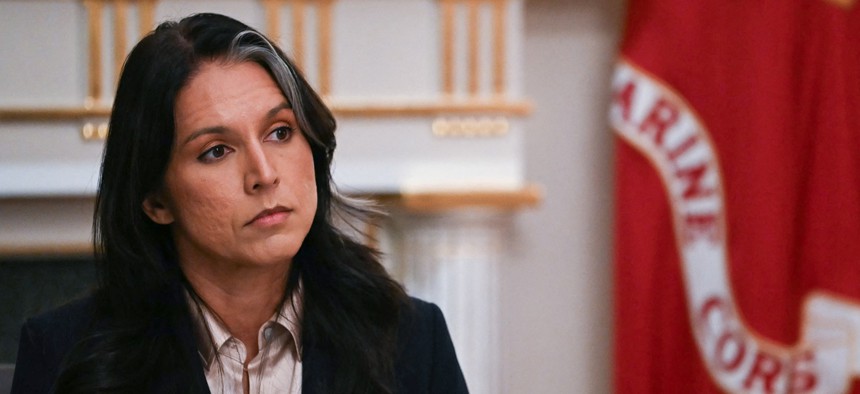
US Director of National Intelligence Tulsi Gabbard listens as President Donald Trump speaks during a Cabinet Meeting in the Cabinet Room of the White House in Washington, DC on December 2, 2025. ANDREW CABALLERO-REYNOLDS / AFP via Getty Images




Gabbard’s office denies wrongdoing amid scrutiny over whistleblower complaint
ODNI said she acted within her authority in response to reports describing an NSA-intercepted phone call tied to the case.

Director of National Intelligence Tulsi Gabbard’s office is rejecting allegations raised in a whistleblower complaint and related media reporting, saying her handling of highly classified intelligence was lawful as lawmakers press for more information about the case.
“Every single action taken by DNI Gabbard was fully within her legal and statutory authority, and these politically motivated attempts to manipulate highly classified information undermine the essential national security work being done by great Americans in the Intelligence Community every day,” a spokesperson for Gabbard told Nextgov/FCW on Sunday.
The response follows a series of reports describing intelligence derived from a National Security Agency–intercepted phone call referenced in the whistleblower complaint. The Guardian, citing the whistleblower’s attorney Andrew Bakaj, said NSA analysts flagged a discussion between two foreign intelligence figures who spoke about a person close to President Donald Trump.
Subsequent reporting by The New York Times and The Wall Street Journal said the discussion, in part, involved Iran and cited people familiar with the matter.
According to the Guardian, the intelligence was elevated to Gabbard, who later delivered a paper copy directly to White House Chief of Staff Susie Wiles rather than allowing it to be circulated more broadly. The outlet reported that Gabbard then instructed the NSA not to publish the report and instead directed that the classified details be sent to her office.
Nextgov/FCW was not able to independently verify the reporting. The complaint remains highly classified, limiting visibility into the intelligence underpinning it to a small circle of officials. Bakaj has not returned multiple requests for comment.
In a memo to lawmakers posted online by Gabbard’s office, Intelligence Community Inspector General Chris Fox said the whistleblower alleged Gabbard restricted the sharing of the intelligence for political purposes. Fox had served in Gabbard’s office as an aide before being confirmed to the oversight role.
The complaint was first made public in a Wall Street Journal report last week, which said it had been filed with the intelligence community’s inspector general but remained stalled in Gabbard’s office for about eight months. The complaint was not shared with Congress until this past week.
Many details about the complaint and its underlying intelligence are unclear. Tamara Johnson, the former acting Inspector General of the intelligence community, dismissed the complaint and said in a June 6 letter addressed to the whistleblower that the IG “could not determine if the allegations appear credible.”
“The duty to safeguard classified information is paramount, as mishandling or leaking of such information could significantly harm national security,” NSA Deputy Director Tim Kosiba said in a statement. “Consistent with all applicable laws, NSA investigates any mishandling or unauthorized disclosure of intelligence and partners closely with [the] Department of Justice and Federal Bureau of Investigation to ensure the necessary steps are taken to hold those accountable.”
“Distinct from unauthorized disclosures and working closely with NSA’s Office of General Counsel, NSA ensures that whistleblowing is protected by Federal laws, policies and procedures,” added Kosiba.
Asked whether the Senate Intelligence Committee has spoken with the whistleblower, the panel’s top Democrat, Virginia Sen. Mark Warner, said Sunday that his understanding is the whistleblower has been awaiting legal guidance on how to engage.
“We are trying to get both the redactions and the underlying intelligence, and that is in process,” he said in a “Face the Nation” interview.
Intercepted phone calls can be difficult to interpret because intelligence analysts may lack full context about who is speaking or whether what’s being said is accurate. In some cases, targeted persons could intentionally say misleading things, under the assumption that their communications are being monitored, to confuse or deter intelligence-gathering efforts.
Members of the “Gang of Eight” — senior Senate and House leaders who receive some of the executive branch’s most sensitive classified briefings — were provided a heavily redacted version of the complaint for review last Tuesday.
Lawmakers have since split over whether Gabbard’s actions were lawful and over the credibility of the whistleblower’s allegations.
Arkansas Sen. Tom Cotton, the Republican chair of the Senate Intelligence Committee, said in a recent X post that the complaint is “not credible and the inspectors general and the DNI took the necessary steps” to ensure the materials were “handled and transmitted appropriately in accordance with law.”