

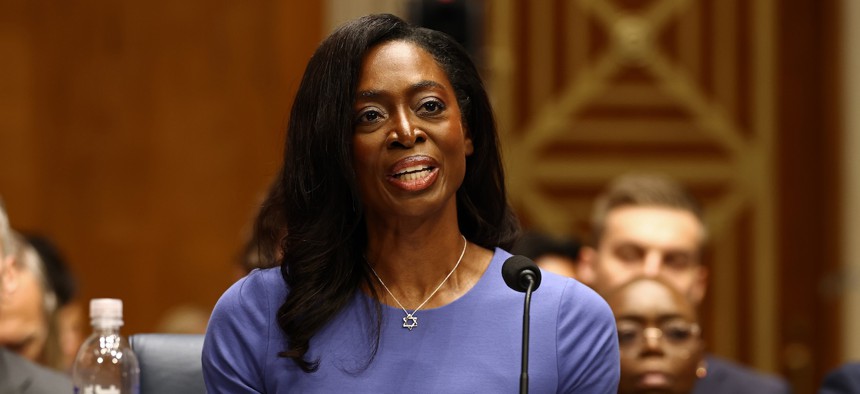
On Wednesday, Dr. Erica Schwartz pledged transparency and scientific integrity, but questions from the committee’s chairman put her path to confirmation in doubt. Finn Gomez/Getty Images





CDC nominee faces questions over whether she can lead the agency independently
Dr. Erica Schwartz sought to reassure senators she would follow the science as lawmakers pressed her on vaccines, abortion data and disease surveillance.
President Donald Trump’s pick to lead the Centers for Disease Control and Prevention didn’t appear to secure the support needed to take over the public health agency during a lengthy and often tense confirmation hearing Wednesday.
While Dr. Erica Schwartz told lawmakers on the U.S. Senate Committee that oversees health policy she would “never betray the science,” she didn’t seem to win the trust of Democrats or key Republicans needed to advance.
Chairman Bill Cassidy, R-La., repeatedly questioned Schwartz about whether she would follow the example set by former CDC Director Susan Monarez, who testified last year that she was fired after refusing to pre-approve vaccine recommendations or fire career officials for no reason.
“We need unbiased leaders who make decisions based upon science, not politics or ideology, and are committed to protecting children's health,” Cassidy said in his opening statement.
More than two hours later, at the end of the hearing, Cassidy told Schwartz he believed administration officials had overprepared her and that some of her answers missed the mark.
“I felt like you were always trying not to answer my question, which was disappointing,” he said.
Cassidy, or any Republican on the committee where the party holds a thin 12-11 majority, could effectively block Schwartz’s nomination if Democrats unanimously oppose it.
Restoring trust
Schwartz, who worked as a Navy occupational medicine physician, earning the rank of admiral, and deputy surgeon general, testified that, if confirmed, she would work to rebuild the CDC’s reputation among all Americans.
“My first priority will be restoring trust in public health institutions through radical transparency and unwavering scientific integrity,” Schwartz said. “As CDC director, my sacred responsibility is to provide the American people with public health guidance that is clear, honest and evidence-based.”
Schwartz said she would work to “modernize the CDC into a near real-time public health enterprise” while ensuring local, state and tribal governments become the “operational backbone of American public health.”
Schwartz testified in response to questions from both Democrats and Republicans on the Health, Education, Labor and Pensions Committee that she "accept(s) that evidence" that vaccines don’t lead to an autism diagnosis. She said mRNA vaccine “technology is safe and effective."
Tracking abortions
Missouri Republican Sen. Josh Hawley asked Schwartz to look into the possible health implications for people who live close to a data center, saying his constituents regularly ask him about it and he doesn’t know what to tell them.
Schwartz said she didn’t know whether the National Institute for Occupational Safety and Health, which is housed within the CDC, had done any research on potential data center health implications. If confirmed, she committed to working with Hawley and his staff to look into the issue.
Hawley also asked Schwartz if she would ensure the CDC secures data from every state in the country on when and how abortions take place.
“The CDC collects data on abortions that are committed in the United States of America through a system called the Abortion Reporting System,” Hawley said. “This system is voluntary, and so a number of states, not coincidentally large blue states, do not turn over any data, so that it's difficult to get a picture of just how many abortions and under what circumstances are committed in this country.”
Schwartz testified she would look into the issue if confirmed, adding that “abortion surveillance is absolutely a critical component of what the CDC is currently doing.”
“But I also want to also make sure that certain states are not conflating emergency services and hiding abortions in that emergency services case definition,” she said. “We need to make sure we're pulling out true abortions and making sure that we're really having clear case definitions regarding abortions, so the data is actually accurate.”
Cyclosporiasis
Washington Democratic Sen. Patty Murray asked about the ongoing outbreak of cyclosporiasis and the CDC’s disease monitoring programs during her round of questions.
Schwartz said she believed “that one of the core missions of the Centers for Disease Control and Prevention is tracking outbreaks domestically and also internationally.”
Schwartz said she was unaware the Trump administration moved to make reporting of cyclosporiasis optional last year after Murray asked whether there would be “any scientific or medical justification for CDC having eliminated mandatory reporting of that parasite.”
“The CDC used to conduct surveillance on this very infection through a program called FoodNet, but in July of '25, thanks to Trump, CDC made reporting on that illness optional,” Murray said. “Now we are here a year later, and we're already seeing over 7,000 confirmed or under investigation cases and over 100 hospitalizations with no single cause having yet been identified.”
Schwartz didn’t commit to reinstating mandatory reporting of cyclosporiasis if confirmed to run the CDC, but said she would work with Murray and her staff to understand why that stopped and what the options would be moving forward.