

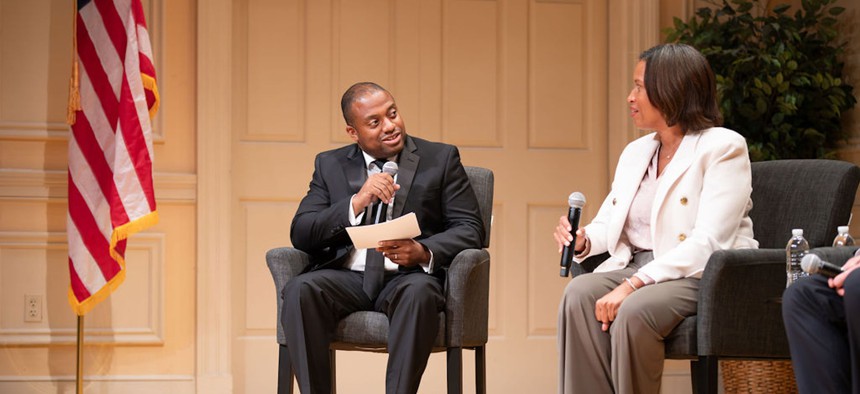
National Academy of Public Administration President and CEO James-Christian Blockwood interviews Washington, D.C., Mayor Muriel Bowser at the “Celebration of the American Public Servant” gala at the Library of Congress on Monday. National Academy of Public Administration




Award-winning civil servants counter negative stereotypes of government employees
The National Academy of Public Administration celebrated public servants as part of the 250th anniversary of the U.S.

Persuading young people to work in public service is challenging, several speakers said on Monday at a “Celebration of the American Public Servant” gala sponsored by the National Academy of Public Administration in conjunction with the U.S. semiquincentennial. Government Executive was a partner for the event.
“When you think about media today, it's not always in our favor to be a public servant,” said JoAnne Bass, a retired Air Force officer who was the first woman to serve as the highest-ranking enlisted leader in a U.S. military branch.
But the federal employees who spoke at the event, many of whom have served for decades or have received a public service award, argued that their work records show the positive impact that a “bureaucrat” can have on the public.
Washington, D.C., Mayor Muriel Bowser told gala attendees at the Library of Congress that “young people may not realize that some of the most brilliant thinkers are in public service.”
National Institute of Standards and Technology worker William Phillips — a Nobel laureate in physics and recipient of NAPA and George Washington University’s Arthur S. Flemming award for feds — described the saying “close enough for government work” as a “nasty phrase.”
“The implication being that if you work for the government, you just have to get the job done, not the best job,” he said.
Phillips highlighted that NIST’s atomic clocks in the ‘70s accurately measured one part in 10^13 (i.e. error rate of one second every 300,000 years).
“Today, the best atomic clocks are good to better than one part in 10^18. That's less than one second in 14 billion years. My friends, 14 billion years ago was the dawn of the universe,” he said. “At [NIST] — where people are working every day to ensure the economic health and the national security of this country, now and in the future — this is what we call close enough for government.”
Kaity Wolfe — a senior State Department official who has been recognized by Leadership Connect’s Next Generation Leader Spotlight — said that she was initially nervous about speaking on the panel, as someone with relatively less government experience.
“But I’ve realized that being uncomfortable is part of public service,” she said.
Wolfe reflected on her time working for the Special Inspector General for Afghanistan Reconstruction, which reported as early as 2012 that U.S. efforts to support democracy in that country were falling short.
“That experience has taught me something that I've carried throughout my career ever since — that public service isn't about protecting institutions, it's about strengthening them,” she said. “It means being a good steward of taxpayer dollars, it means being transparent with the public and sometimes it means having the courage to say things that are uncomfortable and necessary.”
Kenneth Corbin — the chief of IRS Taxpayer Services and winner of the Service to the Citizen Award — touted that he started at the agency at 16-years-old as a GS-1, because he hadn’t yet graduated from high school, and has “had the pleasure of serving every grade in between” to his current position in the Senior Executive Service.
He shared that the public’s reaction to getting COVID-19 stimulus payments, which the IRS was responsible for distributing while also contending with remote work and the normal tax filing season, is one of the most memorable moments from his 40-year career.
“In this journey of service, was it the millions of payments that went out that made the difference? Was it the dollar amount that went out that made the difference? No,” he said. “What made the difference to our team was getting on social media and reading the messages from families who now had money to go buy milk, to buy food, to pay their bills. They appreciated the fact that that work was delivered, and Congress loved it so much that not once, not twice, but three times we delivered those payments.”
If you have a tip that can contribute to our reporting, Sean Michael Newhouse can be reached securely at seanthenewsboy.45 on Signal.
NEXT STORY: Federal acquisition rewrite leaves cybersecurity confusion unresolved