

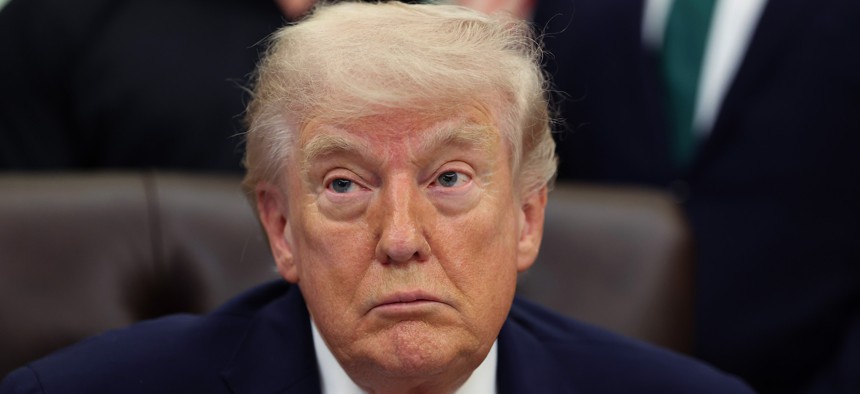
President Donald Trump in the Oval Office on April 18. His administration is requiring agencies to find 10 existing regulations to be revoked any time they propose a new rule. Tasos Katopodis / Getty Images




Experts say Trump inflated his deregulation numbers, but his process changes are here to stay
The president has made several changes to the rulemaking process, including added White House scrutiny of certain regulations and exceptions to some time-consuming steps.

Regulatory experts across the ideological spectrum agreed that the Trump administration overstated how successful it has been at cutting regulations. But they also agree that the actions officials took over the past year have changed the traditional methods for creating — and repealing — rules, setting the stage for more deregulation for the rest of the president’s second term.
10:1
At the start of his second term, Trump signed a directive requiring agencies to find 10 existing rules to be repealed any time they propose a new regulation. The White House Office of Information and Regulatory Affairs reported that officials far exceeded that threshold — issuing 129 deregulatory actions for every new regulation over the first eight months of the administration.
An analysis by the George Washington University Regulatory Studies Center, however, found that “OIRA gamed its methodology to produce a higher ratio.”
Specifically, administration officials only considered new regulations to be significant rules (generally those that have an annual effect on the economy of at least $100 million). In contrast, they took a broader view of what counted as a deregulatory action, including repealing regulations that were no longer in effect as well as guidance documents, policy letters and internal agency materials.
“There is a legitimate policy case for counting them, as [guidance documents, etc.] can impose real compliance burdens on businesses and individuals even when they never go through a notice-and-comment rulemaking process,” wrote Tambudzai Charumbira (Gundani), a research assistant at the Center. “Whenever there’s a party changeover in the White House, incoming administrations immediately reverse the outgoing administration’s sub-regulatory output. It’s the low-hanging fruit that every administration plucks.”
Nevertheless, the Center’s analysis found that Trump’s 10:1 rule may be slowing the pace of new regulations. In 2025, there were nearly 61,600 pages added to the Federal Register (where agency regulations are published), which is the lowest total in a president’s first year among recent administrations.
Dan Goldbeck — the director of regulatory policy at American Action Forum, a center-right think tank — emphasized that slowing down rulemaking is still important, even if it’s not outright deregulation.
“Perhaps the more significant item is just slowing the pace of new regulations,” he said. “That gives industry a better idea going forward of what they can expect in terms of not having some big regulatory surprise jump out at them.”
During Trump’s first term, when he required agencies to repeal two regulations for every new one, regulatory experts similarly found that officials inflated the number of deregulatory actions that they took but that the administration did also produce less rulemaking.
An Office of Management and Budget spokesperson said that the president’s deregulatory agenda is “a victory for the American people whether or not it is published in the Federal Register.”
“Last year, the Trump administration implemented 646 de-regulatory actions,” they said. “That includes the removal of radical, [diversity, equity and inclusion], unpopular, destructive and costly policies that were imposed through sub-regulatory guidance, and that’s how we removed them.”
Katie Tracy, a regulatory expert at the left-leaning Public Citizen nonprofit, argued that measuring the president’s deregulatory push is not just about quantity but also quality. As an example, she pointed to the EPA’s recent repeal of the Obama greenhouse gas endangerment finding, which the Trump administration characterized as “the single largest deregulatory action in U.S. history.”
“That's where I think that there's a bigger picture here. It's not just about some number of regulations. It's about what that represents,” she said. “It represents passing harm, passing cost, on to the public. Corporations don't want to pay for the harm they've imposed on communities.”
Reforms to the Rulemaking Process
Tracy also contended that the Trump administration’s actions, such as pushing out hundreds of thousands of federal employees and requiring independent regulatory boards (e.g. Federal Trade Commission) to run proposed rules through the White House, are weakening agencies’ ability to regulate industries.
“All of that is an effort to ensure that the White House is the one making the calls,” she said. “It's [no longer] what we've traditionally thought of as the agencies or people in the agencies — the subject-matter experts — who are able to make the calls.”
The Trump administration has also pushed agencies to speed up the repeal of regulations by skipping the public review steps. When an agency promulgates a new rule, or revokes one, it must seek, respond to and potentially incorporate public comment on the proposal — a process that usually takes at least a year.
Officials have instructed agencies, when repealing rules that are deemed unconstitutional or unlawful in light of recent Supreme Court rulings, to rely on the “good cause” exception. That statutory provision provides that agencies can skip notice and comment if doing so would be "impracticable, unnecessary or contrary to the public interest.”
Tracy said that Public Citizen is tracking the administration’s use of the “good cause” exception.
“It's been rarely used, but now we're seeing it used quite frequently without any justification for doing so,” she said. “So it's very clear that they don't want the public weighing in.”
Congressional Review Act
In recent history, the president and a politically aligned Congress have relied on the Congressional Review Act to repeal by simple majority rules that were promulgated at the end of the previous administration. During Trump’s first term, the GOP used the CRA to revoke 16 late Obama rules. President Joe Biden and congressional Democrats then took advantage of the law to repeal three Trump regulations.
According to American Action Forum, House and Senate Republicans in Trump’s second term have used the CRA to overturn 22 Biden rules. The GOP, however, has adopted a novel interpretation of the law, which is enabling them to repeal additional administrative actions from the previous president.
Under the CRA, Congress generally has a limited window to revoke regulations, which ended in spring 2025. But the Trump administration in January 2026 transmitted to Congress a 2023 public land order that protected about 225,500 acres of Minnesota land from mineral and geothermal mining for 20 years — making the order subject to repeal through the law.
Both the House and Senate have approved the measure (H.J. Res 140) revoking the Minnesota public land order. It’s awaiting Trump’s signature.
In floor remarks ahead of the vote, Sen. Tina Smith, D-Minn., argued that the CRA was never intended to be used to repeal years-old public land orders.
“What would you do if the shoe was on the other foot?” she asked her Republican colleagues. “What would you do if we set this precedent where we say that with a simple partisan majority, Congress can claw back a public land order that has been in place potentially for years or decades?”
Future Deregulation
At the end of Trump’s first term, the Health and Human Services Department issued the “sunset rule” that would automatically terminate the department’s regulations between five to 10 years after they are implemented unless officials conduct a review to determine their effectiveness. The Biden administration withdrew the rule before it was implemented.
Goldbeck, of AAF, argued that such reviews would enable agencies to measure expectations about the regulation when it’s being developed against its real-world impacts. He also predicted that the Trump administration will undertake a similar effort in the remaining three years of his second term.
“Now that they have the template in place, I feel like — whether it be at HHS or some other agency, or if they try to do it across all agencies, that would be pretty ambitious — but I would foresee some instances of it coming back,” he said.
If you have a tip that can contribute to our reporting, Sean Michael Newhouse can be reached securely at seanthenewsboy.45 on Signal.
NEXT STORY: U.S. citizens shot by ICE urge Congress to rein in federal immigration agents