

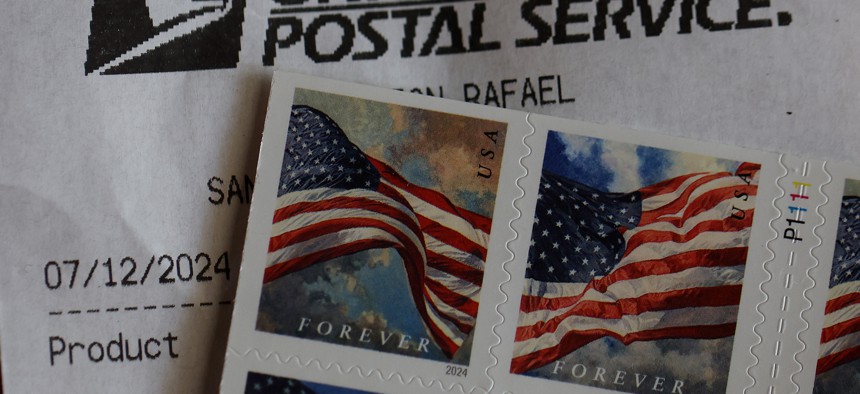
The postmaster general proposed that prices for stamps, currently 78 cents, could be increased to between 90 and 95 cents in response to financial pressures on the agency. Justin Sullivan / Getty Images




Nearly $1 stamps? Lawmakers contemplate how to avert USPS financial crisis
During a hearing, officials testified that the Postal Service will likely run out of money without congressional intervention.

Officials said at a hearing Tuesday that tradeoffs in services may be necessary, as the U.S. Postal Service faces the prospect of running out of money within the next year.
“We would hope that this is the beginning of the ultimate end of the ongoing [postal] crises that we have all witnessed far too long,” said Rep. Kweisi Mfume, D-Md., the ranking member of the House Oversight and Government Reform panel’s Government Operations Subcommittee.
In his testimony, Postmaster General David Steiner warned that USPS could reach a financial cliff as soon as fall 2026. As a response, he floated reducing the postal agency’s mandate to deliver mail six days per week or raising stamp prices to 90 to 95 cents. Stamps currently are 78 cents, having been increased six times since 2021.
“If you want the same number of delivery days and post offices, we can do that, but someone has to pay for it. If you want to have a discussion about reducing services, we can do that,” Steiner said. “But there's one thing we can't do, and that is the status quo, and we don't have a lot of time.”
David Marroni, a senior official at the Government Accountability Office, testified that any fix to the USPS’ finances will likely require congressional action, calling the postal agency’s current business model "unsustainable."
“There is a fundamental tension between the level of services that Congress expects USPS to provide and the revenue that USPS can reasonably be expected to generate,” he said. “Something has to change.”
Steiner argued that an “easy action” Congress could take is to raise the USPS’ $15 billion statutory debt limit, which the agency’s Board of Governors has previously requested.
“Increasing our borrowing authority buys us time, time that we can use to best determine what the Postal Service should do to best serve the American public,” the postmaster general said.
Rep. Pete Sessions, R-Texas, the subcommittee’s chairman, however, emphasized that lawmakers would need more information before taking such an action.
“Congress needs to have confidence not only that [USPS will] be able to pay it back, but that they're on the right road to achieve financial security,” he said. “For Congress to consider this request, the Postal Service must also prove that they have exhausted their [other] options already.”
Throughout the hearing, Steiner contended that USPS has generated savings through implementation of Delivering for America, a 10-year modernization plan initiated by his predecessor in 2021 that generally entails slowing some delivery and increasing the prices of certain products. Lawmakers from both parties and mail stakeholders have called for an end to the plan, arguing that it has worsened performance without achieving financial benefits.
Former Postmaster General Louis DeJoy predicted that Delivering for America would enable the USPS to break even by fiscal 2023, which did not happen. The postal agency has remained in the red, most recently experiencing a net loss of $9 billion in fiscal 2025.
Steiner testified that USPS is “not going to save our way out of the hole that we’re in.”
“I don’t expect to [break even] anytime soon [based] on the current path that we are on,” he said.
Share your experience with us: Sean Michael Newhouse: snewhouse@govexec.com, Signal: seanthenewsboy.45
NEXT STORY: Inside DOGE’s early days of pressure campaigns, rule breaking and ‘chaos’