

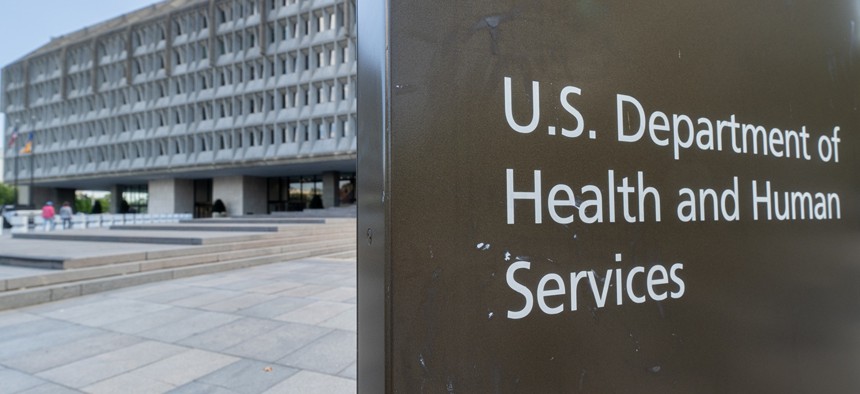
HHS issued an internal memo earlier this month saying that it was reorganizing its Office of Planning, Research and Evaluation within the Administration for Children and Families. J. David Ake / Getty Images





Critics sound alarm over HHS plans to restructure evaluation office
A coalition of nonprofits, research institutions, child welfare advocates and more note that plans to push research out of the Administration for Children and Families and into the purview of political appointees jeopardize the credibility of that work.

Over 130 research institutions, data organizations, companies, child welfare advocates and others are asking the Department of Health and Human Services to stop its planned restructuring of the research arm at the Administration for Children and Families.
The changes, which would put much of the work under the purview of political appointees, risk undermining the credibility of the office’s research, the groups say in a Monday letter sent to HHS Secretary Robert F. Kennedy Jr.
HHS issued an internal memo earlier this month, first reported by the Imprint, saying that it was reorganizing its Office of Planning, Research and Evaluation, which evaluates the effectiveness of the programs managed by ACF, like Head Start and government cash assistance programs.
The Feb. 10 memo, viewed by Nextgov/FCW, gave ACF until Wednesday — or 15 days from its issuance — to make a plan to transfer its early childhood, child welfare and family assistance research portfolios from the central evaluation office to the program offices themselves. That includes the Office of Early Childhood Development, Administration on Children, Youth and Families and the Office of Family Assistance. Implementation is set to start March 12.
Putting staff within program offices will help researchers tap into the expertise in those offices, help programmatic staff easily integrate learnings into their work and boost the “accountability” of research investments, the memo says. It comes from the head of ACF, Alex Adams.
The central OPRE will advise program offices on research and continue with a small number of its own, more general projects, it says.
Those sounding the alarm say that the changes — which they note are being done without the input of relevant stakeholders or Congress — jeopardize the objectivity and credibility of the research done by the office, which is meant to inform policymakers with evidence on which programs work and which ones don’t. HHS did not respond to a request for comment.
The nonpartisan, nonprofit Data Foundation organized the letter after validating the changes, which it heard about through a platform it maintains to get confidential tips on changes to the federal evidence ecosystem. The signatories also include Naomi Goldstein, who led the research office from 2015 to 2022.
The Data Foundation estimates that staffing at the central research office is expected to go from 120 employees to 20.
“Years of ongoing studies, taxpayer-funded data collection efforts, and research partnerships will likely be abandoned—in many cases just as they were poised to deliver findings,” the foundation’s president and CEO, Nick Hart, said in a joint statement with Michele Jolin, CEO and co-founder of Results for America.
“Notably, congressional appropriations for FY 2026 largely supported OPRE's functions as written, raising serious questions about whether this restructuring is consistent with congressional intent,” they said.
Research not mandated by Congress is expected to be hit the hardest. But even congressionally mandated research could see changes, as it is expected to require approval from political appointees moving forward, according to the Data Foundation.
As for the impact of the changes, Congress has at times tied the research done by OPRE to funding, too.
In one federal funding program for mental health, substance abuse and in-home parent services, for example, states have to spend at least half of their available funding on programs deemed evidence-based by OPRE to get reimbursements from the federal government.
Last December, HHS changed its policy so that the ACF Assistant Secretary has the final call over how programs are rated in terms of their evidence backing.
The new restructuring puts much of the office’s work under the authority of political appointees, not the civil servant that leads OPRE, Clare DiSalvo — who resigned on Monday from her role supporting ACF as a government contractor — wrote in a public post. She’d worked inside HHS or as an embedded contractor for nearly 14 years.
“This risks undermining the credibility of federally funded research and eroding its power to benefit people’s lives,” she wrote.
The office’s own evaluation policy, dated 2021, emphasizes independence as one of five core pillars.
“It is important to insulate evaluation functions from undue influence and from both the appearance and the reality of bias,” that policy reads. “To promote objectivity, ACF protects independence in the design, execution, analysis, and reporting of evaluations.”
DiSalvo said that this restructuring is the latest in a string of administration actions that hurt the work done by the office.
Over the last year, the teams managing government data have shrunk as the Trump administration sought to downsize the workforce, and many top positions saw vacancies.
The restructuring at ACF also isn’t the first time stakeholders have worried about the neutrality of statistics and data organizations in the government. In one high profile instance, Trump fired Erika McEntarfer, who was at the time the head of the Bureau of Labor Statistics, after accusing her, without evidence, of rigging the jobs report — a move that sparked broader concerns about the independence of government statistics overall.
The availability of data itself has also been affected: Shortly after Trump took office, thousands of government data pages were taken offline as agencies tried to comply with executive orders targeting diversity, equity and inclusion.
If you have a tip you'd like to share, Natalie Alms can be securely contacted at nalms.41 on Signal.
NEXT STORY: Trump Education Department outsources more responsibilities, continuing proposed wind-down