

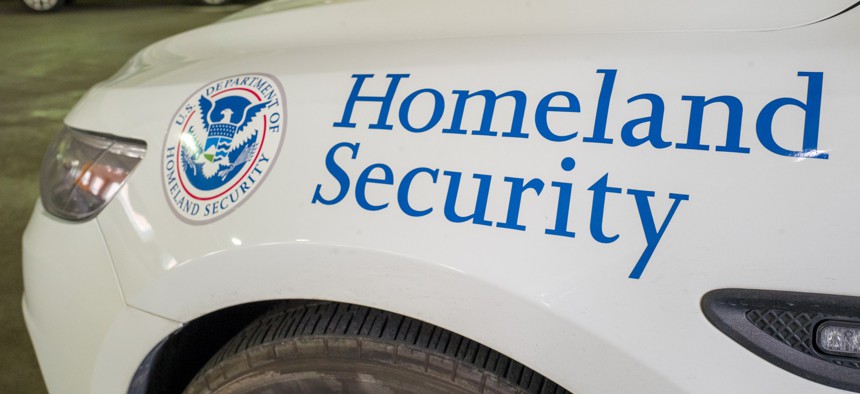
It's anyone's guess how long the DHS shutdown may last. Smith Collection / Gado / Getty Images




5 things to watch with the DHS shutdown
COMMENTARY | The Homeland Security Department has already been at the center of unprecedented government shutdown history this year, here's why this recent lone agency impasse could be different from others.
Tuesday marked the 11th day the Department of Homeland Security has been “shut down” due to a "lapse in appropriations." This is the third time this fiscal year that DHS has shut down, something that’s never happened before to any agency.
Moreover, Congress and the White House have made no visible progress on a deal to reopen DHS.
On Tuesday night, the president delivered the first-ever State-of-the-Union speech during a government shutdown. He gave no sign of feeling pressure to reach a deal with Congress, instead calling for “the full and immediate restoration of funding” for DHS.
What is really happening? Since 12:01 a.m. Feb. 14, most DHS employees have been performing essential work and have been exempt from furloughs. As in the 43-day shutdown last fall, many of these workers will not be paid on their next payday. Some DHS personnel, including all of its law enforcement personnel, will likely be paid as they were in October and November. Overall, then, this is a “normal” shutdown.
But what if the shutdown continues for weeks? What if the White House responds other than normally? With midterm election primaries about to start, what if the White House decides to pay DHS employees that have to work? How would they be paid? What about contracts and contractors? And where might the White House accept negative impact by not paying workers or even furloughing more of them?
As the DHS shutdown lengthens, here is what I am watching:
1. We know which DHS components are deemed essential and which workers are exempt from furloughs. So far, it’s similar to earlier shutdowns. WATCH to see if that changes as the shutdown continues.
2. WATCH to see if the White House expands which workers get paid despite the lapse in appropriations, likely under an expanded use of unobligated reconciliation funds.
Remember that DHS received $170 billion last summer in the FY25 budget reconciliation, mostly for Immigration and Customs Enforcement and Customs and Border Protection. These funds technically are not appropriations, and they don’t expire for years. ICE and CBP agents were paid from these funds during the long shutdown.
Office of Management and Budget Director Russ Vought could direct that some of these funds be spent to pay workers in other parts of DHS (such as the Coast Guard, Transportation Safety Administration, U.S. Citizenship and Immigration Services, Federal Emergency Management Agency, Cybersecurity and Infrastructure Security Agency, the Secret Service, etc.). The administration already did this in last fall’s shutdown, for all DHS law enforcement personnel and for some Pentagon personnel during the 43-day shutdown. It could expand those payments to include law enforcement support workers and many others in DHS.
Redirecting reconciliation funding could mitigate many DHS shutdown impacts and reduce the pressure to cut a deal with Congress to end the DHS shutdown. I suspect there may be enough unobligated reconciliation funding for the White House to pay everyone they want paid and to keep the DHS shutdown going for months, perhaps for the entire rest of FY26. WATCH to see when the administration might do that.
3. WATCH for negative consequences as the shutdown continues and parts of the nation are impacted. Will commercial air travel suffer as TSA agents work without pay? Will FEMA reduce responses to disasters? Will CISA cybersecurity work be negatively affected? If so, what will the administration do?
The White House has broad authority to act to reduce unacceptable negative consequences where it wants to. In the 2018-19 partial shutdown, for example, the White House used its power to change what work was designated essential. In last fall’s shutdown, workers were paid, at White House direction, with reconciliation and other funds such as Pentagon research and development appropriations.
If White House actions reduce unacceptable negative consequences by deeming politically-sensitive functions essential and/or by paying exempt workers in those functions, then the DHS shutdown could last even longer.
4. WATCH for the impact on contractors. DHS contract awards have already been slowed down, both because of the earlier shutdown and of the requirement that all contracts valued at $100,000 or more must be approved at the highest levels of the department. On top of being slow to award contracts, will DHS also be slower in paying invoices for work already performed and costs already incurred? The absence of appropriations will likely delay new contract awards as well. All of this could drive some companies, particularly smaller ones, out of business if the shutdown lasts too long.
5. WATCH to see if Congress and the White House restart or ramp up discussions. If so, they could reach a deal that reopens all or part of DHS, but the State of the Union speech gave little indication of that happening.
So far, this is a normal shutdown, but it is already the third-longest DHS has had in its 23-year existence. If the White House chooses to use reconciliation funds to pay exempt workers, it will be unlike any other shutdown in American history, with funds used to keep operating even without appropriations. That means the shutdown could go on for weeks or even months. Keep watching!
NEXT STORY: Top NSC cyber official returns to academia