

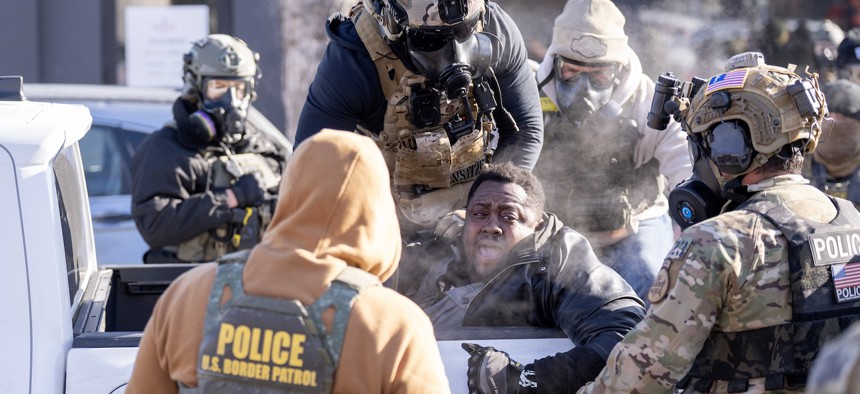
A protester in Minneapolis is arrested after Alex Pretti was fatally shot by federal agents in the area early on Jan. 24, 2026. Democrats withdrew their support for the “minibus” package after the fatal shooting on Saturday and have asked for the Homeland Security Department portion of it to be pulled out for separate negotiation. Alex Kormann/The Minnesota Star Tribune via Getty Images



Path to averting a shutdown remains elusive as lawmakers debate DHS funding
About half of the federal government would cease full operations if Congress cannot come up with a plan by Friday night.

Congress is barrelling toward a partial government shutdown at the end of the week, as disagreements over how to fund the Homeland Security Department and restrict its operations are threatening to upend a bipartisan agreement to fund much of government.
About half of federal agencies are currently only funded through Jan. 30 and will be forced to shut down first thing Saturday absent congressional action. The House has already passed a package to fund those agencies through September, but they now face an uncertain future in the Senate.
The measures were expected to smoothly make their ways to President Trump’s desk, but Democrats withdrew their support after federal agents fatally shot Alex Pretti on Saturday. They have instead asked for the DHS portion of the “minibus” package to be pulled out for separate negotiation while they approve the other five bills.
In addition to DHS, the existing package would fund the departments of Defense, Labor, Health and Human Services, Education, Transportation, Housing and Urban Development, State and Treasury, as well as other related agencies.
Senate Minority Leader Chuck Schumer, D-N.Y., called the DHS funding bill “woefully inadequate to rein in the abuses” of Immigration and Customs Enforcement, and said Democrats would withhold their votes from any packages that funds it.
Democrats won some concessions in the spending measure, but far fewer than what they had hoped to achieve. The bill trims Customs and Border Protection funding by $1 billion. ICE spending would remain flat, but capacity for detaining immigrants would shrink. The measure would provide $20 million for body cameras for law enforcement at both agencies, though detractors suggested it would not mandate they be worn. It would also require agency personnel to go through deescalation training.
DHS will still have plenty of funds from which to draw: the department was awarded $190 billion in the One Big Beautiful Bill Act, though lawmakers included in the new measure provisions requiring monthly updates on how that money is being spent. The DHS inspector general would receive an added $13 million for its oversight work.
Sen. Susan Collins, R-Maine, who chairs the Senate Appropriations Committee, said on Monday that bills were the result of difficult bipartisan, bicameral negotiations, as well as discussions with the White House. Reaching an agreement was “not an easy task,” she said, though she added she “recognize[s] and share[s] the concerns” with the DHS bill after Pretti’s death. She highlighted the “safeguards” on immigration enforcement that were included and stressed the bulk of the bill goes toward non-controversial provisions such as funding the Transportation Security Administration, cybersecurity and the Federal Emergency Management Agency.
“I hope we can come together in a constructive way to get this done and to ensure that we do not lurch into a dangerous and detrimental government shutdown,” Collins said. “So, that is my goal, and I look forward to working with our colleagues this week to accomplish that objective.”
Sen. Katie Britt, R-Ala., the Senate’s lead appropriator for DHS, similarly focused on the non-immigration provisions of the department’s funding bill and said those programs “must be funded.”
“We know from recent history that government shutdowns do not help anyone and are not in the best interest of the American people,” Britt said. “As we approach a government funding deadline, I remain committed to finding a pathway forward.”
Senate Republicans on Monday initiated the preliminary procedural steps for the minibus package, setting up a vote on Thursday. They have so far shown no indication they are willing to split up the bill, which would require the House—currently in recess—to take additional votes on or before Jan. 30 to avoid a shutdown.
Additional restrictions on DHS Democrats have sought include requiring third-party warrants to enter homes, additional training and performance requirements for new personnel and a prohibition on ICE detaining U.S. citizens.
White House Press Secretary Karoline Leavitt said policy discussions on immigration "are happening," noting Trump discussed the issue with Gov. Tim Walz, D-Minn., on Monday. Walz has joined many Democrats in demanding federal officers end their extended operations in his state. The governor said after the call that Trump would "look into" reducing the number of federal deployments in Minnesota and work with DHS to ensure the state can conduct an independent investigation in Pretti's death. Leavitt said lawmakers should back the minibus as previously negotiated.
“At this point, the White House supports the bipartisan work that was done to advance the bipartisan appropriations package and we want to see that passed,” Leavitt said.
Share your news tips with us: Eric Katz: ekatz@govexec.com, Signal: erickatz.28
NEXT STORY: Some FEMA employee layoffs put on hold, while reform council renewed