

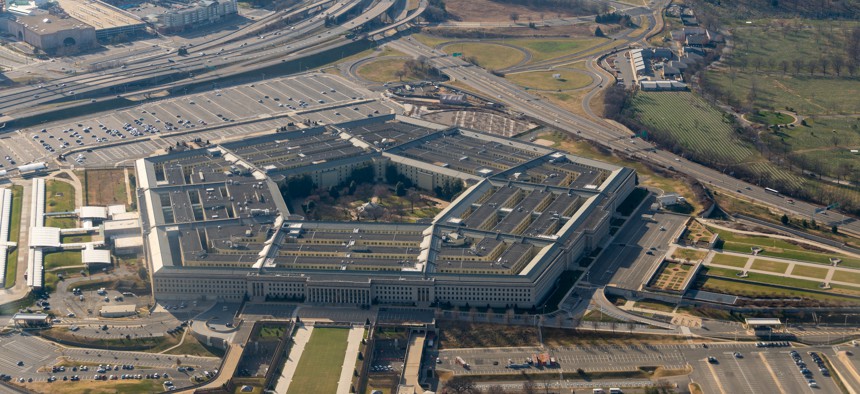
The Government Accountability Office said that the Defense Department likely reported data on civilian telework and remote work incorrectly. Austin Nooe / Getty Images





Nearly all civilian Defense employees are back in the office, but watchdog says officials should better track telework eligibility
Employees who are still teleworking are mostly exempt from the in-person work requirement.

About 8% of Defense Department civilian employees have not returned to full-time in-person work, according to a Thursday Government Accountability Office report that encouraged officials to improve data collection and evaluation of agency telework and remote work.
Investigators found that over the past five years DOD has not been fully recording data on employee eligibility for hybrid telework or remote work. As a result, they determined that officials have likely publicly reported data on civilian work from home inaccurately.
For example, the Office of Management and Budget in May 2024, based on DOD data, reported that the department had 61,549 remote employees. But for the next month, DOD officials told GAO there were 35,558 remote employees.
“DOD has collected some data on telework and remote work position eligibility and use but does not have formal processes to ensure accurate, timely and complete data on employee eligibility,” according to the report. “Without such processes, DOD has a limited understanding of how many employees are approved for these arrangements and cannot be assured that its use of these flexibilities complies with its policy.”
Department officials told GAO that as of July 31, 2025, those who hadn’t complied with President Donald Trump’s return-to-office mandate for the federal workforce were generally deferred resignation program participants, military spouses or had a reasonable accommodation that permitted work from home.
Government workers who took the DRP separation incentive were not required to return for in-person work. Many military spouses work for the federal government remotely, as deployment relocations can impact employment opportunities.
Feds with disabilities were exempt from the return-to-office order, but many have told Government Executive that they’ve recently struggled to obtain reasonable accommodations for telework.
Other findings about work from home at DOD in GAO’s report include:
- In calendar year 2024, 81% of civilian work hours were spent in-person based on an analysis of personnel time and attendance data.
- About 20,000 civil servants who had been approved to work fully remotely needed to be relocated.
- Employees in mission critical occupations, such as contracting and human resources management, were more likely to use telework and remote work.
Investigators also found that DOD has not formally evaluated how telework and remote work have impacted agency goals, but GAO collected anecdotes from employees that presented a mixed picture.
“Officials from one component said they received 1,000 applicants for a hard-to-fill position after re-categorizing it as a remote position due to initially receiving only 30 local applicants, all of whom were unqualified,” according to the report, while other officials said certain teleworking employees were unreachable during work hours.
GAO recommended that DOD “develop formal processes to ensure data on civilian employee eligibility for telework and remote work are accurate, timely and complete” and “establish clear and specific requirements for evaluating the effects of telework and remote work programs in relation to the department’s goals.” DOD concurred with both recommendations.
Share your news tips with us: Sean Michael Newhouse: snewhouse@govexec.com, Signal: seanthenewsboy.45
NEXT STORY: White House creates new assistant attorney general focused on fraud