

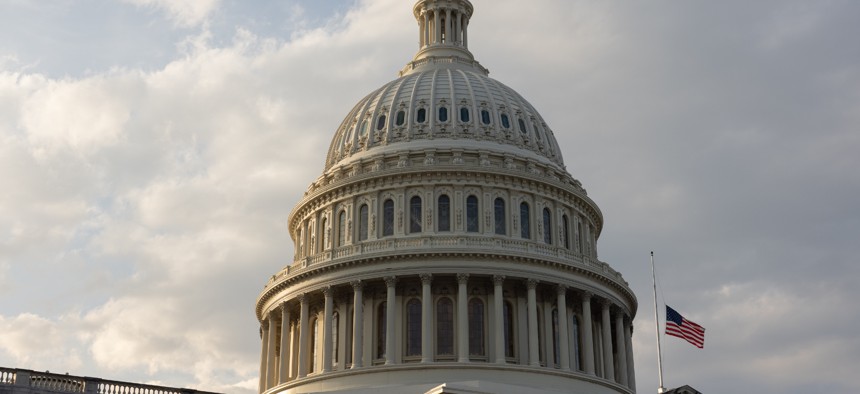
The latest bipartisan spending deal would fund the departments of Commerce, Commerce, Energy, Interior and Justice, as well as the Environmental Protection Agency, U.S. Forest Service, NASA and other agencies through Sept. 30. Anna Rose Layden / Getty Images





Major takeaways for federal agencies from the latest bipartisan spending package
The new "minibus" rejects many Trump proposals, from reorganizations to program eliminations.

Congress has unveiled a new package of bills to fund some agencies through fiscal 2026, the latest bipartisan breakthrough as lawmakers seek to avert another government shutdown at the end of the month.
The bill would set line-by-line, component-by-component spending levels across the departments of Commerce, Energy, Interior and Justice, as well as the Environmental Protection Agency, U.S. Forest Service, NASA and other agencies. Combined with the first full-year spending package Trump signed into law in November, Congress, if it approves the newest “minibus,” will have enacted half of the 12 annual must-pass appropriations bills. Remaining agencies are still operating under a continuing resolution that is set to expire Jan. 30 and appropriators are still negotiating over those measures.
Lawmakers have agreed to overall spending levels slightly lower than those currently in place, leading to small cuts at many agencies. The reductions are far less severe than those proposed by President Trump, however, and provide more explicit direction to the Trump administration than did the full-year stopgap bill in place during fiscal 2025.
Sen. Patty Murray, D-Wash., the top Democratic appropriator in the Senate, said it was vital Congress pass annual spending bills to avoid ceding power to the Trump administration in making funding choices.
“Importantly, passing these bills will help ensure that Congress, not President Trump and [Office of Management and Budget Director] Russ Vought, decides how taxpayer dollars are spent—by once again providing hundreds of detailed spending directives and reasserting congressional control over these incredibly important spending decisions,” Murray said.
The administration could still seek to subvert the spending authorized in the bill by submitting rescission packages to Congress.
The House is set to vote on the package on Thursday and is poised to send it to the Senate, which is expected to then act on it in the following days. Here is a look at the most significant outcomes for federal agencies in the bills:
Small cuts
While Democrats largely fended off the massive cuts President Trump and House Republicans had sought, they still accepted some reductions. Sen. Chris Van Hollen, D-Md., who sits on the Senate Appropriations Committee, said the package of bills was “not perfect” and conceded that “we had to make tough decisions when it comes to what programs to cut and what to protect.” The Environmental Protection Agency would see its funding decreased by 4%, though its budget level would still be $4.7 billion more than Trump proposed. NASA would see its funding cut by 2%, though its core functions would survive. The Energy Department would see its funding remain virtually flat, rejecting the nearly $4 billion cut Trump wanted.
Pumping the brakes on reorganizations
Lawmakers rejected Trump’s efforts to reshape agencies throughout government. The president proposed merging all wildfire fighting efforts into one agency and last year signed an executive order to that effect. Lawmakers specifically blocked that proposal, however, opting to instead maintain the current structure in which federal firefighting operations occur at the U.S. Forest Service within the Agriculture Department, the Interior Department and other agencies. Congress required a study into the feasibility of Trump’s proposal, including how it would differ from the current leadership provided by the National Interagency Fire Center.
The Trump administration also hoped to merge the Bureau of Alcohol, Tobacco, Firearms and Explosives with the Drug Enforcement Administration but Congress killed the effort in the spending package. The Interior Department is in the midst of consolidating thousands of employees away from their bureaus and into the Office of the Secretary, though lawmakers instructed it that any shift of more than 10 employees required Interior to go through the formal reprogramming process. At NASA, the package “directs NASA to provide a briefing on the future of NASA Headquarters, including any plans for NASA to move staff outside of the Washington D.C. region,” lawmakers said in a statement accompanying the bill.
Science survives
In several instances, the White House had looked to decimate spending on scientific efforts at federal agencies. It proposed gutting the National Science Foundation with a 57% funding cut, but lawmakers agreed to just a 3% trimming. The Office of Science within Energy would have seen a $1 billion cut under Trump’s proposal, but lawmakers rejected the suggestion. The president sought to cut NASA’s science budget in half, but lawmakers largely left it in place. The National Oceanic and Atmospheric Administration would receive nearly $1.7 billion more than Trump requested.
Rebuilding workforces
The Trump administration has slashed workforces in agencies across government and Congress is now looking to unwind some of those efforts. The National Park Service has shed nearly one-quarter of its permanent staff in the last year, but Congress requested briefings on staffing levels every 60 days and Democrats said the funding was meant to restore staffing to fiscal 2024 levels. The Indian Health Service would receive $38 million to ensure adequate staffing at new facilities. Lawmakers noted in a bipartisan statement accompanying the bill that they were “deeply concerned” about staffing at the National Weather Service and provided $10 million to ensure all Weather Forecast Offices are fully staffed. Congress said the cuts “jeopardize the ability to maintain 24/7 operational coverage critical for timely and accurate weather forecasting, warnings, and emergency response.”
Lawmakers also voiced concerns about the workforce levels within the Executive Office of Immigration Review, the Justice Department agency that houses the nation’s immigration courts, and asked for updates on federal officials being detailed to serve as judges.
Eliminating eliminations
Congress is looking to mostly reject Trump’s effort to kill off federal entities and programs. The White House sought to eliminate the National Endowment for the Arts and the National Endowment for the Humanities, but Congress opted to keep both flat funded with $207 million for each. Trump looked to eliminate forest and rangeland research at the U.S. Forest Service, but the spending package would fully fund the efforts at $308 million. The president would have nearly eliminated climate research at NOAA, but Congress opted to provide $224 million for the projects.
At Energy, Trump requested a nearly 75% to the Office of Energy Efficiency and Renewable Energy, but lawmakers are seeking a more modest 10% cut. Trump would have eliminated the department’s Weatherization Assistance Program, which seeks to lower energy costs for low-income households by improving efficiency, but Congress instead boosted its funding.
Share your news tips with us: Eric Katz: ekatz@govexec.com, Signal: erickatz.28
NEXT STORY: Trump administration agrees to drop anti-DEI criteria for stalled health research grants