

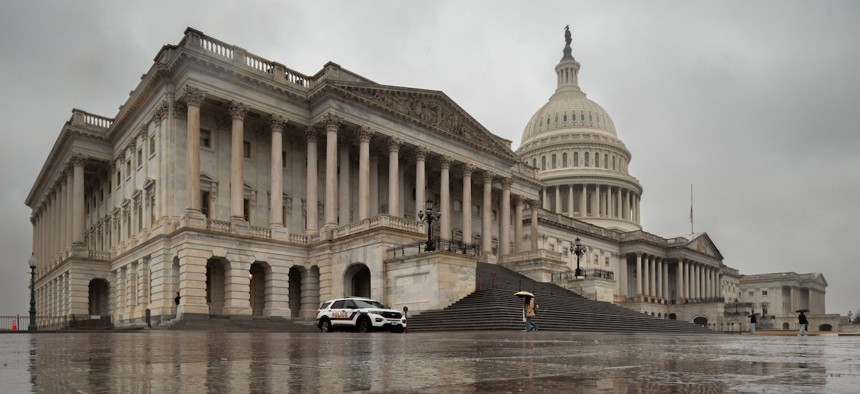
The House last week easily passed a minibus funding the departments Commerce, Energy, Interior and Justice, as well as the Environmental Protection Agency, U.S. Forest Service, NASA and other agencies. J. David Ake/Getty Images




A federal workforce census, targeted cuts and more key takeaways from the latest FY26 spending package
The latest "minibus" fully funds some offices Trump sought to zero out, creates a new flexible account for the president and has some suggestions for new federal building designs.

Congress has unveiled yet another package of bills to fund some agencies through fiscal 2026, marking a third bipartisan breakthrough as lawmakers seek to avert a partial government shutdown at the end of the month.
The bill would set line-by-line, component-by-component spending levels across the departments of State and Treasury, as well as the Office of Personnel Management, General Services Administration and other agencies. If the Senate completes its work on the second “minibus” package of the fiscal year later this week as expected, passage of the latest group of bills would leave just four of the 12 annual must-pass appropriations bills unresolved. The remaining agencies are still operating under a continuing resolution that is set to expire Jan. 30 and appropriators are still negotiating over those measures.
The House last week easily passed a minibus funding the departments Commerce, Energy, Interior and Justice, as well as the Environmental Protection Agency, U.S. Forest Service, NASA and other agencies. The Senate is expected to send the measure to President Trump’s desk this week. The department of Agriculture and Veterans Affairs, among other agencies, were funded through September as part of the measure that ended the 43-day shutdown in November.
Like in previous spending bills, Congress agreed to some spending cuts that were relatively small compared to those Trump preferred. The bills provide more explicit direction to the Trump administration than did the full-year stopgap bill in place during fiscal 2025.
Democratic appropriators have conceded they are disappointed to accept spending reductions but called it imperative to pass full-year appropriations bills to avoid ceding power to the Trump administration in making funding choices.
“It continues efforts to rein in the Trump administration through new requirements on the use of funds and increased transparency measures,” said Rep. Rosa DeLauro, D-Conn., the top Democrat on the House Appropriations Committee.
The latest package was originally set to include funding for the Homeland Security Department, but Democrats have balked at providing appropriations for the agency without including significant barriers on Trump’s immigration crackdown. Lawmakers have floated the possibility of approving a full-year stopgap bill for some agencies if they cannot come to a bipartisan agreement on a regular funding bill.
The House is expected to vote on the new State-and-Treasury bill this week, with the Senate acting shortly thereafter. Here is a look at the most significant provisions for federal agencies in the bills:
Avoiding the sharpest cuts
The Internal Revenue Service, which has been flat-funded for three consecutive years, will see a 7% cut, staving off the 20% reduction Trump had sought. The president was looking to gut the agency’s enforcement arm by 34%, but lawmakers opted for a similar 7% reduction. Taxpayer Services will see an increase.
Trump proposed slashing the Small Business Administration by 40%, but Congress rejected that cut entirely. Lawmakers instructed SBA to boost staffing in its district offices. The U.S. Agency for Global Media, which has shed the bulk of its staff across Voice of America and its other entities, would see a funding boost to $643 million. The agency must consult with Congress before altering its operations in any way, lawmakers said in pushing back on Trump’s efforts to dramatically slash its funding.
Trump proposed eliminating election security grants from the Election Assistance Commission, but Congress tripled its funding to $45 million. Before being forced to walk it back last year, Trump also sought to lay off virtually the entire workforce for Treasury’s Community Development Financial Institutions Fund. Congress instead opted to fully fund the office, which invests in economic opportunities in underserved communities.
A half-empty, half-full glass for State
The outcome for U.S. diplomacy funding depends on one’s perspective. The overall bill to fund State and related agencies is set to provide a 16% cut, though the total is still 10% above the level the Trump administration actually expended after withholding and impounding various funds. The bill essentially ignores the U.S. Agency for International Development, which Trump shuttered last year, but some of its funding is preserved in newly consolidated accounts within State’s appropriation. An Economic Development account would receive $6.8 billion and a Humanitarian Assistance account $5.4 billion, for example. The measure provides $50 billion in total, well above the $31 billion Trump proposed.
The bill funds U.S. contributions to the United Nations and other international organizations, which Trump had sought to zero out. The Millennium Challenge Corporation, which funds international development projects, would see an 11% cut but avoid the 72% reduction that Trump proposed.
Classical federal buildings
Lawmakers included a provision in the report accompanying the bill stating federal buildings should “reflect regional, traditional, and classical architectural heritage.” Federal buildings should therefore be designed in classical or traditional architectural styles, lawmakers said, who encouraged GSA to plan future federal buildings accordingly. “Public architecture should uplift and beautify public spaces, respect regional traditions, and ennoble our system of self government,” the appropriators said in the joint statement. Republicans noted the bill would help in “making federal buildings beautiful again.”
Federal workforce updates
The Trump administration has overseen the removal of more than 300,000 federal employees from government in its first year, in part by offering a variety of incentives to push them out. Lawmakers requested data on the number of federal civil servants on board the day before Trump took office and on Sept. 30, 2025, broken down by agency, occupation, duty station and compensation. It is looking for precise data on who participated in the deferred resignation program, which allowed employees to sit on paid leave for several months before leaving government.
Lawmakers also asked the Office of Special Counsel for data on their caseload related to the Hatch Act as well as whistleblower disclosures.
New ‘flexible’ fund for Trump’s foreign policy
Congress agreed to create an “America First Opportunity Fund,” an account with $850 million for the Trump administration to spend as it sees fit within certain parameters. The funding will be divided between national security, narcotics and law enforcement, peacekeeping operations and foreign military financing. Republican lawmakers said the fund would allow for greater flexibility for confronting modern challenges.
Russ Vought won’t get his increase for OMB
Office of Management and Budget Director Russ Vought raised eyebrows when he requested a funding boost and more staff while orchestrating mass reductions across the federal workforce. He proposed a 13% funding bump for OMB, including a 4% increase in staffing. Vought told lawmakers it was a “hallmark” of his time at OMB that he valued the input of career employees. “They are not only of great value to the taxpayer, but the whole nation,” Vought said. Congress rejected Vought’s request, however, and kept OMB flat funded.
Share your news tips with us: Eric Katz: ekatz@govexec.com, Signal: erickatz.28