

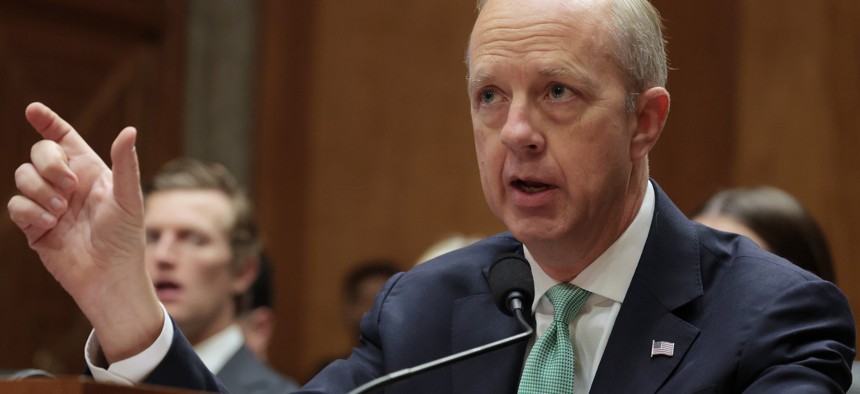
Eric Ueland, deputy director for management at the Office of Management and Budget, speaks during a hearing on Capitol Hill on April 3. Ueland said in a Monday statement that the President's Management Agenda "helps ensure we carry out the President's vision to deliver an effective and efficient Government directly accountable to all Americans.” Anna Moneymaker/Getty Images



Push to 'reform the government root and branch' detailed in Trump’s new management agenda
The President's Management Agenda for Trump's second term offers fewer specific policy plans than other recent agendas.
The Trump administration laid out its plans to “end weaponized government” in its new management agenda released Monday.
The latest President’s Management Agenda includes goals to eliminate “woke” programs, downsize the government workforce and real estate portfolio, implement workforce reforms and modernize government technology, as well as targets to "annihilate government censorship of speech” and centralize government contracting.
The agenda reflects much of the Trump administration’s longstanding priority to drastically reshape the government, an objective the White House focused on immediately after the inauguration through its Department of Government Efficiency.
The Trump administration has already implemented many of the agenda’s federal workforce objectives included in the new plan, such as defunding diversity, equity and inclusion initiatives, slashing the number of government workers and “hold[ing] employees accountable for results aligned with presidential policies.”
- After the president issued an executive order to cease DEI-related activities across government, agencies conducted mass layoffs of employees performing such work.
- Since the start of the year, hundreds of thousands of federal employees have left government either through reductions in force or voluntary separation incentives like the deferred resignation program.
- Members of the senior executive service are now being evaluated based on whether they “faithfully administered the law and the president’s policies” and yielded outcomes that “align with and advance the president’s specific policy agenda.” This mirrors language in the new agenda to hold employees accountable for results aligned with White House policies.
Under a larger goal to "eliminate woke, weaponization and waste,” the administration includes directives to “eradicate” so-called woke programs, “end discrimination by government” and “cease payments to fraudsters and eliminate waste,” among others.
While federal agencies do sometimes fail to stop fraudsters from abusing government programs, the administration has also accused some of the programs and agencies it has shuttered since Jan. 20 of being rife with fraud — and then struggled to provide evidence of widespread fraud. Trump has also fired many of the inspectors general charged with doing the work of rooting out fraud, waste and abuse.
“President Trump’s historic victory was a mandate to reform the Government root and branch,” Eric Ueland, the Office of Management and Budget’s deputy director for management said in a statement. “The PMA helps ensure we carry out the President's vision to deliver an effective and efficient Government directly accountable to all Americans.”
‘Smarter, faster, cheaper’
Two pages in length, the document is shorter than the management agendas of recent administrations, including that of the first Trump administration, which was 52 pages long. White Houses have been releasing agendas with their management reform priorities since the administration of President George W. Bush.
The memo, sent to agencies by Office of Management and Budget director Russell Vought on Monday, references the administration's efforts to consolidate government procurement in order to “buy as one entity: smarter, faster, cheaper” and give political appointees more control over the grant making process.
The agenda also includes a section on technology, with goals to consolidate systems, reduce the number of government websites, combat cyber threats, eliminate data silos and “reduce wasteful processes through artificial intelligence.” Gregory Barbaccia, the administration’s chief information officer, previously told Nextgov/FCW that the administration wants to use AI to make up for the loss of federal employees.
The administration included a line about ensuring that “digital-first services” are “built for real people, not bureaucracy” — although unlike the agendas from the Biden and first Trump administrations, the latest management agenda doesn’t include customer experience as a standalone goal.
Finally, the document also includes a goal to “find and annihilate” government censorship of free speech, a reflection of views among Trump and allies that U.S. institutions have systematically sought to narrow American’s First Amendment rights, especially views expressed by conservatives.
Much of the “censorship” arguments have been born out of efforts under the first Trump administration and Biden administration to stamp out foreign influence campaigns and other false information about contentious topics like the COVID-19 pandemic and election results.
Agencies like the Cybersecurity and Infrastructure Security Agency played a major role in these efforts, in which they would interact with social media companies to discuss take-downs of false information. A conclusion made by one former official, in particular, undercut false claims made by the president that the 2020 election was stolen.
Legal challenges issued during the Biden administration led the agency to largely tamp down on those discussions, and in Trump 2.0 major government offices tasked with tracking influence campaigns have been removed or greatly diminished.
Nextgov/FCW reporter David DiMolfetta contributed to this report.
If you have a tip you'd like to share, Natalie Alms can be securely contacted at nalms.41 on Signal.
NEXT STORY: Appeals court upholds firing of Democratic Merit Systems Protection Board member