

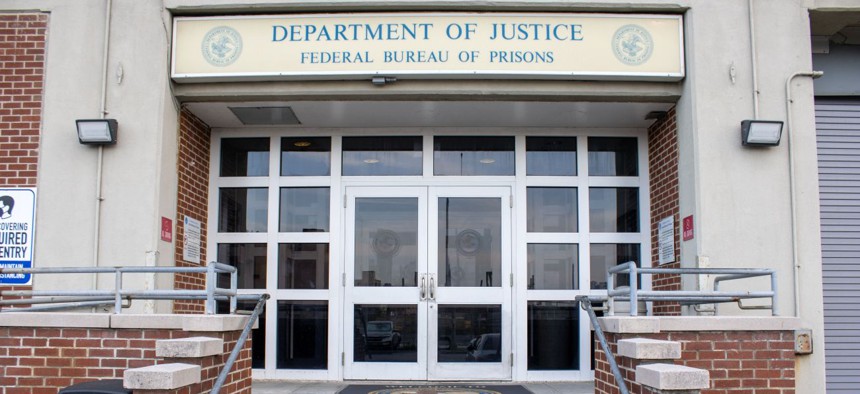
A federal judge for the second time in as many months has ordered the U.S. Bureau of Prisons to reinstate its collective bargaining agreements, ruling that a second contract termination notice violated his prior order. stock photo




Judge again orders reinstatement of Bureau of Prisons union contracts, but stops short of contempt
U.S. District Judge Jordan Oliver found that the agency’s re-termination of its collective bargaining agreements last week violated last month’s preliminary injunction but said he would not police individual contract infractions.

A federal judge in Connecticut on Friday ordered the U.S. Bureau of Prisons again to reinstate its collective bargaining agreement, ruling that last week’s re-termination of union contracts violated the preliminary injunction he issued last month.
In September, U.S. District Judge Vernon Oliver found that the Bureau of Prisons’ move last year to terminate its union contracts with the American Federation of Government Employees likely violated the Administrative Procedure Act because the agency’s official reasoning was “entirely pretextual.”
But last week, the union reported that several wardens across the federal prison system were instructed not to take action to reinstate the agreements, and at least one employee was denied union representation in a disciplinary meeting in which they were ultimately fired. AFGE’s Council of Prison Locals called for Oliver to enforce his court order and to hold agency leadership in contempt.
The following day, the union reported that some pieces of the CBA were restored on a limited basis—some officials began seeing requests for official time, office space and union representation at a committee meeting approved. But the agency then issued a new termination notice and rescinded prior statements about the first contract cancellation, particularly a blog post from Director William Marshall that stated AFGE wasn’t the “kind of union” he supports.
In a 14-page opinion Friday, Oliver found that last week’s re-termination violated his order, describing the gambit as impermissible “self help.” Such a move would only be fruitful if, as the Biden administration did when it rescinded the “remain in Mexico” policy, the agency presented its new termination to the court prior to implementing it and then requested modification or rescission of the injunction.
“At no point did the defendants in Biden v. Texas seek to disregard a court order,” Oliver wrote. “Instead, they complied with the injunction, despite issuing a new action, and only sought to implement it after moving to vacate the original injunction . . . Here, in contrast, the defendants failed to move the court for amendment, clarification or dissolution. . . Rather than abiding by this order, defendants issued the re-termination memorandum, which purported to terminate the CBA under new rationale.”
But the judge stopped short of granting the unions’ request as it pertained to whether the agency initially “defied” the injunction, and he denied the motion to hold leadership in contempt. Oliver wrote that BOP plausibly raised the notion that “administrative burden” was to blame for the agency’s slow reinstitution of the CBA, and that individual violations of the contract should be handled through its own procedures.
“Individual instances of noncompliance with the CBA, such as failing to allow union representation at disciplinary proceedings or delaying responses to official time requests, are properly addressed under the agreement itself,” the order states. “The CBA has an extensive grievance process for managing individual complaints of noncompliance. Those concerns are properly addressed under the CBA—not by this court.”
In a statement Friday, Council of Prison Locals President Brandy Moore White applauded the judge’s ruling and urged management to comply.
“The employees we represent work in some of the most challenging and dangerous conditions in federal service, and their union contract gives them a collaborative way to speak out when their safety or the safety of the public is in jeopardy,” White said. “Our members deserve nothing less than full compliance with the court’s decision, and we will keep fighting for our members to ensure the safety and security of the workers we represent.”
If you have a tip that can contribute to our reporting, Erich Wagner can be securely contacted at ewagner.47 on Signal.
NEXT STORY: VA allows union contract to expire for most employees