

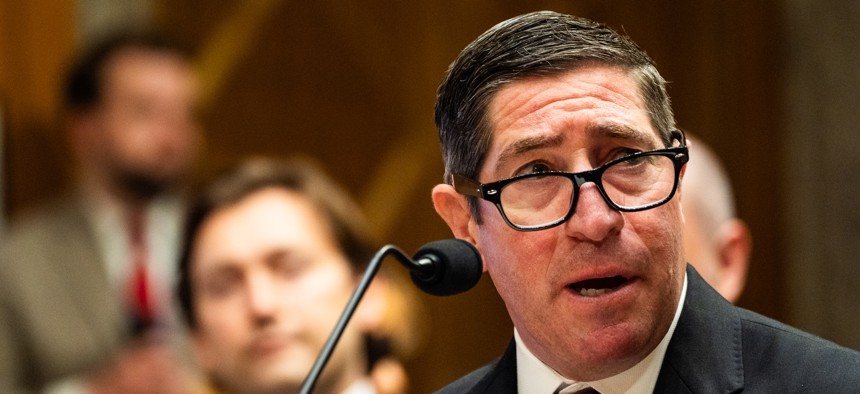
Office of Personnel Management Director Scott Kupor last week proposed ending his agency's administration of the annual Federal Employee Viewpoint Survey, passing the task along to individual agencies. Demetrius Freeman/The Washington Post via Getty Images




OPM proposes ‘decentralized’ FEVS with fewer questions and less transparency
Agencies would be expected to conduct their own workforce surveys each year, with little rules on how much, or how little, they divulge to the public about it.

The Office of Personnel Management last week proposed new regulations that would end the HR agency’s annual administration of the Federal Employees Viewpoint Survey, instead passing the task along to individual agencies with fewer guardrails and less transparency.
OPM Director Scott Kupor announced the plan in a blog post, arguing without evidence that the annual survey of federal employee engagement and job satisfaction had become a “box-checking exercise” for some agencies and a “vanity” project for others. The proposed changes come after OPM failed to administer the FEVS in 2025, a violation of federal statute.
“Employee engagement surveys should therefore be designed, administered and acted upon by the agencies that understand their own missions, structures, workforces and management challenges—not administered by OPM as a government-wide ritual. Done right, surveys become a management tool for agency leaders to measure what matters, identify where alignment is breaking down, and take responsibility for improving the employee experience.”
In addition, the proposal would cut the overall number of questions that must be asked each year from 16 down to 10. While a few questions have been retained, most have either been significantly revised or replaced entirely, particularly those questions pertaining to employee morale and workload. In their place are questions pertaining to managers’ “expectations” for workers and how efficiently agencies remove perceived poor performers.
Jenny Mattingly, vice president of policy and stakeholder engagement for the Partnership for Public Service, which each year collates FEVS results into the Best Places to Work in the Federal Government rankings, said those changes effectively eviscerate the questions upon which the survey’s Global Satisfaction Index are based. While the law requiring agencies to survey their workforces was aimed at measuring employee engagement and morale, last week’s proposal—tucked into broader regulations around strategic human capital—suggests the Trump administration wants to use it more as a workforce planning tool.
“There seems to be some conflation here between strategic planning and using workforce surveys as a planning tool,” she said. “Which could be a right idea—agencies can and should be doing these things—but FEVS is supposed to be an engagement tool. Those are two separate things.”
And while the plan ostensibly preserves the requirement that the annual surveys’ results be published, the manner in which agencies post their results—and in how much detail—will largely be up to the organizations’ discretion.
“Although the operative statute requires that survey results be posted publicly on the agency’s website (unless doing so would jeopardize or negatively impact national security), these specific requirements are not spelled out in the statute requiring annual employee surveys,” the regulations state. “Instead, OPM proposes to note simply that each agency may determine the specific content of its public disclosure of its annual survey results."
OPM’s proposal is unusual in that most regulatory and policy changes it has initiated since Trump’s return to the White House have sought to pull functions into the HR agency’s orbit, not decentralize them. Don Kettl, professor emeritus and former dean at the University of Maryland’s School of Public Policy, said the move seems to be of a piece with OPM’s previous actions to reduce the utility and longevity of Fedscope data and to release only limited information on positions affected by Schedule Policy/Career.
“It is important to understand what’s happening right now within the historical context, but without that historical data, that makes it that much harder,” Kettl said. “FEVS in particular, we didn’t have it at all last year, and this year they’re talking about a fundamental change. Did it need an update? Absolutely. But if you break the chain of evidence, it becomes that much harder to understand what is and isn’t happening with employee engagement, which is at the core of our relationship with government.”
Mattingly took issue with Kupor’s characterization that the FEVS had limited utility for individual agencies with different needs. Agencies previously were able to ask OPM for supplemental questions to be asked alongside FEVS, and some HR offices have successfully used the survey to drive performance. Without a government-wide survey—and centrally conducted annual analysis in the form of an annual governmentwide report—senior officials and the public will lose out on valuable trend data on the state of public service.
“Chief human capital officers, HR offices and senior leaders are definitely aware of the survey and look at it as one tool in their toolbox,” she said. “[With] all this significant workforce reshaping that is happening, you have a lot of changes to employees’ workloads and morale, and you have reorgs and other things going on as well. Removing some of these satisfaction questions and devolving the overall survey back to agencies, it removes our ability to publicly benchmark these changes against previous administrations, previous actions and previous iterations of agencies. So it really is a tool that helps both agency leadership, but also the public to see how these things are impacting employees, and ultimately service delivery.”
If you have a tip that can contribute to our reporting, Erich Wagner can be securely contacted at ewagner.47 on Signal.
NEXT STORY: OPM finalizes ‘Nixonian’ rule centralizing and enabling some federal firings