

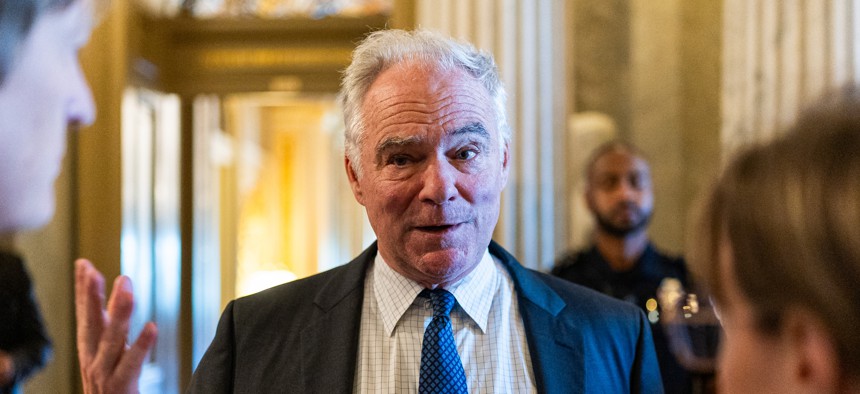
Sen. Tim Kaine, D-Va., and Rep. James Walkinshaw, D-Va., led more than 50 lawmakers in demanding the Trump administration provide better documentation of its implementation of Schedule Policy/Career. Finn Gomez/Getty Images




More than 50 Dem lawmakers demand more Schedule F transparency
Efforts to understand the true scope of the recent executive order moving around 8,000 career federal jobs into Schedule Policy/Career, making their incumbents effectively at-will employees, have been stymied by the administration’s scant public documentation.

More than 50 congressional Democrats on Wednesday called on President Trump to produce more detailed information about last month’s conversion of roughly 8,000 federal jobs into Schedule Policy/Career, a new job category in which career employees serve on an at-will basis.
The group, which is led by Rep. James Walkinshaw and Tim Kaine, both D-Va., oppose the policy, formerly known as Schedule F, by which career positions in purportedly “policy-related” areas are removed from the federal government’s competitive service and the employees filling them stripped of most civil service protections.
“These federal employees are best able to fulfill [their] duties without fear of the politicization of their positions,” they wrote in a letter to Trump. “We are concerned that the thousands of positions and federal employees who were reclassified through Schedule Policy/Career will face political pressures that undermine the integrity of their critical work and be subjected to greater threats of termination without just cause or due process. All of this will greatly weaken the nonpartisan nature of the civil service.”
The lawmakers questioned how “completely apolitical” jobs like those in HR and procurement have been targeted for reclassification and said it is difficult to understand the true scope given the only limited disclosures regarding Schedule Policy/Career’s implementation. As of press time, the only documentation provided by the administration has consisted of a list of reclassified jobs, without any information regarding where jobs sit in agencies’ organizational charts or how many employees were associated with each job.
“The lack of transparency into the Schedule P/C process compounds our concerns about the intent and impact of the policy,” they wrote. “To date, only an appendix listing the agencies, position titles and corresponding position description codes that were classified to Schedule P/C has been made public. But that appendix does not include the exact total number of positions affected, how many employees are affected within each position, the seniority levels of the different positions, or their governmentwide occupational series numbers, leaving the public and Congress without a clear understanding of the exact extent to which the federal workforce is being politicized.”
The lawmakers demanded more—and more granular—data regarding the first tranche of Schedule P/C conversions, including the total number of employees impacted for each agency and subagency and their demographic information. They also requested details on whether any agencies’ requested reclassifications were denied, how agencies will handle adverse action appeals that began prior to an employee’s reclassification, and what safeguards are being put in place to protect whistleblowers from retaliation.
The lawmakers’ letter comes as, despite the White House’s claims to the contrary last month, agencies may be prepping for a second round of reclassifications in Schedule Policy/Career. Office of Personnel Management Director Scott Kupor told Bloomberg Law in an interview last week that a new round could focus on GS-13 and GS-14 posts, and NOTUS reported a new list of jobs could be sent to the White House for conversion by the end of September.
“This policy change opens the door for corruption and inefficiency in government, the likes of which we have not seen since before passage of the Pendleton Act [in 1883],” the lawmakers wrote. “When the people tasked with carrying out the law can be fired for telling the truth, waste goes unreported and bad actors go unchecked, it’s the American people who will suffer as a result.”
If you have a tip that can contribute to our reporting, Erich Wagner can be securely contacted at ewagner.47 on Signal.
NEXT STORY: Arbitrator restores telework and remote work at the Forest Service