

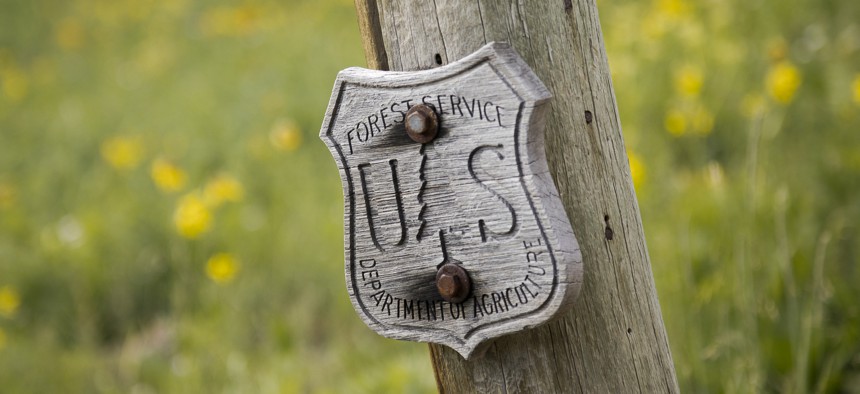
An independent arbitrator last week found that the U.S. Forest Service violated its union contract when it implemented President Trump's return to office mandate last year. NATHAN BILOW / GETTY IMAGES




Arbitrator restores telework and remote work at the Forest Service
The U.S. Forest Service violated its collective bargaining agreement with the National Federation of Federal Employees last year when it unilaterally canceled telework and remote work agreements en masse as part of the Trump administration’s return-to-office mandate.

Some 20,000 U.S. Forest Service employees could soon get their telework and remote work agreements restored—and for some ex-workers, their jobs back—after an independent arbitrator last week found the agency violated union contracts when it canceled those deals last year.
In April 2025, Forest Service management unilaterally canceled the two workplace flexibilities en masse, as part of the agency’s implementation of President Trump’s January 2025 directive that federal employees report to agency offices on a full-time basis. The National Federation of Federal Employees, a union that represents around 20,000 Forest Service workers, filed a grievance, asserting violations of its contract with the agency, which mandated that telework could only be canceled because of an employee’s performance, changes in eligibility or because of a “business need.”
Office of Personnel Management guidance issued in 2025 said that agencies should implement Trump’s return-to-office mandate “in accordance” with their collective bargaining obligations but advised without evidence that telework provisions of union contracts were “unlawful and unenforceable.”
In proceedings before an independent arbitrator, NFFE argued that the agency’s disregard of its CBA amounted to an unfair labor practice, as well as a violation of merit systems principles, which bar “arbitrary” personnel actions. Union officials testified to a chaotic rollout of return to office, as the agency struggled to cobble working arrangements for jobs that traditionally had little in-office component.
“Our Forest Inventory and Analysis employees—their job is to go out to the field and count trees literally, and go back to their office and record those data...those were often remote employees because, if you have a unit that has to cover a dozen states, it does not make sense for the agency to have, you know, little, tiny offices or rental arrangements,” said Carl Houtman, negotiations chairman for NFFE’s Forest Service Council, per the arbitrator. “It’s just the way it has been for a very long time. And employees have built their lives around this type of remote work.”
The agency, for its part, argued that the cancellation of telework and remote work agreements constituted an evocation of management rights, and argued that implementation of a presidential directive constituted a “business need” for the purposes of the CBA.
“The agency denies that it committed an unfair labor practice by failing to bargain the change and by unilaterally implementing a change tor remote assignments,” arbitrator Robert T. Simmelkjaer wrote. “From the agency’s perspective, it ‘had no choice regarding whether or not it implemented the directives set forth in the presidential memo and therefore had no duty to bargain over the changes.’”
But Simmelkjaer disagreed, finding that Trump’s return-to-office memo was legally akin to an executive order or change in federal regulations, which courts have found do not take precedent over pre-existing provisions of collective bargaining agreements. That means that the Forest Service should have waited until the next set of contract negotiations to broach the issue, he wrote.
“Absent express contract language granting the agency unilateral authority to terminate the individual remote and telework agreements, irrespective of supervisory input, and assuming arguendo that the agency purportedly had no choice except to implement the president’s memorandum, this arbitrator cannot construe the PM and its RTO as preempting the terms and conditions of a legally binding CBA,” Simmelkjaer wrote.
Simmelkjaer ordered the Forest Service to reinstate telework and remote work agreements that existed prior to Trump’s memo, as well as to offer those who left the agency due to the return-to-office mandate their old jobs back.
In a statement, NFFE Forest Service Council President Genny Kotyk said the decision could serve as a needed reprieve from the Trump administration’s plan to reorganize the agency and move its headquarters to Utah.
“This favorable decision could not have come at a better time,” she said. “Our employees are currently being threatened to move across the country and uproot their lives—supposedly to cut costs—or being forced to leave the agency. With telework and remote work agreements lawfully reimplemented, many employees will be relieved of having to make that difficult decision, while also saving taxpayers the substantial cost to relocate.”
If you have a tip that can contribute to our reporting, Erich Wagner can be securely contacted at ewagner.47 on Signal.
NEXT STORY: The biggest story in the federal workforce cuts isn't how many left, it's who wasn't replaced