

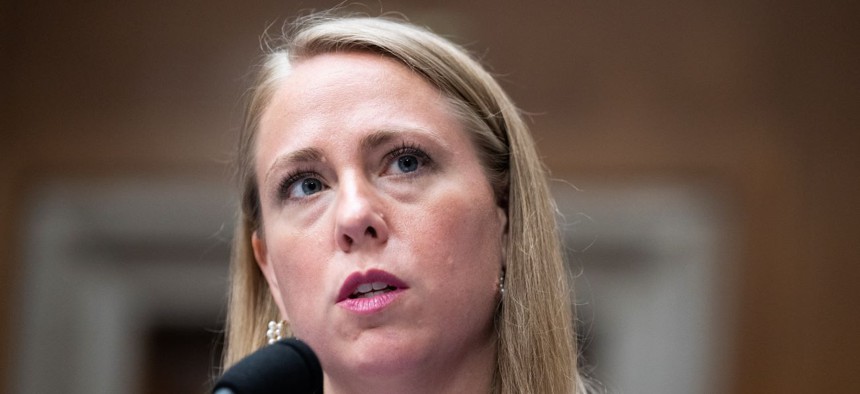
The American Federation of Government Employees on Tuesday accused Equal Employment Opportunity Commission Chairwoman Andrea Lucas of unlawfully blocking all EEO class action cases involving federal agencies. Tom Williams/CQ-Roll Call, Inc via Getty Images



AFGE sues over EEOC’s apparent shutdown of class action cases against agencies
Equal Employment Opportunity Commission Chairwoman Andrea Lucas surreptitiously ordered a halt on all class-action proceedings in which a federal agency is a defendant last December, despite regulations requiring such cases be handled “promptly.”

The nation’s largest federal employee union on Tuesday sued the Equal Employment Opportunity Commission to force the quasi-judicial agency undo an unpublished edict that has blocked all class-action cases involving federal agencies for more than six months.
The American Federation of Government Employees accused EEOC Chairwoman Andrea Lucas of surreptitiously issuing a directive halting proceedings in all class-action discrimination and harassment complaints involving federal agencies last December. Though the document has never been published, administrative judges have since issued indefinite stays or otherwise paused class action case proceedings, including certifications, hearings and other appearances, and evidentiary and discovery processes.
“Effective immediately, all case processing in the above-captioned matter must be paused until further notice,” wrote EEOC Administrative Judge Erania Ebron on Dec. 10, 2025. “All scheduled deadlines and appearances are also cancelled. This notification applies to all class cases in the federal sector, including those alleging disparate impact.”
AFGE filed the suit in U.S. District Court for the District of Columbia alongside union members and U.S. Bureau of Prisons correctional officers Deanna Chelette and Alexzandria Boyd, both of whom are within a certified class alleging their employer does not do enough to prevent rampant sexual harassment of female employees by inmates at the Federal Correctional Complex in Pollock, La. Their EEO case, filed in 2024 and receiving class-action certification for around 200 employees in March 2025, reports that inmates routinely verbally harass female correctional officers and subject them to “exhibitionist nudity,” public masturbation, rape threats and unwanted touching.
The EEOC’s own regulations encourage the use of class-action cases as a cheaper and faster manner of resolving allegations of discrimination or harassment than requiring each employee to file complaints individually—or filing individual or class-action lawsuits in federal court—and requires that class complaints “shall be processed promptly.” The union’s lawsuit accuses the commission of violating its own regulations, engaging in arbitrary and capricious decision-making in halting the processing of cases without any public announcement or rationale, among other violations of the Administrative Procedure Act.
“Defendants have not published the suspension directive or provided any explanation or authority for the decision,” the union wrote. “They have provided no procedure for an affected party to seek an exception or case-specific review. The directive has no stated termination date, leaving thousands of federal employees with no indication of when the EEOC will permit the adjudication of class claims to resume, and under what circumstances.”
AFGE argued that Lucas’ directive does far more than simply block class action EEO cases from moving forward. Because of how classes are determined by the commission, individuals who are not involved in a case but could be covered by its class cannot pursue their own claims on their own.
“The directive is also harmful to absent class members. In class cases, they cannot opt out, as their overlapping individual complaints are subsumed as soon as a formal class complaint is filed,” the union wrote. “They therefore cannot pursue their own claims in any form, administrative or judicial, while the proceeding that governs their rights remains frozen.”
If you have a tip that can contribute to our reporting, Erich Wagner can be securely contacted at ewagner.47 on Signal.
NEXT STORY: As USDA relocation deadlines near, employees say questions remain unanswered