

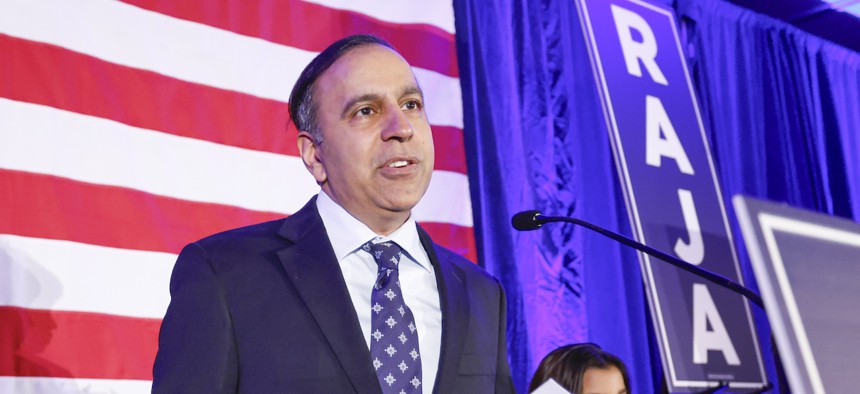
The lawmaker criticized the recent proposal to make federal employees sign a non-disclosure agreement. Kamil Krzaczynski/Getty Images

NDA proposal for feds draws scrutiny on Capitol Hill
Rep. Raja Krishnamoorth, D-Ill., expressed “serious concern” about the Office of Personnel Management’s controversial proposal, including its impact on whistleblowers and employees who report wrongdoing.

Rep. Raja Krishnamoorthi, D-Ill., on Tuesday said the Trump administration’s recently unveiled plan to make federal employees sign a non-disclosure agreement “threatens” the federal workforce’s constitutional rights and creates a chilling effect on would-be whistleblowers and demanded information into how it was developed.
Last month, the Office of Personnel Management formally proposed requiring all federal employees to sign NDAs barring them from divulging “confidential” information in most cases, prompting swift outcry from civil service groups and employment lawyers. A draft copy of the document bars signatories from disclosing information related to internal agency operations, personnel and procurement matters and “any sensitive, pre-decisional or deliberative material.”
In a letter to OPM Director Scott Kupor, the Illinois Democrat criticized the proposal as “over-broad” and likely to make it more difficult for whistleblowers to divulge allegations of waste, fraud and abuse.
“Although OPM has stated the proposal does not supersede existing whistleblower protections, rights guaranteed on paper can be rendered ineffective if employees reasonably fear discipline, civil liability or criminal penalties for exercising them,” Krishnamoorthi wrote. “As drafted, the NDA will leave federal employees questioning whether communications with Congress, inspectors general, law enforcement or other authorized oversight bodies could jeopardize or seriously damage their careers . . . Federal employees should not be forced to guess which communications are permissible and which could expose them to punishment.”
Krishnamoorthi particularly questioned OPM’s citation of “confidential” information, which he said is never “clearly defined” in the document.
“OPM itself recognizes that federal employees have the right to disclose evidence of violations of law, gross waste of funds, abuse of authority and threats to public health or safety to Congress, inspectors general, and other authorized recipients,” he wrote. “Yet the proposed NDA threatens disciplinary, civil and potentially criminal consequences for violations involving an undefined category of ‘confidential’ information. When employees cannot confidently distinguish between protected disclosures and prohibited conduct, many will understandably choose silence rather than risk punishment.”
The Democrat demanded information on OPM’s legal analysis of whether the proposed NDA comports with the First Amendment and the Whistleblower Protection Act, a definition of “confidential” for the purposes of the document, as well as any potential consequences federal employees who refuse to sign the agreement would face, and whether it would apply equally to both career employees and political appointees.
“In its draft notice, OPM also cited unauthorized disclosures to the press—including reporting on OPM’s own controversial personnel proposals—as the primary justification for this rule, arguing that leaks ‘risk chilling candid interagency feedback, disrupting orderly decision-making, and weakening trust within and among federal agencies,’” Krishnamoorthi wrote. “This proposal notably does not mention the most high-profile information disclosure of this administration—Defense Secretary Pete Hegseth’s sharing of operational military strike details over a Signal group chat. That omission raises a direct question about whether this policy is designed to apply consistently across all federal employees and officials—or whether it is aimed primarily at career civil servants who speak out about wrongdoing.”
If you have a tip that can contribute to our reporting, Erich Wagner can be securely contacted at ewagner.47 on Signal.
NEXT STORY: Union renews call for lawmakers to override Trump’s anti-union EO at the Pentagon