

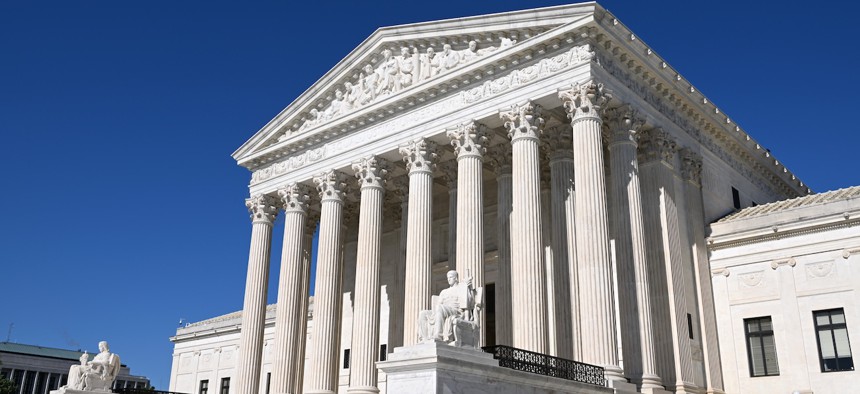
The policy barred its members from speaking or writing publicly about immigration in their personal capacities. Li Rui/Xinhua via Getty Images




Supreme Court rejects lower court bid to review immigration judge gag order
Justices reversed an appeals court decision that would have greenlit a fact-finding expedition into whether President Trump had effectively nullified review of personnel policies under the 1978 Civil Service Reform Act.

The Supreme Court on Tuesday rejected an appeals court’s effort to investigate whether the Trump administration has effectively neutered the law undergirding the federal civil service on procedural grounds.
Last year, a three-judge panel on the U.S. Court of Appeals for the Fourth Circuit revived a 2020 lawsuit filed by the National Association of Immigration Judges challenging a policy barring its members from speaking or writing publicly about immigration in their personal capacities.
The union alleged that the so-called “gag rule,” first issued in 2017, made more restrictive in 2020 and revised again in 2021, violated the judges’ free speech rights. But a district court judge dismissed the case in 2023, finding that they must first challenge the policy before the Merit Systems Protection Board.
But last year, the Fourth Circuit panel issued a ruling that revived the case, instructing the lower court to examine whether the Trump administration’s push to fire political leaders at independent agencies like the MSPB and U.S. Office of Special Counsel had “so undermined” the 1978 Civil Service Reform Act as to deny federal workers meaningful review of agency actions.
Both the Trump administration and the immigration judges’ union asked the Supreme Court to intervene in the case. In a ruling Tuesday, the court reversed the appellate judges’ decision and sent the case back to them for further proceedings.
In an unsigned opinion, the court found that the Fourth Circuit could not issue its decision questioning the CSRA’s continued viability because neither party raised it as an argument before the judges. There were no noted dissents.
“As [NAIJ] conceded below, our precedent establishes that Congress, through the CSRA, intended to channel covered claims to the MSPB,” the justices wrote. “The parties thus confined their arguments to the narrow question whether respondent’s claims were, in fact, covered. Unsatisfied with rejecting respondent’s arguments on that question, however, the Fourth Circuit sua sponte addressed a much broader one and remanded for further proceedings on that question.”
Justices Clarence Thomas and Amy Coney Barrett issued a concurring opinion stating that they would have also decided the case in favor of the Trump administration on the merits, as well.
“Neither the president’s view that he can remove federal executive officials, nor his having done so, change the meaning of the statute or the binding nature of this court’s interpretation of it,” they wrote. “’Conditions may have changed, but the statute has not.’ Courts may not ‘rewrite the statutory scheme in order to approximate what we think Congress might have wanted had it known that’ the president or courts may conclude that its removal restrictions were ‘beyond its authority.’”
In a statement Tuesday, NAIJ President Holly D’Andrea said that while her union was disappointed in the decision, it would continue to fight the Justice Department’s gag rule as the litigation moves forward.
“The case has been remanded to the Fourth Circuit, and NAIJ will continue fighting to protect the free speech rights of immigration judges, to seek meaningful review of the Executive Office for Immigration Review’s speech policies, and to ensure that immigration judges may engage in public discourse on immigration matters in their personal capacities,” she said. “Justice cannot endure when judges are intimidated into silence, nor can a nation remain free when the rule of law is subordinate to the whims of political ambition.”
If you have a tip that can contribute to our reporting, Erich Wagner can be securely contacted at ewagner.47 on Signal.
NEXT STORY: They were told they’d move on. A year later, many fired federal employees say they haven’t been able to