

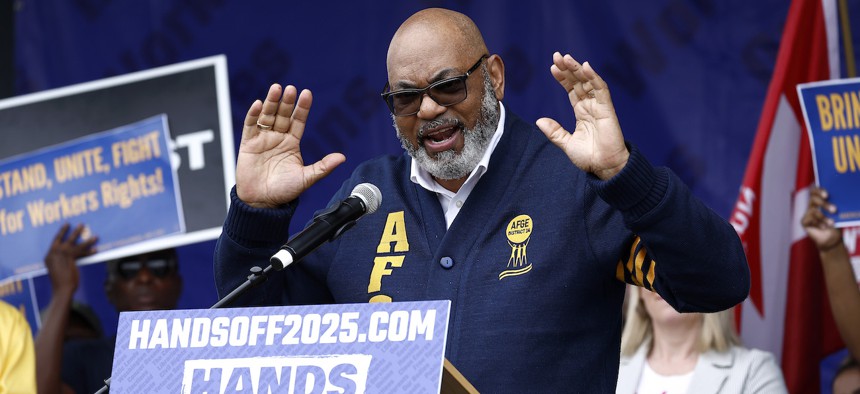
AFGE President Everett Kelley called the new FLRA rule "another step in this administration’s efforts to politicize federal employment." Photo by Paul Morigi/Getty Images for Community Change Action




Labor groups sue to block FLRA’s political seizure of union elections
Federal employee unions warned that fast-tracked changes centralizing control of union representation petitions with the agency’s political appointees will bog down, rather than streamline, the election process.

A coalition of labor groups on Thursday sued the Federal Labor Relations Authority in an effort to block new regulations granting the agency’s political appointees control over union elections at federal agencies, arguing both that the agency robbed stakeholders of the opportunity to weigh in on the changes and that the measure would have the opposite effect from its stated aim.
Since 1983, the handling of petitions for union elections and other petitions relating to the composition of bargaining units at federal agencies have primarily been handled by the FLRA’s regional directors and their staff—career employees—with a process by which parties can appeal their decisions to the authority’s three-member board, presidential appointees confirmed by the Senate.
But last month, the FLRA issued an interim final rule wresting control of those petitions from regional directors, who the agency said will now work “collaboratively” with the three-member authority to process, and removed the appeals process. The rule, set to take effect April 23, bypassed the notice-and-comment period agencies traditionally employ when they consider major changes to their operating rules.
“After reexamination of its practices, the FLRA finds that the memorandum of delegated authorities and responsibilities to the [regional directors], and the related regulations governing representation matters, merit revision,” the rule states. “The FLRA envisions a streamlined process in which representation matters are resolved through the collaborative efforts of the regional offices and the authority—rather than a strict separation of an initial decision by an RD, followed by a possible appeal to, and potentially duplicative decision by, the authority.”
Thursday’s legal challenge, filed by the American Federation of Government Employees, National Association of Government Employees, National Federation of Federal Employees and other unions, argues that the interim rule’s “threadbare” justification for upending four decades of precedent, the peremptory implementation window and failure to seek public comment before finalizing the regulations all amount to the type of “arbitrary and capricious” decision making forbidden by the Administrative Procedure Act.
While the FLRA stated that a reason for issuing this change was to eliminate “duplicative” proceedings in cases in which a party appeals the regional director’s decision, the unions said such cases are exceedingly rare: in 2025, 277 representation petitions were filed with the agency’s regional directors, while only six cases were appealed to the authority’s three-member board. And contrary to the agency’s claim that the new process would “streamline” the processing of union elections, the three-member authority was the only part of the agency to miss its processing goal last year.
“Indeed, in fiscal 2025, the authority’s own performance report stated that it did not meet its targets for the ‘average age of representation cases decided or otherwise resolved by the authority’ nor the ‘average age of representation cases pending before the authority,’” the unions wrote. “In contrast, targets for the percentage of cases ‘resolved by the [Office of General Counsel] through withdrawal, election or issuance of a decision or order within 120 days of the filing of a petition’ and the same ‘within 365 days of the filing of a petition’ were met by the OGC and its regional directors. It is both implausible and unexplained that these unacceptable delays at the authority level would be remedied by requiring the authority to take on an enormous amount of additional representation decisions.”
The unions filed their lawsuit in the U.S. District Court for Massachusetts, where the case has been assigned to Chief Judge Denise Casper, an Obama appointee.
In a statement Thursday, AFGE National President Everett Kelley suggested that the FLRA had an ulterior motive for its regulatory change: meddling in ongoing and future union organization drives.
“Make no mistake, these changes are significant and substantive,” he said. “They eliminate the nonpartisan, nonpolitical decision-making process that currently governs who can and can’t be represented by a union. We should recognize this for what it is—just another step in this administration’s efforts to politicize federal employment and make it easier to retaliate against those, including unions, that speak out against them.”
NEXT STORY: Hegseth orders termination of union contracts