

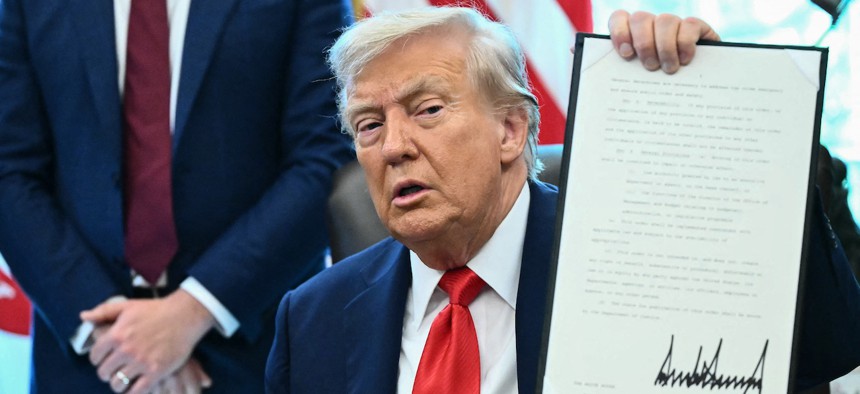
A small agency designed to resolve labor-management disputes is taking an unusual approach as agencies enforce Trump's executive orders Photo by MANDEL NGAN/AFP via Getty Images




How an obscure federal agency threatens to upend union disputes
The Federal Mediation and Conciliation Service has begun delaying and denying union requests for arbitrators to hear grievance cases, a move that has shocked longtime experts.

This story has been updated at 4 p.m. ET to include comments from FMCS.
A small federal agency has taken unusual steps to interfere in federal employee unions’ ability to secure independent adjudicators to hash out disputes with agency management, though on Friday it clarified that its new approach won’t apply to pre-existing cases, following pressure from advocates and arbitrators alike.
As the Trump administration has defended in court the legality of two 2025 executive orders that strip two-thirds of the federal workforce of its collective bargaining rights on national security grounds, its attorneys have frequently relied on the idea that unions could challenge the edicts’ validity as part of preexisting administrative disputes to support the idea that federal judges lack jurisdiction to hear the labor groups’ lawsuits.
“The government identified numerous avenues for unions to challenge the executive order’s validity before the [Federal Labor Relations Authority] and then on direct review in a court of appeals, and plaintiff fails to explain why those avenues are unavailable,” the government wrote in a legal brief last October. “Specifically, the government explained that plaintiff can file an unfair-labor-practice charge with the FLRA’s general counsel or raise such a claim through the grievance and arbitration procedures in the union’s collective bargaining agreements.”
But one of those touted avenues—arbitrated grievances—was temporarily closed for some unions earlier this month. The Federal Mediation and Conciliation Service issued new guidance last week stating that it would not appoint arbitrators to hear grievances at agencies impacted by the national security EOs without management’s assent. President Trump previously sought to eliminate FMCS entirely via executive order last year, but that effort petered out following multiple federal court orders blocking the agency's closure.
“When an agency invokes an executive order as a reason for non-participation during the arbitration panel selection process, the agency has revoked any actual or implied consent to participate in the proceedings,” wrote FMCS General Counsel Anna Davis, a career employee who also serves as the senior official performing the duties of the agency director. “Without an agency’s consent, FMCS cannot continue the process of issuing an arbitration panel. Again, ‘FMCS has no power to . . . compel parties to arbitrate any issue.’”
But federal sector labor attorneys said that document amounts to a post hoc justification, issued only after the agency began mysteriously balking at assigning arbitrators in multiple cases earlier this month. Suzanne Summerlin, an independent attorney that represents unions, said in two separate cases, FMCS interrupted and delayed the arbitrator selection process over “threshold issues,” and in one case requested she submit a legal brief in support of appointing an arbitrator.
One case involved one of the agencies targeted by Trump in his union executive orders, despite the fact that a 1993 Federal Labor Relations Authority precedent requires agencies that have been recently exempted from federal sector labor law to continue to participate in preexisting grievance proceedings. The underlying collective bargaining agreement also allows either party to advance those proceedings unilaterally. In another case, FMCS demanded information about whether a bargaining unit was made up of “information management” employees, something that would make those workers ineligible for union representation, before allowing arbitration to proceed.
“It seems like they’re just trying to gum up the works and not let anyone get a grievance arbitration going,” Summerlin said. “It feels like a power grab by the political factions in these agencies, for sure.”
Ibidun Roberts, another independent labor attorney who works frequently with federal employee unions, described a similar scenario, in which the Veterans Affairs Department seemingly engaged in communication in which the Veterans Affairs Department privately requested that FMCS block the appointment of an arbitrator. She said the questions posed by FMCS in her and other attorneys’ recent experience for decades have been for arbitrators—or the FLRA, on appeal—to decide, not the mediation service.
“We don’t bargain in order for FMCS to make the decision, we do it so that an arbitrator will make them,” she said. “It was wrong for VA to even put them in that predicament, but it was also wrong for FMCS to take them up on it. The response should have been, ‘We don’t get involved.’”
Arbitrators, too, have taken notice. If FMCS moves forward with its efforts to take a more active role in the grievance process, it could impact their livelihood, as they are typically paid by the case.
“Several of our members, as well as some advocates, have brought this to the Academy's attention, and we are seeking clarity about the actual nature of the agency's actions, and the reasons for them,” Joshua Javits, a federal arbitrator and president of the National Academy of Arbitrators, told Government Executive.
In an interview Friday, Davis told Government Executive that although the April 22 guidance remains operative, it will not apply to arbitrator panel requests made prior to that date. The decision to issue new guidance came after VA was “very vocal” about its refusal to participate in grievance proceedings, and following outreach to union attorneys and, ultimately, the Justice Department.
While union attorneys have argued that agencies had already provided their consent to participating in arbitration when they signed their respective collective bargaining agreements, Davis said FMCS is measuring consent at the time of the request for a panel of arbitrators. She said FMCS is developing FAQ documents to better explain its new approach, in which panel requests involving agencies implicated in Trump’s executive orders are honored—to preserve CBA-related deadlines—but held in abeyance until courts can hash out the edicts’ legality.
“There’s ongoing litigation, so we’re not rejecting or denying arbitration requests—we’re honoring the timeline in [unions’] CBAs and we’re still accepting and preserving requests, so we still wanted to honor that,” Davis said. “We’re not trying to insert ourselves, we’re trying to preserve and protect the process.”
Since the guidance was issued, three requests for arbitrator panels have been filed, of which two have been held in abeyance, both involving the VA.
Robert Tobias, distinguished practitioner in residence at American University’s Key Leadership Program and a former president of the National Treasury Employees Union, was aghast when he learned that FMCS was delaying the issuance of arbitrator panels.
“Oh my god,” he said. “This is supposed to be a ministerial process . . . Their job is only to ensure that the arbitrators who are on the list are competent to be arbitrators, that they have the requisite background, experience and qualifications to be arbitrators on the list. The job is to assign them when requested, and if either of the parties think that the arbitrator lacks qualifications, that’s for someone else to determine, not FMCS.”
If you have a tip that can contribute to our reporting, Erich Wagner can be securely contacted at ewagner.47 on Signal.
NEXT STORY: Feds that Trump fired without cause can take their appeals directly to federal court, judges say