

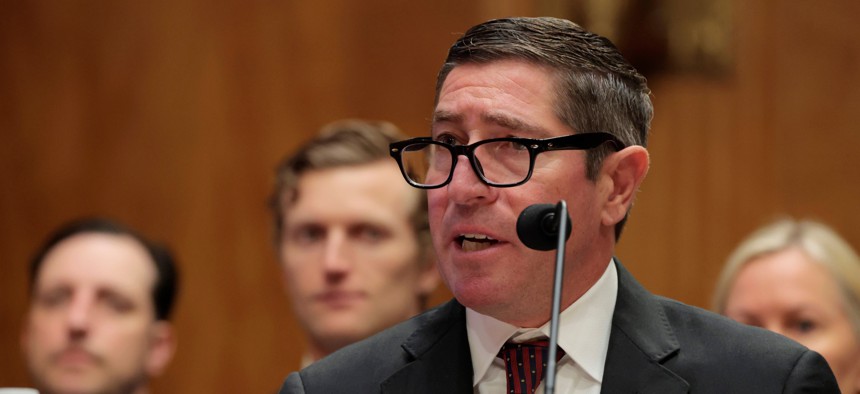
OPM Director Scott Kupor speaking at a hearing with the Senate Committee on Homeland Security and Governmental Affairs on April 3, 2025. Kupor recently penned a memo telling agencies to get in compliance with executive orders ending collective bargaining while lawsuits against the orders continue to play out. Anna Moneymaker / Getty Images




OPM instructs agencies to terminate union contracts potentially in violation of court orders
A smattering of agencies implicated in President Trump’s executive orders barring labor representation for two-thirds of the federal workforce had held off on formally terminating their collective bargaining agreements due to injunctions barring the edicts’ implementation.

Office of Personnel Management Director Scott Kupor told agencies Thursday to get a move on with the administration’s quest to excise labor unions from most federal agencies, seemingly in defiance of multiple federal court orders blocking the initiative.
Last March and August, President Trump signed a pair of executive orders citing a seldom-used provision of the 1978 Civil Service Reform Act to ban unions at most federal agencies under the auspices of national security. Though most agencies implicated in the two edicts terminated their contracts with federal employee unions last summer, a smattering of agencies still recognize their workforces’ labor representatives due to court orders temporarily barring the orders’ implementation.
But in a memo to agency heads Thursday, Kupor demanded agencies comply with Trump’s executive orders, apparently in defiance of the various injunctions prohibiting such actions taking place.
“For various reasons, including litigation, implementation of these executive orders at certain agencies and agency subdivisions has been delayed,” Kupor wrote. “The U.S. Office of Personnel Management now advises agencies and agency subdivisions covered by E.O. 14251 and E.O. 14343 that they should proceed to terminate or modify collective bargaining agreements in order to fully comply with those executive orders.”
The memo specifically notes that agencies should notify “any labor unions and bargaining unit employees" impacted by the orders of their contract’s termination, mentioning units represented by the National Treasury Employees Union by name. Since last August, OPM’s guidance governing the executive orders’ implementation had stated to hold off on terminating NTEU CBAs, due to ongoing litigation by that union, and since then a smattering of injunctions have blocked the edicts on an agency-by-agency basis.
An OPM spokesperson denied allegations that Kupor had instructed agencies to defy federal judges but did not immediately provide data regarding how many agencies named in the executive order had thus far refrained from terminating union contracts for reasons other than court action.
In a filing to the U.S. Court of Appeals for the D.C. Circuit, where a three-judge panel predicated a decision allowing the executive orders to take effect upon the administration’s inaction in terminating CBAs, NTEU General Counsel Paras Shah highlighted the new document’s importance in the case.
“Whether excluded agencies have been honoring their CBAs was the court’s deciding factor in staying the district court’s preliminary injunction and remains relevant to the irreparable harm issue in this appeal,” Shah wrote. “If the court viewed the executive order’s harm as speculative before, OPM’s directive to formally terminate CBAs covering two-thirds of NTEU’s workers renders that harm certain and imminent.”
Share your news tips with us: Erich Wagner: ewagner@govexec.com; Signal: ewagner.47
NEXT STORY: Former feds turn to tailored job search resources to continue service-oriented work