

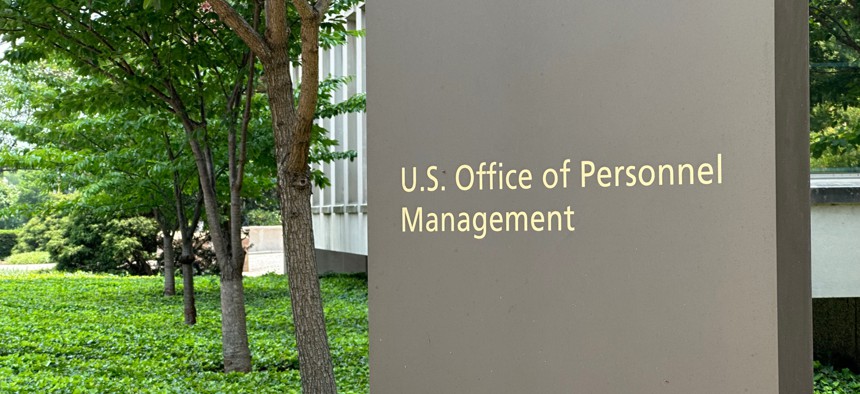
The Trump administration is aiming to correct for what it views as inflated ratings within the federal workforce with the first major overhaul of the federal employee performance management system in decades. Douglas Rissing / Getty Images




OPM formally proposes limiting top performance ratings for federal workers
The plan to institute a forced or “standardized” distribution of performance ratings upon the federal workforce has survived mostly unchanged from a December draft that drew near universal criticism from agency officials in internal deliberations last month.
Federal supervisors are poised to soon face limitations on how many employees they can rate as above average in their annual performance reviews after the Trump administration on Monday proposed upending the process for evaluating civil servants.
The Office of Personnel Management’s proposed rule would implement the first major overhaul of the federal employee performance management system in decades. The Trump administration is aiming to correct for what it views as inflated ratings within the federal workforce.
The rule, which OPM will formally release on Tuesday, largely mirrors a draft version Government Executive exclusively obtained and reported on in December.
The most prominent change in the proposed rule would involve removing the prohibition on the “forced distribution” of performance ratings, meaning agencies would be permitted to set quotas for how many employees could receive each rating. The administration previously implemented such a change for the Senior Executive Service—the top career officials in government—but the new rule would have a much wider impact as it would affect nearly everyone else in the civil service of more than 2 million individuals.
OPM has long prohibited forced, or standardized, distribution and historically said it was antithetical to good performance management. The agency updated its stance to say the practice would provide better accountability of poor performers and enhance organizational performance. The agency proposed similar changes governing the performance management of senior level and scientific or professional employees in a separate filing in the Federal Register, also set for publication Tuesday.
Under the rule, OPM would require agencies to implement forced distribution but would only implement caps on top ratings—namely fours and fives on the current five-point scale upon which most federal workers are currently evaluated, but not for those below that threshold.
“The ability to measure and assess employee performance enables agencies to reward excellence, address skill gaps, and strengthen accountability,” OPM said. “If relative performance is not accurately measured in an employee’s rating of record, then the entire performance management system across the government is compromised.”
OPM’s regulations would exempt political appointees hired under Schedules C and the newly created G in the excepted service from the forced distribution proposal, which OPM said would ensure political appointees are not overrepresented in the top performance categories.
The rule would also constrict the number of ratings from the current five-level structure down to four, by eliminating the current level two or “minimally satisfactory” rating. It would allow supervisors to give out a level one rating—meaning employees are demonstrating “unacceptable” performance—without the higher-level review that is currently required.
Agencies would have to receive approval of their appraisal systems from OPM every other year. Any agency not meeting to-be-released criteria in its performance management systems would be subject to an OPM recommendation to the Office of Management and Budget that it limit spending on that agency’s performance awards.
From fiscal 2022 to 2024, OPM found that nearly two-thirds of non-SES employees received a four or five rating while just 0.6% received a rating below a three. That mirrored a 2016 Government Accountability Office report that found 99% of employees received at least a "fully successful," or level three, rating.
“The distribution of these ratings suggests there is inflation of non-SES employee ratings and poor performing employees are likely not being identified or held accountable through a rigorous appraisal process,” OPM said.
OPM argued that adopting a forced distribution of performance ratings would counter “leniency bias,” in which supervisors subconsciously go easy on their direct reports, and increase employees’ motivation to compete to be a top performer, citing a 2010 study in the journal Management Science. But while that paper does report improved performance under forced distribution systems in the short term, that initial progress can prove ethereal.
“Most importantly, in our within-subjects design we find that the introduction of a forced distribution leads to a short-term performance increase which is followed by a rather sharp drop in performance,” the researchers wrote. “Apparently, while the participants initially understand that they need to work harder under a forced distribution, they are soon demotivated as they cannot attain the good grades and high bonuses they have earned before.”
Last month, Government Executive reported that agency representatives across government, tasked by OPM with reviewing the proposal, nearly universally panned it in internal discussions, warning that its adoption would decrease employee performance and abandon merit systems principles. That mirrored feedback provided to Government Executive by current and former human resources officials, as well as outside experts. Three weeks after its publication, the agencies named therein reached out through an OPM spokesperson to say that the comments they provided on the rule were the opinions of individual employees and not the agencies themselves.
That is despite agencies presenting their submitted comments as if they were delivered on behalf of the agencies. They consistently began with phrases like, “We believe,” “The agency agrees,” “NASA recommends” and other similar constructions.
“The comments attributed to our respective agencies do not reflect official agency positions and should not be characterized as such,” the agencies said through the OPM spokesperson.
One change OPM did make in response to those comments was to acknowledge concerns that making employees compete for a limited number of top ratings would lead to a decrease in teamwork and collaboration. The HR agency suggested agencies could better emphasize those qualities in workers’ performance plans.
“OPM believes that any such concerns may be addressed by making competencies like teamwork, problem-solving, collaboration and mentoring critical elements in individual performance plans,” the rule states. “These concerns may also be addressed by including specific, measurable, achievable and meaningful goals in individual performance plans, and ensuring such goals align with broader organizational and team objectives.”
After the White House requested it do so, according to the internal comments reviewed by Government Executive, OPM added to the rule a ban on employees filing union grievances over a perceived unfair performance rating. Such a step was unnecessarily burdensome and expensive, OPM said. Also at the White House’s request, OPM also noted that cash bonuses can be more fairly doled out under a forced distribution system. The HR agency added new language suggesting the rule would comply with existing civil service and civil rights laws as discrimination based on factors such as race or political affiliation is already, and will remain, prohibited.
The estimated cost associated with implementation of the new rule also rose substantially from the December draft, increasing from around $200,000 to roughly $3.5 million, mostly due to changes to HR and IT systems across government.
Trump in his first term similarly sought to encourage agencies to more meaningfully distinguish between levels of performance, though those efforts focused more on limiting bonuses and did not lead to any rulemaking on forced distribution. The White House proposed creating a $1 billion interagency fund to award performance bonuses to select employees instead of providing across-the-board cost-of-living adjustments, but Congress never took up the idea.
Share your experience with us: Eric Katz: ekatz@govexec.com, Signal: erickatz.28, Erich Wagner: ewagner@govexec.com; Signal: ewagner.47
NEXT STORY: OPM clarifies that agencies should not violate court orders to terminate union contracts