

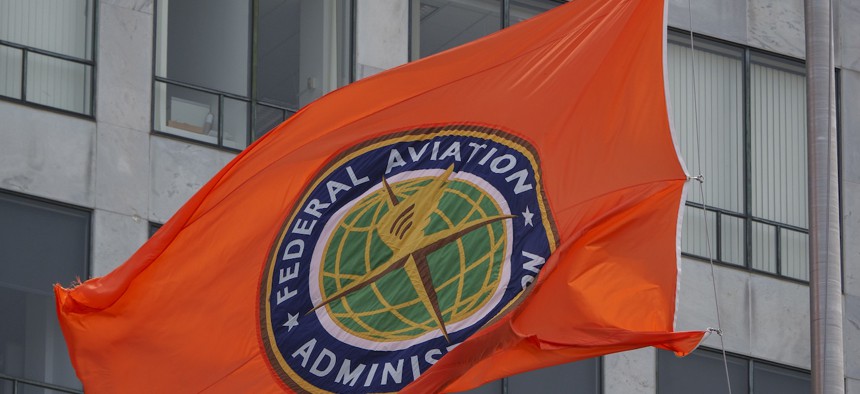
The Federal Aviation Administration began furloughing employees on Monday, impacted workers told Government Executive. Kevin Carter/Getty Images




Employees begin furloughs as lawmakers hope to end shutdown Tuesday
The unusual nature of the funding lapse has led to some confusion for impacted federal workers.

Federal employees across parts of government went or stayed home on Monday, furloughed for the second time in three months even as lawmakers scramble to reopen agencies within the next 24 hours.
The Senate late Friday approved a spending package to fund most of the agencies that have not yet received full-year appropriations, while keeping the Homeland Security Department afloat with a two-week stopgap continuing resolution. The House was on recess at the time and hoped to quickly pass the measure Monday, but House Democrats appear to have blocked that timetable.
Instead, House Republicans are aiming to approve the package in the Rules Committee on Monday in hopes of teeing up a simple majority vote Tuesday. There is some concern that the bill could run into roadblocks, as some Republicans have also threatened to withhold their support if the measure is not further amended.
The Office of Management and Budget on Friday informed agencies a funding lapse would occur and they should initiate shutdown procedures. Agencies took varying approaches over the weekend and on Monday, leading to some confusion over exactly how employees should proceed.
The Internal Revenue Service, as it did in the shutdown that began in October, told employees they would use carryover funds this week, and all employees should “report to work on their normal schedules,” according to an email sent to staff. Much of DHS, as is typical, was “excepted” or “exempted” from the shutdown, either due to the nature of their work or because their funding comes from non-appropriated sources, such as fees charged by U.S. Citizenship and Immigration Services. The Federal Aviation Administration and Housing and Urban Development Department, however, were among agencies that already began furloughing employees on Monday, impacted workers told Government Executive.
The departments of Defense, Labor, Health and Human Services, Education, Transportation, Housing and Urban Development, State and Treasury, as well as other related agencies, such as the Office of Personnel Management and the General Services Administration, are currently experiencing a funding lapse.
FAA has furloughed around 10,000 employees, according to an updated contingency plan the agency posted just before the lapse began. Impacted staff were notified of their furlough status on Sunday and required to report to their offices to put up out of office messages and other steps required as part of their “orderly shutdown procedures,” according to one impacted worker.
HHS on Friday told employees to report on Monday to initiate the shutdown, according to emails obtained by Government Executive. On Monday morning at 3 a.m., however, the department changed course and told furloughed workers they could instead take those steps remotely. Many employees still reported because they had not seen the message or had not yet received permission to telework from their supervisors, and were directed to return home shortly after arriving in the office.
One employee said they were told on Friday they would be “excepted” from the shutdown, only to be told subsequently that they would instead be furloughed.
While the fate of the funding bill remains uncertain, House Republican leaders on Monday expressed confidence that they would be able to clear Monday’s procedural hurdle and send the package to President Trump’s desk on Tuesday. Trump has declared his support for the bill.
The original deal fell apart after DHS law enforcement personnel fatally shot Alex Pretti in Minnesota earlier this month, leading Democrats to balk at providing the department with its full funding without additional reforms. Senate Minority Leader Chuck Schumer, D-N.Y., has laid out his caucus’ demands for changes at DHS, including the removal of masks by DHS law enforcement personnel, mandated use of body cameras, a requirement for third-party warrants to enter homes, the end of roving patrols in metropolitan areas by Immigration and Customs Enforcement and more uniform restrictions on use of force by federal agents. Democrats plan to negotiate over those items with the White House while the two-week DHS CR is in effect.
Share your news tips with us: Eric Katz: ekatz@govexec.com, Signal: erickatz.28
NEXT STORY: Schedule F won’t fix government’s performance management problems, report finds