

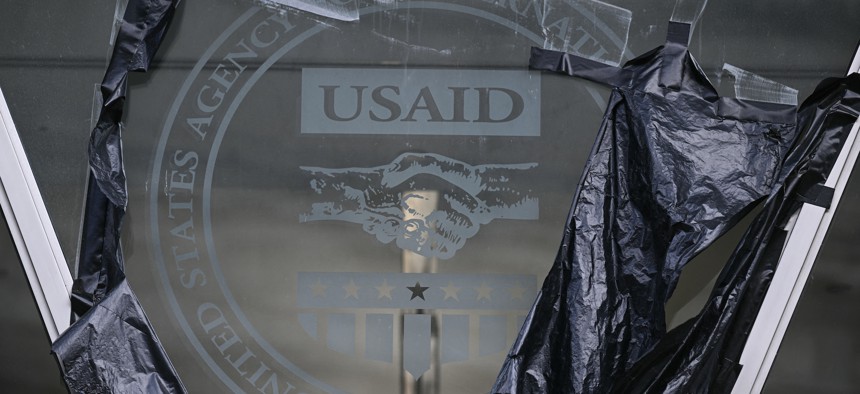
Remnants of signage for the U.S. Agency for International Development on the facade of the Ronald Reagan Building and International Trade Center building in Washington, D.C., on Dec. 29, 2025. The agency was dismantled earlier last year. BRENDAN SMIALOWSKI / Getty Images





Out of government, former USAID employees continue to offer their expertise
Former development workers founded Aid on the Hill to lobby members of Congress about international assistance.

A year ago, U.S. Agency for International Development employee Amanda Nataro was all set for a work trip to Liberia — a country whose health care workforce was devastated due to the 2014 Ebola epidemic, the largest outbreak of the virus in history that spread to the U.S. — to support a program preparing high school students for medical school.
She didn’t get on the plane, however, due to a stop work order that would ultimately lead to the layoffs of nearly all USAID employees, as the Trump administration decided to transfer the independent agency under the State Department.
After losing her federal job, Nataro co-founded Aid on the Hill, a nonpartisan initiative led by former development professionals that urges U.S. lawmakers to continue supporting international assistance. On Thursday, the organization held an advocacy day on Capitol Hill where volunteers met with several congressional offices.
“We've been doing this since February and March of 2025, so we have a good hallway reputation,” Nataro said. “People have come to see us as experts at filling in gaps and providing factual information to lend a voice to the development space. We met with an office today that was really interested in our take on an upcoming bill because they wanted to know how the broader community for development was feeling.”
Kelly Wolfe, who had worked at USAID for 16 years, said congressional staffers have been mostly supportive of the group.
“I was surprised at how receptive they were and how informed they were and how much they talked about their congressman or their senator actually fighting for foreign aid,” she said.
The compromise appropriations bill that funds the State Department (HR 7006), which the House passed 341-79 on Jan. 14, cuts its programs by 16%. Still, it provides $50 billion, despite Trump only requesting $31 billion, and provides money for the United Nations and other international organizations that the administration sought to zero out.
Nevertheless, Elizabeth Berard, who used to work on HIV/AIDS programs at USAID, said organizations that she previously assisted are suffering from the turmoil in U.S. foreign assistance.
“What we are hearing from local African, Caribbean and Latin American partners is that they are seeing on the ground more cases of gender-based violence that they have no one to refer to, they are seeing more cases of children living with HIV in the community and there isn't funding for those children to get to the local health facility and they are seeing health facilities close leaving no access to health services in their local community, meaning patients are having to travel long distances to access health services,” she said.
A Boston University epidemiologist projected that foreign aid cuts have caused the deaths of nearly 800,000 people. Likewise, the Center for Global Development nonprofit in December estimated that funding reductions have led to 500,000 to 1 million deaths.
Administration officials have previously argued that moving USAID into the State Department would “enhance efficiency, accountability, uniformity and strategic impact in delivering foreign assistance programs — allowing our nation and president to speak with one voice in foreign affairs.”
The dismantling of USAID also has adversely impacted its former employees. Wolfe and Berard reacted with bemusement when Trump claimed during a Tuesday press conference that ex-agency workers were making triple their government salaries after finding new jobs in the private sector.
Wolfe is still looking for a new job. And Berard, who worked at USAID for 17 years, said she is a full-time substitute teacher at an elementary school making less than a quarter of her previous salary. She did note, however, that she is “really, really happy to be working in the local community.”
Their focus, however, remains on people around the world who may no longer be receiving life-saving assistance. In particular, Berard often thinks about a man she met while on a USAID internship in Rwanda who was thankful for the U.S. President’s Emergency Plan for AIDS Relief.
The Trump administration attempted to rescind funding for PEPFAR, which says it has saved 25 million lives since 2003, but the cuts were rejected by Congress.
“It drives me crazy thinking what that young man today would be thinking knowing knowing that the U.S. government and U.S. taxpayers have abandoned him and his other community members.” she said “It's just really atrocious, really sad. It's a sad day for America.”
Share your news tips with us: Sean Michael Newhouse: snewhouse@govexec.com, Signal: seanthenewsboy.45
NEXT STORY: NTEU, White House spar over whether unions can challenge their ouster administratively