

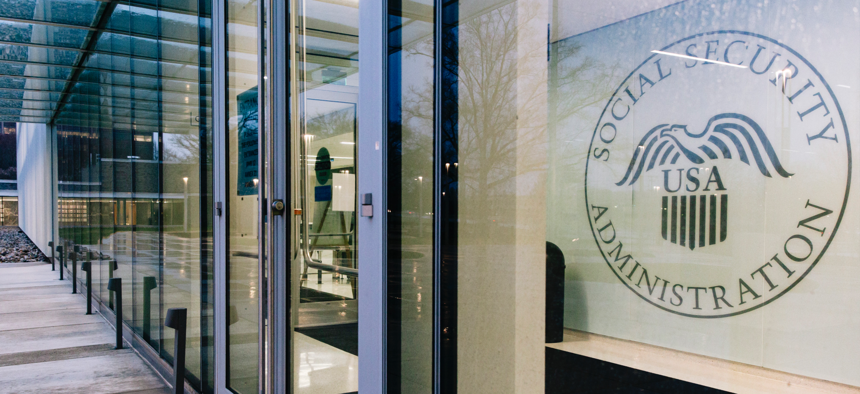
Social Security officials told the GAO that telework was a key recruitment and retention tool prior to the Trump administration's recent executive orders curtailing it. Wesley Lapointe / The Washington Post / Getty Images


GAO: Effectively ending telework increased attrition at Social Security
The government watchdog reported that the already beleaguered Social Security Administration is at risk of “losing many staff in the near term” as a result of the Trump administration’s push to excise the workplace flexibility from federal agencies.

The Social Security Administration is at risk of “losing many staff in the near term” in part as a result of the decision to largely ban telework across government, the Government Accountability Office said in a new report Friday.
According to GAO, telework had already been in decline at SSA when President Trump returned to the White House and issued a presidential memorandum banning telework in most instances in the federal workplace. A combination of former Commissioner Martin O’Malley’s mandate that headquarters and regional office staff telework at most once or twice a week, respectively, and the agency’s ability to recall employees from telework to address workload needs led to a reduction in the percentage of agency work hours spent working remotely from 50% to 55% in the first half of 2024 to 39% to 42% in the second half of the calendar year.
Once Trump’s telework crackdown took effect at SSA in March 2025, that figure fell to just 13% by last April. But officials told the watchdog agency that telework was a key recruitment and retention tool, and employees said in the 2024 Federal Employee Viewpoint Survey that its relative paucity there compared to other federal agencies and private sector employers motivated a desire to leave.
“Among those survey respondents stating that they planned to leave in the next year, almost half indicated that their respective work units’ telework or remote work options influenced their intent to leave the organization,” GAO wrote. “SSA officials told us these staff were likely considering leaving for more work or remote work opportunities, citing employee exit survey results and anecdotal discussions with managers . . . As a result, SSA was at risk of skills gaps in key occupations.”
As part of the Trump administration's effort to reduce the size of government, the agency under then-acting Commissioner Leland Dudek and Commissioner Frank Bisignano undertook a plan to reduce its headcount by 7,000 workers to 50,000 during fiscal 2025, using a combination of the deferred resignation program, voluntary early retirement authority, voluntary separation incentive payments and other departures to thin a workforce that was already at a 50-year low.
Throughout the report, GAO describes efforts by SSA leadership to downplay the impact of telework on its recruitment and retention issues, only to be contradicted by interviews with frontline workers, who stressed the importance of the workplace flexibility.
“Employee engagement—and employee’s satisfaction, commitment and willingness to put in discretionary effort—declined at SSA from 2021 through 2023 and improved in 2024, while most SSA staff regularly teleworked during the four-year period,” GAO wrote. “According to SSA, employee perception of workload contributed to lower engagement scores prior to 2024. However, field office staff, including some who chose not to telework regularly, told us they considered telework availability to be an important benefit.”
And although SSA has set up many of the hallmarks of a successful telework program, including establishing a uniform set of eligibility criteria, applying the same performance standards to in-person and teleworkers alike, and effectively tracking its usage and impact on agency performance, GAO found that leadership failed to evaluate the telework program or the impact of the recent reduction in its availability.
“SSA officials told us the agency had not evaluated telework’s effects, in part, because they believed it would have been costly and complicated,” the report stated. “However, we reported in November 2024 that the Veterans Benefits Administration had determined feasible ways to evaluate its telework program . . . Without evaluating the telework program, SSA lacks the information needed to identify any problems or issues with the program and make appropriate adjustments.”
Share your news tips with us: Erich Wagner: ewagner@govexec.com; Signal: ewagner.47
NEXT STORY: Out of government, former USAID employees continue to offer their expertise