

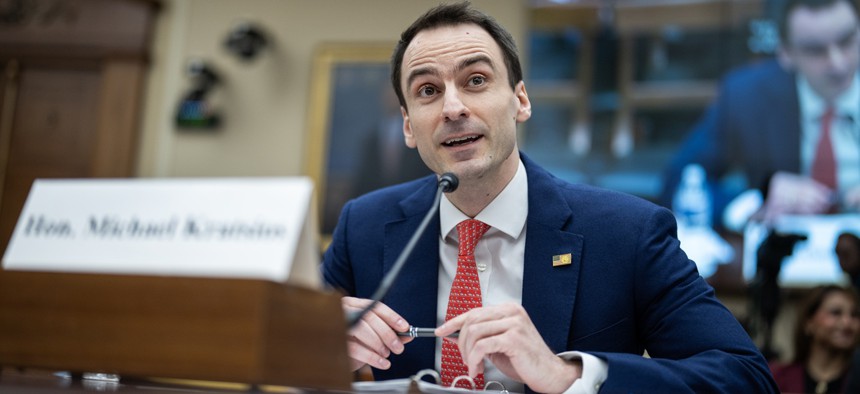
Michael Kratsios, director of the White House Office of Science and Technology Policy, testifies during the House Science, Space and Technology Subcommittee on Research and Technology hearing titled "Assessing America's AI Action Plan," in Rayburn building on Wednesday, January 14, 2026. Tom Williams / CQ-Roll Call, Inc / Getty Images



Democrats question White House tech lead on how workforce churn will impact AI Action Plan
Several House lawmakers also worried over whether the Trump administration’s budget request for 2026 would fall short of the funding agencies need to successfully carry out the White House’s AI action plan.

Office of Science and Technology Policy Director Michael Kratsios shed light on the Trump administration’s artificial intelligence policy plans in a Wednesday House hearing, highlighting the role federal agencies will play in executing these efforts despite mass employee terminations that have taken place over the past year.
But several Democrats on the House Science, Space and Technology's Research and Technology panel questioned the current need for a technology-centric government workforce to advance the tenets of the administration's AI Action Plan against the backdrop of 2025 firing sprees spearheaded by the Department of Government Efficiency and the new hiring initiatives outlined by the U.S. Tech Force.
“We all agree here that, you know, technology and innovation is critical, and government plays a role in that,” Rep. Suhas Subramanyam, D-Va. said. “How do you reconcile trying to recruit for this U.S. Tech Force with the firings of technologists who I think are right now very nervous about working in government?”
Kratsios agreed that bringing tech talent to government is critically important, adding that he considers the U.S. Tech Force hirings and the 2025 firings to be “separate issues.”
“I think what's unique about the tech force initiative and what OPM is driving with that is the buy-in from the private sector,” he said. “I think it’s unique to that program, something we haven't seen in previous programs.”
A key feature of the U.S. Tech Force is partnering with leading private sector companies — such as Oracle, Meta and Palantir — to functionally lend employees for limited terms within the federal government while guaranteeing their private sector jobs will remain when they return.
The National Institute of Standards and Technology stands to play a major role in the administration’s tech policy agenda, including the AI Action Plan. These include developing and promulgating national standards for AI systems, investing in automated cloud-enabled labs for scientific research and leveraging the Center for AI Standards and Innovation to conduct security analyses on leading frontier models.
Kratsios said that data collected by NIST, the National Science Foundation and other scientific agencies will also help advance the administration’s new Genesis Mission within the next two to three years.
“I think there's a very important role for NIST and [the Center for AI Standards and Innovation] to play in promulgating advanced metrology on model evaluation, and that is something that can be used across all industries when they want to deploy these models,” Kratsios said.
Other lawmakers raised concerns about the broader funding status for NIST and other scientific agencies, underscoring the importance of steady federal financial support to scientific agencies as a means to help the administration reach its AI dominance goal.
“You can't talk about the future of manufacturing without talking about the National Institute of Standards and Technology,” Rep. Haley Stevens, D-Mich., said, noting that spurring domestic semiconductor manufacturing is a critical component of the Trump administration’s AI Action Plan.
Stevens cited a $325 million cut to NIST’s budget proposed for fiscal year 2026, resulting in the loss of approximately 500 jobs.
“The cuts hinder NIST AI-related efforts,” Stevens said. “They're going to weaken cyber security and privacy standards … and limit advanced manufacturing, physical infrastructure and resilience innovation.”
Rep. George Whitesides, D-Calif., echoed these concerns.
“I think what's happened to American science is reprehensible, and the cuts that have been proposed –– and that I fear are about to be proposed again in a second presidential budget –– are attacking one of the core pillars of American strength,” Whitesides said. “I think it is crucial that all of us who believe in the importance of science and innovation and technology speak up against the attacks that we have seen in the past year, both against funding, but more importantly, against the dedicated Americans who both in public service and funded by public funds are doing the work to make our world better.
Kratsios defended the budget, saying the Trump administration’s FY26 proposal has always prioritized AI.
“The key thing that I always try to remind people is: even in our attempt to try to right-size the budget, the one area where we have kept a consistent amount of proposed budget funding has been AI,” Kratsios said. “We believe that this is a critical research priority for the administration, and something that we continue to fund.”
Some Democrats voiced support for the shape of the AI Action Plan and the power it gives NIST.
“We were pleased that the President's Executive Order continued to support the NIST efforts and the [Center for AI Standards and Innovation],” Rep. Don Beyer, D-Va., said.
Republicans on the committee largely praised the path set forth in the AI action plan, noting its alignment with past congressional efforts.
“I am glad to see that the Administration’s AI Action Plan includes many of the same tenets as [Congress’] AI Task Force Report, including support for the continuation of NAIRR and for tasking the Center for AI Standards and Innovation with the critical work of developing standards and evaluating frontier AI models,” Rep. Jay Obernolte, R-Calif., said in his opening statement. “It is clear that Congress must step up to the plate and work with the executive branch in developing a competitive vision for American leadership in artificial intelligence.”