

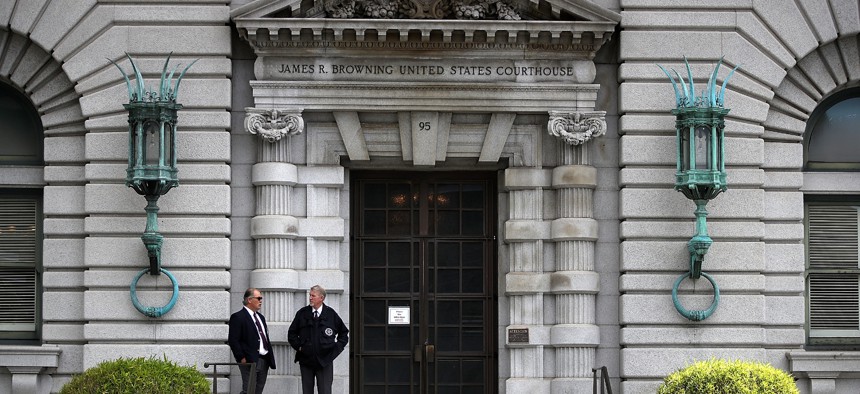
AFGE is asking the Ninth U.S. Circuit Court of Appeals to affirm a ruling preventing the White House from enforcing executive orders collective bargaining rights from swathes of the federal workforce. Justin Sullivan / Getty Images





AFGE urges appellate judges to uphold injunction against Trump’s anti-union EOs
A three-judge panel on the Ninth Circuit Court of Appeals last summer blocked a lower court ruling that found President Trump violated federal employees’ First Amendment rights when it targeted two-thirds of the government workforce for removal of their collective bargaining rights.

The nation’s largest federal employee union on Monday urged a panel of federal appeals judges to affirm a lower court ruling that found that President Trump’s executive orders purporting to strip two-thirds of the federal workforce of their collective bargaining rights amounted to retaliation for protected speech under the First Amendment.
Trump’s edicts, signed in March and August, cited a seldom-used provision of the 1978 Civil Service Reform Act to exclude most federal agencies from federal sector labor law under the auspices of national security. A federal judge in California in June issued a preliminary injunction blocking the orders’ implementation, but a three-judge panel on the Ninth Circuit Court of Appeals stayed that decision last summer, finding that the lower court did not adequately consider whether the president would have taken the same action against labor organizations absent their various legal challenges against the president’s personnel policies.
In oral arguments Monday before Circuit judges John Owens, an Obama appointee, and Bridget Bade and Daniel Bress, both Trump appointees, Ramya Ravindran, an attorney representing the American Federation of Government Employees, argued that the lower court ruling did in fact address the question of whether the president would have issued the same executive order absent the unions’ First Amendment-protected activities, a concept first explained in the 1977 Supreme Court decision Mt. Healthy City School District Board of Education v. Doyle.
“In the [lower court] opinion, it does say that the government has not necessarily rebutted the causal nexus [of retaliatory animus] that the plaintiffs have shown,” Ravindran said. “[It] was the government’s burden to make that argument, and while there was a citation to Mt. Healthy, it is just one sentence of their brief. This is not a situation where the government presented their argument like, ‘Section 1, Section 2,’ and so on—they just didn’t meet their burden and it wasn’t presented.”
Josh Koppel, an attorney with the Justice Department, continued to argue that both unions should have pursued their claims before the Federal Labor Relations Authority before heading to federal court, despite the fact that the executive orders place impacted unions outside of the FLRA’s jurisdiction. And, in any event, the president’s national security determinations are not subject to judicial review.
“Plaintiffs make much of the scope of the executive order and that it is orders of magnitude larger than previous executive orders [exempting agencies and subdivisions from federal sector labor law], and here they assert that it is two-thirds of the federal workforce,” Bade said. “What if it was the entire federal workforce? Is there some principle that guides us? Could the president do that?”
“I don’t want to concede any authority of the president here—I’m not authorized to do that and I don’t think it’s beneficial for this court, but it all depends on the circumstances,” Koppel said. “If it were in the middle of World War II and the statute had been in effect, if the president determined that all resources of the federal government should be devoted to war, I wouldn’t want to say at that point that the president doesn’t have the authority to exclude the entire workforce. It would depend on the circumstances, and that’s really the president’s decision to make.”
Bress appeared leery of taking any action that might impede the deference that the judicial branch traditionally gives the president on matters of national security.
“In the area of national security, the president gets some deference, and you’re kind of asking—or I’m asking—with what jaundiced eye am I to be reviewing things?” Bress asked. “Because one can start scouring something for discriminatory animus toward a particular point of view, but that’s a fairly serious charge to make against the exercise of core executive authority that is also, in this case, granted by a statute.”
“There will be cases where I think that tension will be difficult and perhaps then lead to deferring to those considerations,” Ravindran said. “But in this case, we don’t have to scour, and we don’t have to make assumptions or inferences or speculate about what could be motivating the president. The White House chose to publish a fact sheet about this executive order. We’re not taking random statements and trying to put them together.”
Share your news tips with us: Erich Wagner: ewagner@govexec.com; Signal: ewagner.47
NEXT STORY: NSA alum returns to agency to serve as deputy director