

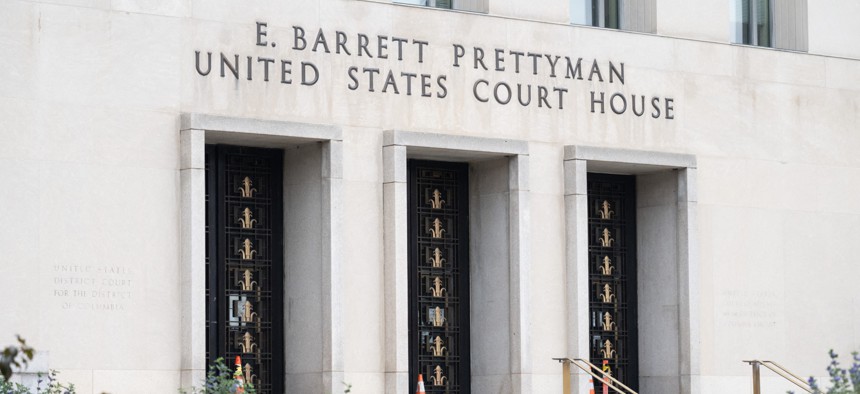
A three-judge panel on the U.S. Court of Appeals for the D.C. Circuit requested supplemental legal briefs from the Trump administration and the National Treasury Employees Union on whether unions must first challenge their exclusion with the Federal Labor Relations Authority SAUL LOEB / AFP / Getty Images





NTEU, White House spar over whether unions can challenge their ouster administratively
The Trump administration contends unions can seek review of their ouster from most federal agencies on national security grounds before the Federal Labor Relations Authority, but labor groups say that analysis misconstrues a term of art in federal labor law.

Attorneys representing federal employee unions and the White House this month debated an whether an untested theory of federal sector labor law enabled labor groups ousted due to President Trump’s executive orders stripping two-thirds of the federal workforce of their collective bargaining rights administratively, a question that could upend the fight over federal employees’ rights.
At issue is a provision of the 1978 Civil Service Reform Act that allows federal workers to petition the Federal Labor Relations Authority over the makeup of a bargaining unit or whether a union enjoys majority support from the workforce it represents.
Though it has traditionally been used only to resolve disputes over whom to include or exclude from a bargaining unit, attorneys with the Justice Department have argued that the phrase “or a matter relating to representation” grants unions a lane to challenge their exclusion from the federal workplace as a result of Trump’s executive orders, signed last March and August, seeking to decertify unions at most federal agencies on national security grounds.
After oral arguments before a three-judge panel on the U.S. Court of Appeals for the D.C. Circuit, the jurists overseeing the case requested supplemental legal briefs from the Trump administration and the National Treasury Employees Union on the issue. If the judges side with the Trump administration, unions would be forced to challenge their removal from federal agencies before the FLRA before bringing their claims to court.
In its filing, the Justice Department insisted that the provision would allow unions impacted by the executive orders to clarify workers’ bargaining unit status, a determination that could in then turn be appealed to federal appellate court.
“FLRA guidance . . . explains that ‘after a labor organization has been recognized or certified as the exclusive representative in an appropriate unit, a petition may be filed requesting, for example: 1) clarification of the bargaining unit status of certain employees positions,’” lawyers for the administration wrote. “The statutes thus permit plaintiffs to file petitions to clarify their certifications and recognitions as the exclusive representatives of employees at the affected agencies and any other matter relating to representation. Such petitions could explain that the unions’ status as exclusive representative, and the employees’ bargaining-unit status, have been called into question by an agency implementing the president’s exclusion order.”
But lawyers for NTEU said the Justice Department’s rationale fundamentally misunderstands a term of art within the federal labor relations statute—that “matters relating to representation” refers specifically to questions regarding who is included in a bargaining unit or whether a particular union still enjoys majority support. They note that the provision specifies that the remedy for successful petitions is for the FLRA to conduct an election of the bargaining unit.
”By its plain terms, [the statutory provision] specifically requires an election when a clarification petition involves a question of representation,” they wrote, quoting a 2020 FLRA decision. “The provision states that if a petition is filed ‘seeking clarification of . . . a matter relating to representation,’ then ‘the authority shall investigate the petition, and if it has reasonable cause to believe that a question of representation exists . . . the authority shall supervise or conduct an election on that question.’ Because [the provision] requires an election to resolve a ‘question of representation,’ such questions include only those that an election can resolve.”
The three-judge panel is expected to issue a ruling in the case in the coming weeks.
Share your news tips with us: Erich Wagner: ewagner@govexec.com; Signal: ewagner.47
NEXT STORY: VA has shed 40,000 employees, Democratic report finds, with drastic impacts on veterans