

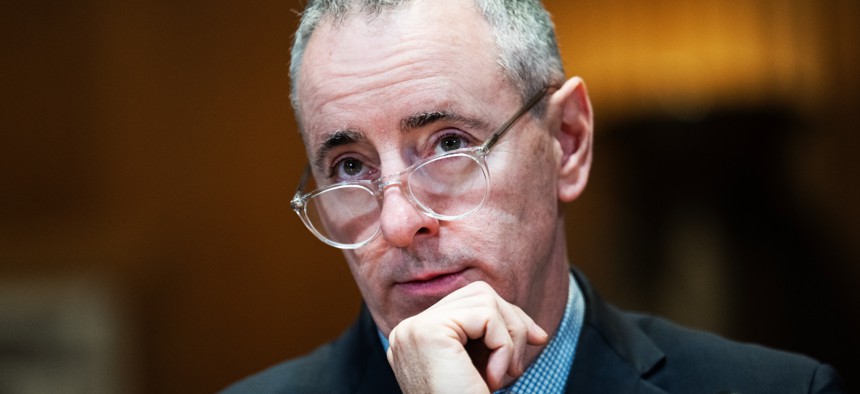
Rep. Brian Fitzpatrick, R-Pa., said legislation he co-sponsored with Rep. Jared Golden, D-Maine, to restore collective bargaining at 40 federal agencies would "strengthen a system that keeps government effective, stable and responsive." Tom Williams / CQ-Roll Call, Inc / Getty Images




House passes bill nullifying Trump’s anti-union EOs
Twenty Republicans crossed party lines to support legislation to unwind what opponents described as the largest act of “union busting” in U.S. history.

The House voted 231-195 on Thursday to pass legislation that would nullify President Trump’s efforts to strip more than 1 million federal workers of their collective bargaining rights, sending the measure over to the Senate, where its prospects are less rosy.
Twenty Republican lawmakers broke ranks to support the Protect America’s Workforce Act (H.R. 2550) on the floor. Introduced by Reps. Jared Golden, D-Maine, and Brian Fitzpatrick, R-Pa., the measure effectively nullifies Trump’s March executive order barring unions at more than 40 federal agencies under the guise of national security and bars federal agencies from terminating any union contracts that were in place prior to the edict’s signature.
Despite its bipartisan support, the vote required a months-long discharge petition drive to amass a majority of House lawmakers’ support and force floor consideration of the measure. House GOP leaders opposed the bill, arguing that contradicting the president here would kneecap his efforts to make agencies “more efficient.”
“[Unions] create barriers to accountability beyond the basic employee protections that exist in law,” said Rep. James Comer, R-Ky., chairman of the House Oversight and Reform Committee, who cited a recent White House report on the use of official time. “[Indeed], many federal employees spend all their time on union business, to the tune of more than 3 million work hours in 2024 alone, for a cost of more than $200 million.”
Three million work hours amounts to 0.069% of the 4.4 billion work hours performed by federal civilian employees each year, while the cost associated with that official time usage totals 0.003% of 2024’s $6.8 trillion in federal discretionary spending.
But Fitzpatrick said the protections that unions provide federal workers are key to the government’s ability to serve the American people.
“This represents a core principle, that the government that serves the people must also respect the rights of those who serve within it,” he said. “Federal employees work tirelessly every day, often behind the scenes, to process Social Security benefits, safeguard our food and water, care for our veterans, and to respond whenever disaster strikes. By restoring their collective bargaining rights, we strengthen a system that keeps government effective, stable and responsive, all without compromising security or mission readiness.”
Rep. Mark Pocan, D-Wisc., said that Trump’s anti-union executive orders remind him of then-Gov. Scott Walker’s push to excise public sector unions from Wisconsin. The results were disastrous, he said.
“Our Department of Education saw a two-thirds drop in the number of people applying to be teachers,” he said. “We lost a lot of long-time public employees, and that affected services.”
Labor leaders were quick to laud the House’s passage of the bill, though its prospects in the Senate are murkier. Lawmakers removed language similar to the Protect America’s Workforce Act, albeit focused on the Defense Department, from the latest draft of the National Defense Authorization Act due to a lack of Senate GOP support.
“This is an incredible testament to the strength of federal employees and the longstanding support for their fundamental right to organize and join a union,” said Randy Erwin, national president of the National Federation of Federal Employees in a statement. “The president cannot unilaterally strip working people of their constitutional freedom of association. In bipartisan fashion, Congress has asserted their authority to hold the president accountable for the biggest attack on workers that this country has ever seen.”
“President Trump betrayed workers when he tried to rip away our collective bargaining rights,” said Liz Schuler, president of the AFL-CIO. “In these increasingly polarized times, working people delivered a rare bipartisan majority to stop the administration’s unprecedented attacks on our freedoms. We commend the Republicans and Democrats who stood with workers and voted to reverse the single largest act of union-busting in American history.”
Share your news tips with us: Erich Wagner: ewagner@govexec.com; Signal: ewagner.47
NEXT STORY: Bipartisan leaders push suicide prevention program, more mental health support for DHS law enforcement