

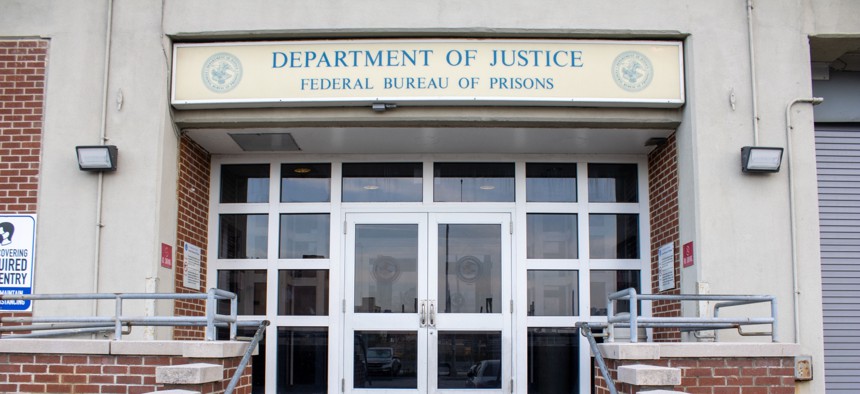
American Federation of Government Employees’ Council of Prison Locals 33 has filed suit against the U.S. Bureau of Prisons over the latter's September move to end collective bargaining agreements per recent executive orders. Wirestock / Getty Images





Correctional officers sue for restoration of union rights
The American Federation of Government Employees’ agency-specific lawsuit challenging the Trump administration’s executive orders aimed at excising unions from most federal agencies accused the U.S. Bureau of Prisons of arbitrary and capricious decision-making.

A union representing federal prison workers this month sued the U.S. Bureau of Prisons over the September dissolution of its collective bargaining agreement, accusing the federal agency of arbitrary and capricious decision-making and violating employees’ First Amendment rights.
In March, President Trump signed an executive order citing a seldom-used provision of the 1978 Civil Service Reform Act to strip two-thirds of the federal workforce of its collective bargaining rights on national security grounds. Though the edict, and an August follow-up applying its provisions to an additional half-dozen agencies, has been subject to intense litigation, federal appellate courts have largely allowed the measure to be implemented as cases work their way through the process.
Shortly after a federal appeals court put a broad preliminary injunction on pause in August, agencies began formally cancelling collective bargaining agreements, though the Bureau of Prisons did not follow suit for another seven weeks.
That delay is at the heart of the lawsuit filed earlier this month by the American Federation of Government Employees’ Council of Prison Locals 33. While other agencies had already ceased honoring the provisions of their union contracts months prior to formally terminating them, BOP continued to fulfill its collective bargaining obligations, even after the Office of Personnel Management updated its guidance greenlighting the cancellation of CBAs.
“For example, between August 1 and September 25, the agency continued to hold labor management relations meetings at the local level across the country as anticipated by the CBA,” the union wrote. “[In] addition, through the end of September 2025, BOP continued to notify employees of their right to union representation in disciplinary meetings and interviews, as required by the CBA and in line with the union acting as the exclusive representative of local staff.”
The lawsuit takes pains to clarify that it is not challenging the broader legality of Trump’s union executive orders. It cites OPM’s August guidance update to argue that the orders merely exempt agencies from the requirements of federal sector labor law, effectively giving agencies the choice of whether to cancel their union contracts.
“On August 13, following the Ninth Circuit’s stay, OPM issued an updated FAQ. The FAQ did not direct agencies to terminate CBAs,” the union wrote. “Rather, it stated that agencies ’may choose to terminate, abrogate or repudiate CBAs with [non-NTEU] unions, and should consult with their general counsels to assess next steps regarding those CBAS.”
Based on the discretion granted to agencies via OPM’s guidance, AFGE argued that BOP’s decision to terminate its union contract violated the Administrative Procedure Act, as Director William Marshall’s blog post announcing the move described the union as an “obstacle to progress,” rather than based on national security issues.
“BOP failed to meet the most basic requirement of reasoned decision-making under the APA, which is to provide a reasoned explanation for its action,” the lawsuit states. “BOP did not explain why it was exercising its discretion to terminate the CBA following issuance of the EO. BOP did not explain why it was terminating the CBA on Sept. 25, 2025, six months after the EO and nearly two months after the Ninth Circuit stayed the preliminary injunction that had been in effect.”
The lawsuit was filed in the U.S. District Court for Connecticut, and has been assigned to U.S. District Judge Vernon Oliver, a Biden appointee.
Share your news tips with us: Erich Wagner: ewagner@govexec.com; Signal: ewagner.47
NEXT STORY: A federal employee morale survey is worthwhile...but not this way