






Government Executive
Skip to Content
  • Exercise Your Privacy Rights
Special Report
The Trump administration laid off around 4,000 people on Oct. 10 across seven agencies, but the reductions are currently blocked under a court order.
Workforce
Federal Workforce Reduction Tracker
The Health and Human Services Department is requiring all telework and remote work reasonable accommodation requests to be approved by at least an assistant secretary.
Workforce
HHS adds new conditions to telework for employees with disabilities
Impacted State Department employees received a message this week stating that they would be separated on Dec. 5.
Workforce
State becomes the latest agency to proceed with RIFs despite statutory pause
Rep. Brandon Gill, R-Texas, introduced the legislation.
Workforce
House panel advances bills extending probationary periods to two years
Supporters of terminated federal workers gather outside of the offices of the U.S. Agency for International Development in Washington, D.C. on Feb. 28, 2025.
Workforce
Government transformation is badly needed
sponsor content
The Hidden Dangers of Legacy PAM: Why Your Security Solution May Actually Be a Risk
Special Report
The Trump administration laid off around 4,000 people on Oct. 10 across seven agencies, but the reductions are currently blocked under a court order.
Workforce
Federal Workforce Reduction Tracker
The Health and Human Services Department is requiring all telework and remote work reasonable accommodation requests to be approved by at least an assistant secretary.
Workforce
HHS adds new conditions to telework for employees with disabilities
Impacted State Department employees received a message this week stating that they would be separated on Dec. 5.
Workforce
State becomes the latest agency to proceed with RIFs despite statutory pause
Rep. Brandon Gill, R-Texas, introduced the legislation.
Workforce
House panel advances bills extending probationary periods to two years
Supporters of terminated federal workers gather outside of the offices of the U.S. Agency for International Development in Washington, D.C. on Feb. 28, 2025.
Workforce
Government transformation is badly needed
sponsor content
The Hidden Dangers of Legacy PAM: Why Your Security Solution May Actually Be a Risk
Government Executive
  • Podcasts
  • Events
  • About
  • Newsletters
  • Advertise
  • News
  • Tech
  • Management
  • Pay & Benefits
  • Oversight
  • Workforce
  • Defense
  • Insights
  • Leadership Voices
  • Podcasts
  • Events
  • About
  • Newsletters
  • Advertise
  • Exercise Your Privacy Rights
  • News
  • Management
  • Oversight
  • Defense
  • Tech
  • Pay & Benefits
  • Workforce
  • Insights
  • Leadership Voices
  • Trending
  • Shutdown
  • RIFs
  • Budget
  • DOGE
  • TSP
Federal Workforce Reduction Tracker

HHS adds new conditions to telework for employees with disabilities

State becomes the latest agency to proceed with RIFs despite statutory pause

House panel advances bills extending probationary periods to two years

Government transformation is badly needed

[SPONSORED] The Hidden Dangers of Legacy PAM: Why Your Security Solution May Actually Be a Risk

Nappy.co

Get the latest workforce news delivered to your inbox.

View Privacy Policy

Stay Connected

Featured eBooks
Best Dates to Retire in 2026
Changing Workforce
Future-Ready Workforce
Insights & Reports
AI that acts: How agentic systems can transform government
Presented By AWS
Download Now
The Observability Pipeline Buyer's Guide
Presented By Cribl
Download Now
Workforce

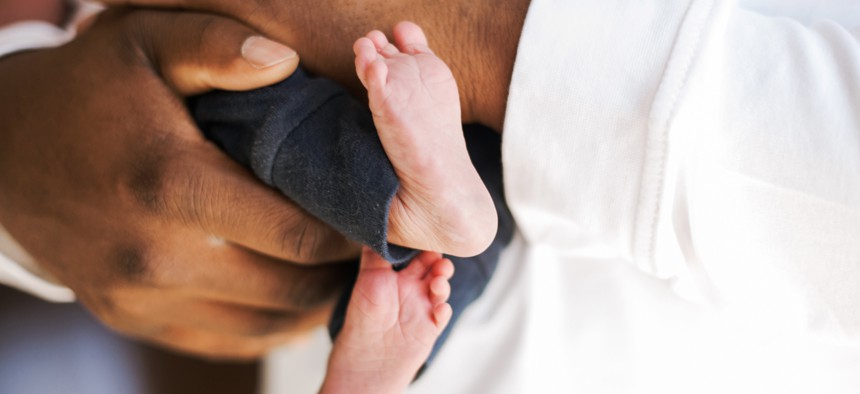
Paid Family Leave Is Good for Moms and Baby Brains

Nearly 80% of US workers don't receive paid family leave, leaving them having to choose between earning a paycheck or bonding with their newborns.

Futurity

|
April 24, 2022
  • Promising Practices
  • Benefits
By
Futurity

Infants whose mothers received paid family leave showed greater brain activity in their first three months, a new study suggests.

In the fall of 2021, Democrats pushed to establish a national paid leave program under the Build Back Better Act, an initiative that would guarantee paid family and sick leave to US workers. The bill faltered in the Senate before eventually being shelved when it failed to garner enough votes.

Without a paid leave policy, the US maintains its position as the only industrialized nation that doesn’t guarantee this aid to its citizens. Nearly 80% of US workers do not receive paid leave through their employer, leaving them, when having children, to choose between earning a paycheck or bonding with their newborns.

This lack of paid leave has profound consequences for both new mothers and their babies, according to developmental psychologists, including Natalie Brito, assistant professor of applied psychology at New York University’s Steinhart School. To explore this impact, Brito studied a diverse sample of families in New York City to examine links between paid leave and electrical activity in infant brains at the age of three months.

As reported in Child Development, the findings show that infants with increased activity of higher-frequency brain waves were 7.39 times more likely to have mothers with paid leave.

Here, Brito talks about about the state of maternity in the US, the benefits of paid leave, and the adverse impacts faced by those without it:

B: Why are the first several months of an infant’s life such an important period for brain development?

A: One of the key features of the brain is its plasticity, or ability to adapt to environmental experiences, and the brain is highly plastic during infancy. The first few months of life are so important for brain development because neural connections in the infant brain are emerging in the context of warm, predictable, and responsive social interactions between the parent and infant.

This brain plasticity makes it easier for infants to learn about the world around them, but this plasticity also makes the brain much more susceptible to negative experiences like parental stress.

The first couple months after childbirth are also a stressful time for parents, and mothers, in particular, often find themselves facing post-birth complications, lactation difficulties, and sleep deprivation.

Although daily stressors are common for parents, high levels of chronic stress can disrupt a parent’s ability to respond to their infant’s cues in a sensitive and timely manner. So parents have an enormous impact on the socioemotional and cognitive development of their infants, but need both time and resources to support this development.

B: Which populations in the US currently are the least likely to have paid maternity leave? How do their experiences differ from those who do?

A: Currently, only 23% of all employed workers in the US have access to paid parental leave through their employers. Nine states and the District of Columbia currently offer some form of paid leave, via state-run programs or temporary disability insurance, that allows parents to have partially-paid time off work to care for a new child. But in reality, these policies are very inconsistent in how much paid time parents are able to receive and the amount of wage replacement during leave.

Black mothers, single mothers, and mothers with lower levels of education have significantly less access to both paid and unpaid leave. Parents who do not have access to paid leave are more likely to return to work too early after childbirth—one report estimated that almost a quarter of mothers who did not have access to paid leave returned to work within 10 days of giving birth.

Mothers who took paid leave were less likely to be re-hospitalized after discharge, less likely to have postpartum depression, and more likely to breastfeed their infant. Infants of mothers who took paid leave were also less likely to be re-hospitalized after discharge, more likely to attend baby well-visits and receive vaccinations, and more likely to have better language and socioemotional skills during toddlerhood.

Our lab’s newest study suggests that compared to mothers with unpaid leave after childbirth, mothers with paid leave had less physiological stress, were more sensitive and responsive with their infants, and their infants demonstrated a brain activity profile that may reflect a more mature pattern of brain function.

B: What would an effective maternity paid leave policy in the US look like? Is there research to support the benefits of paternity leave as well?

A: Paid leave needs to be granted on a national level to every working caregiver, regardless of the type of employment or full-time versus part-time status. The key is to provide enough wage compensation for that family to be economically stable during this important transition.

Mothers need to be able to physically and mentally recover or persevere through the many postpartum challenges during this time. As many challenges start prenatally, having flexibility built into paid leave programs to begin during pregnancy would be an even greater benefit for mothers.

And although most of the research has examined benefits of paid maternal leave, paid leave policies need to be directed towards caregivers in general, not just mothers. Paternity leave has also been shown to positively [affect] relationships within families, and that increased time between fathers and infants may help attune fathers to the needs of their infants and partners.

Source: NYU

Original Study DOI: 10.1111/cdev.13765

Share This:

NEXT STORY: Coronavirus Roundup: A New CDC Center Is Focused on Disease Forecasting 

President Bill Clinton looks on as Vice President Al Gore presents his National Performance Review. The two are standing among piles of government regulations.
Management
Reinventing government: Reflections 30 years later
Outgoing NTEU President Tony Reardon said he believes federal employee unions learned a lot from the Trump era.
Workforce
Retiring NTEU President Reflects on 3 Decades in Organized Labor
Management
'Long, Long Overdue': An Oral History of the GPRA
Members and supporters of the American Federation of Government Employees (AFGE) participate in a "Stand Up, Stand In" protest in the Hart Senate Office Building atrium in Washington, D.C., as part of the 2020 Legislative and Grassroots Mobilization Conference.
Workforce
State of the Unions: A New Normal
Government Executive started as a print magazine in 1969 and has been a digital publication since 1996.
Oversight
What I Learned Covering Government for 34 Years
sponsor content
Balancing Modernization: Federal IT Between Now and Next
President Bill Clinton looks on as Vice President Al Gore presents his National Performance Review. The two are standing among piles of government regulations.
Management
Reinventing government: Reflections 30 years later
Outgoing NTEU President Tony Reardon said he believes federal employee unions learned a lot from the Trump era.
Workforce
Retiring NTEU President Reflects on 3 Decades in Organized Labor
Management
'Long, Long Overdue': An Oral History of the GPRA
Members and supporters of the American Federation of Government Employees (AFGE) participate in a "Stand Up, Stand In" protest in the Hart Senate Office Building atrium in Washington, D.C., as part of the 2020 Legislative and Grassroots Mobilization Conference.
Workforce
State of the Unions: A New Normal
Government Executive started as a print magazine in 1969 and has been a digital publication since 1996.
Oversight
What I Learned Covering Government for 34 Years
sponsor content
Balancing Modernization: Federal IT Between Now and Next
Government Executive
  • About
  • Contact
  • Advertise
  • Privacy Policy
  • Terms & Conditions
  • Nextgov/FCW
  • Defense One
  • Route Fifty
  • Washington Technology
  • GovTribe
  • More
© 2025 by Government Media Executive Group LLC. All rights reserved.
Back to top
Almost There!

Help us tailor content specifically for you:

Thank you!

Thank you for subscribing! Please check out our other newsletter offerings on our Newsletter page.

Get federal business news in your inbox. Sign up for Govexec Today
Privacy Policy
Almost There! Help us tailor content specifically for you:
Privacy Policy