


Veterans’ preference gives former armed forces members priority in hiring for certain agency positions. Yuliia Kaveshnikova / Getty Images





GSA official put on leave for social media post saying veterans’ preference in federal hiring is hampering tech recruiting
A government workforce expert told Government Executive that many hiring rules, including veterans’ preference, have become “procedural hurdles rather than achieving the intended outcome” because they haven’t been updated in decades.

Updated at 6:00 p.m. ET July 31
A senior official at the General Services Administration recently posted on his personal social media that veterans’ preference in federal hiring is preventing his team from bringing on qualified tech-focused employees.
“Veterans preference is brutally unfair when taken to the extreme of blocking any consideration of non-veterans, but we're seeing that everywhere these days,” wrote Pete Waterman, the director of FedRAMP, a governmentwide program that sets security and risk standards for cloud products. “Even Tech Force wouldn't let us look at normal folks until we made offers to all the veterans first.”
Veterans’ preference gives former armed forces members priority in hiring for certain agency positions. The Trump administration launched Tech Force last year to recruit software and data engineers for two-year positions. While officials initially said they could bring on 1,000 participants by the end of March, the program’s director announced in May that only 180 to 200 hires had been made so far.
“I would love to have everybody here yesterday, but I’m learning the government hiring process does take time,” said Scott Kupor — the director of the Office of Personnel Management, which is overseeing Tech Force — in May.
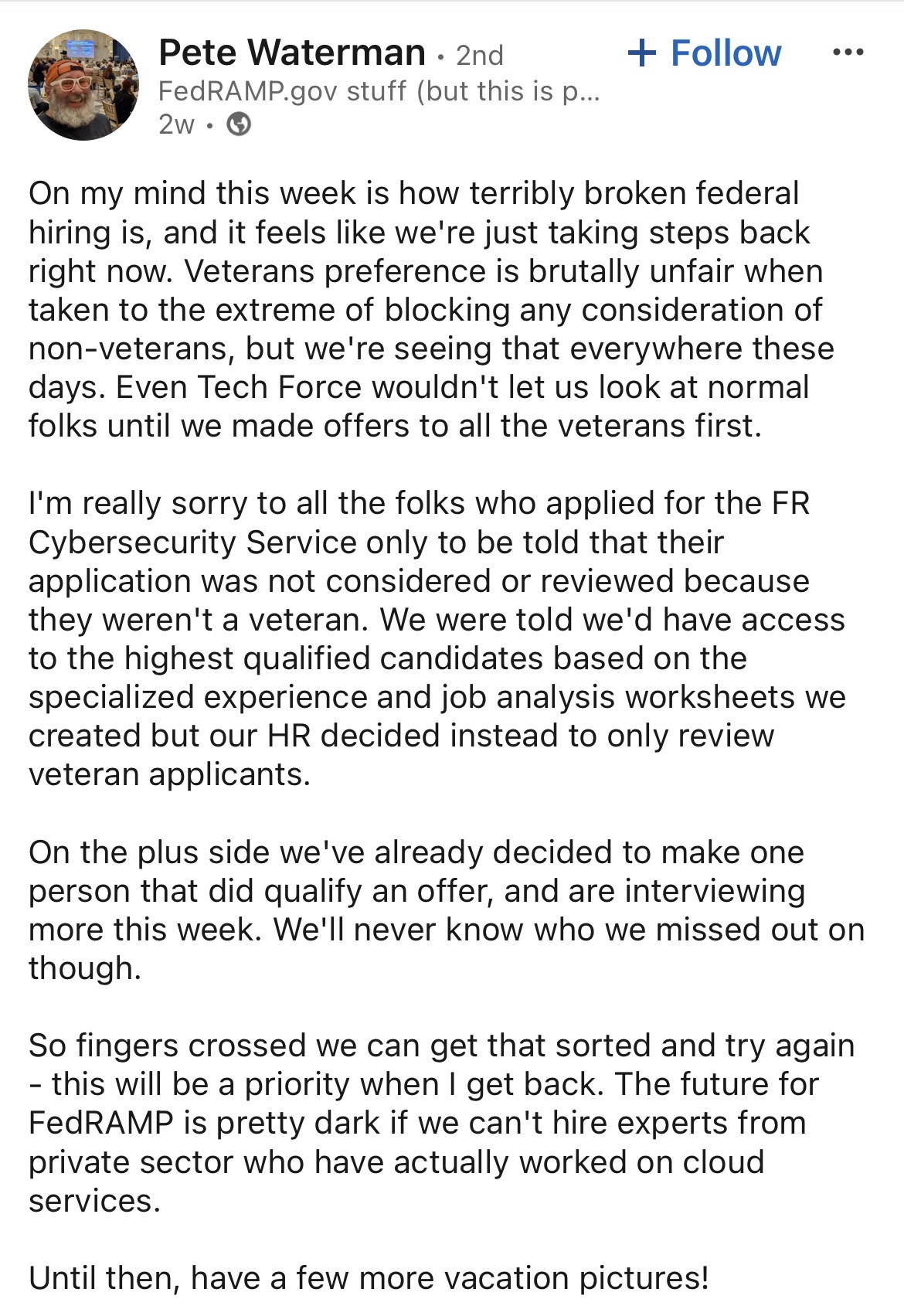
While Waterman’s LinkedIn post received 127 likes and several individuals voiced support, others criticized what he said.
A CEO commented that “As a veteran I can personally tell you there are many qualified veterans that could fill this role.” Likewise, a recruiter for the Treasury Department wrote, “Rather than directing frustration toward veterans or the laws that protect them, the more effective solution is to focus on strengthening HR training.”
Waterman warned that the hiring issues could hurt his program’s effectiveness.
“The future for FedRAMP is pretty dark if we can't hire experts from private sector who have actually worked on cloud services,” he wrote in the post.
GSA Administrator Edward Forst said in a statement to Government Executive that Waterman “has been placed on administrative leave, effective immediately, until further notice.”
“We categorically and completely disagree with a senior employee’s recent remarks denigrating veterans preferences in hiring. GSA has zero tolerance for comments that disparage or disrespect America’s veterans,” he said. "GSA celebrates our veterans and military spouses. They are a critical backbone of our agency: amazing public servants and true heroes whose service continues to strengthen our nation."
Veterans represent approximately 30% of GSA’s workforce and bring invaluable leadership, discipline and experience to our mission every day," Forst added. "Many of our team continue to serve as members of our military reserves. We applaud this dual commitment. We are better for it. This is the ethos of GSA and the federal government.”
Jenny Mattingley, a vice president at the Partnership for Public Service nonprofit who previously worked on federal hiring reform at the Office of Management and Budget, said that the rules around veterans’ preference have largely gone unchanged since they were created after World War II.
“I think what's happened with veterans' preference, along with many other hiring rules, is that they were created in a different time where things moved at a different pace in terms of hiring and where there were only one or two ways into the competitive service,” she said. “So part of the problem is a lot of those rules have really become procedural hurdles rather than achieving the intended outcome.”
But Mattingley emphasized that agencies have flexibility when it comes to implementing veterans’ preference. When she was in government, for example, she helped lead a program that applied veterans’ preference after, instead of before, applicants’ skills were assessed.
“So you're looking at both qualified veterans and qualified non-veterans. Veterans get first preference when agencies are selecting, but they're all technically qualified for the job,” she said. “That was a big change in how veterans' preference was applied. There’s a lot of cultural norms around applying veterans’ preference up front.”
Mattingley also cautioned that the loss of many HR employees as a result of Trump’s staff cuts to the civil service is likely further slowing federal hiring.
“Unless we actually also focus on HR and building out robust HR functions, it kind of doesn't matter if the laws are changed because a lot of this is whether HR has the ability to understand, work with agencies and be strategic about how they apply these laws,” she said.
This story has been updated with a statement from GSA.
If you have a tip that can contribute to our reporting, Sean Michael Newhouse can be reached securely at seanthenewsboy.45 on Signal.
NEXT STORY: AI's growing role in rulemaking raises new transparency questions