


Yuliia Sydorova/Getty Images




Don’t let 5% become your TSP retirement strategy
Getting the full agency match is a good baseline, but if retirement is around the corner there’s more to consider before deciding what to do with the rest of your paycheck.

Should you lower your TSP contributions before retirement? A 5% contribution can secure the full FERS agency contribution, but that does not necessarily make it the best choice for employees nearing retirement. Here’s what to weigh before changing your contribution rate, from taxes and cash flow to long-term savings.
TSP considerations when you are near retirement
Today’s column was inspired by a recent email from an employee who is nearing retirement and wants to know some of the pros and cons of reducing her TSP contributions to 5%, which is the amount that is subject to agency matching.
For federal employees covered by the Federal Employees Retirement System (FERS), contributing 5% of basic pay to the Thrift Savings Plan (TSP) generally captures the full agency contribution. The first 3% is matched dollar-for-dollar, and the next 2% is matched at 50 cents on the dollar.
Combined with the Agency Automatic 1% Contribution, an employee who contributes 5% receives agency contributions equal to 5% of basic pay. That makes 5% an important floor, but not necessarily the ideal ceiling.
For an employee who is retiring in late 2026 or spring 2027, the decision to contribute more turns on the balance between current cash needs, taxes and the long-term value of additional retirement savings.
That decision begins with the annual contribution limits. For 2026, the employee elective-deferral limit is $24,500, shared by traditional and Roth employee contributions. Participants who are at least 50 may also make catch-up contributions: up to $8,000 for most eligible participants or $11,250 for those who turn 60, 61, 62 or 63 during 2026. Agency automatic and matching contributions do not count against the $24,500 employee limit.
Because these limits can change from year to year, employees who are not retiring in 2026 should watch for the annual update. The IRS reviews the limits using cost-of-living adjustments tied to the Consumer Price Index (CPI), as required by federal law.
When inflation warrants an increase, the contribution caps rise in statutory increments, such as the $1,000 increase in the elective-deferral limit from 2025 to 2026. The IRS typically announces the following year’s retirement plan adjustments in late October or November. For example, the TSP published its 2026 contribution-limit announcement in mid-November 2025.
The annual limit is only part of the calculation; timing matters as well. To receive a maximum of 5% in agency automatic and matching contributions, you must contribute at least 5% of basic pay each pay period.
If you reach the annual elective-deferral limit early and payroll contributions stop, matching contributions also stop for the remaining pay periods. Employees who want the full-year match should therefore spread their contributions across all pay periods in the year or, if retiring, over all the pay periods leading to their retirement date.
Recent TSP statistics show that nearly nine in 10 contributing FERS participants save at least 5% of basic pay, but the published monthly data do not distinguish between employees contributing exactly 5% and those contributing more.
Learn more about elective deferral limits by reading the TSP fact sheet, “Annual Limit on Elective Deferrals.”
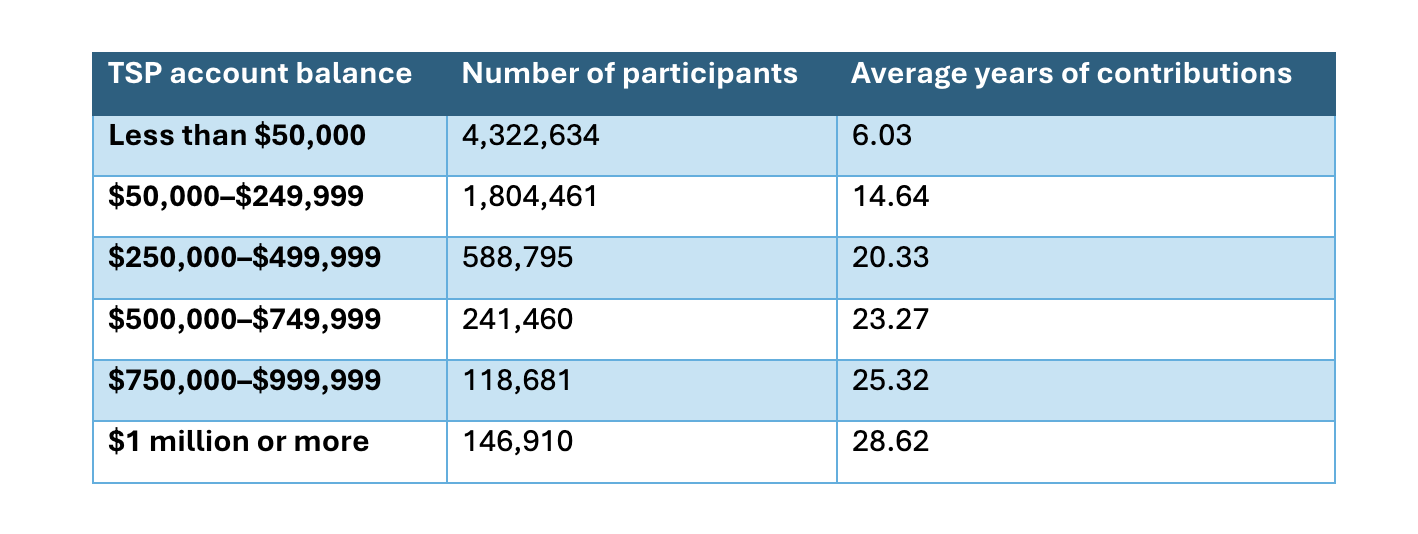
Separate plan-wide data, not limited to FERS employees, show a strong relationship between the length of time participants contribute and the balances they accumulate. As of March 2025, the following balance groups had these average contribution histories:
Limiting contributions to 5% may offer several advantages, especially for employees approaching retirement:
-
More money in each paycheck. Reducing your contribution rate can free up cash for an emergency fund, debt repayment, relocation, health expenses or the transition from your final paycheck to your first retirement benefit payment. This flexibility may be especially valuable because retirement claims can take time to finalize.
-
Full agency contributions can continue. Contributing 5% in every pay period generally allows you to receive the full FERS agency contribution while reducing the risk of reaching the annual employee limit before year-end.
-
Limited short-term effect near retirement. If you plan to retire within a few months, the difference between contributing 5% and a higher rate applies to only a limited number of pay periods. When your retirement savings are already sufficient, using some of that cash for a specific transition expense may be reasonable.
Those benefits, however, must be weighed against the potential costs of limiting contributions to 5% of basic pay:
-
Use-it-or-lose-it contribution opportunity. Once the calendar year ends, you generally cannot make up unused TSP contribution room for that year. Contributing less now could mean missing the chance to invest thousands of additional dollars in the TSP.
-
Less time for your savings to grow. Although you may not consider contributions above 5% when you are near retirement very important, remember that contributions made shortly before retirement can remain invested for many years. Contributing less now reduces the amount available for future compounded growth.
-
A potentially higher tax bill this year. You may not be increasing your take-home pay as much as you think. Traditional TSP contributions reduce your current taxable income. Lowering them may increase your federal and possibly state income tax, particularly during a final high-earning year.
-
Less tax flexibility in retirement. Roth TSP contributions are made after tax, but qualified withdrawals are tax-free. Reducing Roth contributions may leave you with fewer options for managing taxable income later, especially because Roth TSP balances are not subject to required minimum distributions during your lifetime.
-
A greater risk of spending instead of saving. Extra take-home pay improves your retirement readiness only if you use it for a specific financial purpose. If you simply spend the difference, you will enter retirement with fewer assets and no offsetting benefit.
How SECURE Act 2.0 changes the calculation
The choice is further impacted by changes enacted under SECURE Act 2.0. For employees making a near-term contribution decision, the most significant change is the mandatory Roth treatment of certain catch-up contributions beginning in 2026.
The rule applies to an employee who is eligible to make catch-up contributions, generally because the employee will be 50 or older in 2026, and who has 2025 FICA wages from the TSP-covered federal employer that exceeded $150,000.
In other words, 2025 wages of $150,000.01 or more trigger the Roth requirement, while wages of exactly $150,000 or less do not. The test uses prior-year wages from the employer sponsoring the plan, not the employee’s 2026 salary, adjusted gross income or total household income.
Only 2026 contributions above the $24,500 regular elective-deferral limit must be Roth; the rule does not require the employee’s first $24,500 of TSP contributions to be Roth. Employees at or below the threshold may generally choose traditional or Roth treatment for catch-up savings. Because the wage threshold is indexed for inflation, it may change in later years.
The law also raised the required minimum distribution (RMD) starting age from 72 to 73 beginning in 2023 and will raise it to 75 in 2033. It also eliminated lifetime RMDs from a participant’s Roth TSP balance beginning in 2024, reduced the excise tax for missed RMDs and created a larger catch-up limit for participants ages 60 through 63 beginning in 2025.
Taken together, these considerations make 5% a useful benchmark rather than a universal recommendation. It is usually the minimum sensible contribution rate for a FERS employee who wants the full match, but it is not automatically the best rate near retirement.
Before reducing contributions, project them by pay date so the 5% election continues through the final pay period, estimate the tax effect of losing traditional deductions and identify a specific purpose for the additional take-home pay.
Employees affected by the Roth catch-up rule should also compare their expected tax rate in 2026 with their likely tax rate in retirement. Because retirement dates, payroll calendars, FICA wages and tax circumstances differ, employees should confirm their election with their payroll office and consult a qualified tax or financial professional before acting.
Checklist for retirement readiness
Use this checklist to test whether your expected retirement income can support your desired lifestyle, withstand unexpected costs and remain sustainable over a long retirement.
First things first, confirm your retirement eligibility:
-
Confirm that you meet the age and service requirements for an immediate FERS retirement.
-
Verify your service computation date and resolve any missing or incorrect service records.
-
Determine whether you have any outstanding military or temporary civilian service deposits and compare your retirement estimate with and without making these payments.
-
Compare estimates for two different retirement dates to determine the impact on your monthly income from the FERS basic retirement benefit, Social Security or the FERS Supplement and potential income from your TSP investment.
-
If retiring under the MRA + 10 provisions, consider the benefit of working longer to avoid the age reduction vs. postponing your retirement application.
-
If retiring under age 62, compare the benefit of the enhanced annuity calculation factor of 1.1% instead of 1.0% if you will have 20 or more years of service by age 62.
Compute your “net” retirement income:
-
Obtain an official or agency-prepared estimate of your gross FERS annuity, including the FERS retirement supplement, if eligible.
-
Be sure to estimate reductions to your FERS retirement benefit that may include:
-
Survivor benefit elections for a current spouse
-
Court-ordered survivor benefit requirements for a former spouse
-
Part-time work schedule proration
-
Alternative annuity actuarial reduction
-
Offset for Social Security (CSRS Offset coverage only)
-
Unpaid deposits or redeposits (CSRS only)
-
-
Service not covered by retirement deductions is not creditable under FERS; compute retirement estimates without service where retirement deductions were not withheld or deposited. Noncovered civilian service performed after 1988 is not creditable and not eligible for a service credit deposit.
-
Estimate withholdings from your monthly benefit that may include:
-
Federal income tax
-
State income tax
-
Insurance premiums (FEHB, FEGLI, FEDVIP, FLTCIP)
-
Court-ordered apportionment payable to a former spouse
-
-
Review your Social Security estimate at several claiming ages, including at age 62, your full retirement age (67 if born in 1960 or later) and age 70.
-
If retiring at 65 or later, consider the cost of Medicare Part B premiums.
-
Estimate income from your TSP, IRAs, spouse benefits, pensions, part-time work and other sources.
-
Calculate expected after-tax monthly income rather than relying on gross amounts.
-
Identify which income sources are guaranteed and which depend on investment performance.
-
Identify which income sources will receive cost-of-living adjustments and when they are applicable to help maintain buying power in the future.
Cash reserves and retirement spending plan
-
Build a retirement budget that separates essential expenses from discretionary spending.
-
Compare the estimated net income you will have in retirement to your current net income while employed.
-
Account for irregular expenses and inflation rather than using current monthly bills alone.
-
Compare projected income with projected spending and calculate the annual amount your savings must provide.
-
Maintain an accessible emergency reserve so you are not forced to sell investments during a market decline.
-
Try living on your projected retirement income for several months before retiring if you expect to have less net income in retirement.
TSP and investment strategy
-
Confirm that your contribution rate captures the full agency match through your final eligible pay period.
-
Estimate your TSP balance at retirement under conservative, expected and unfavorable market scenarios.
-
Decide how much you expect to withdraw in the first year and whether that amount is sustainable.
-
Review your traditional and Roth balances and the tax treatment of future withdrawals.
-
Check whether your investment allocation matches your time horizon, income needs and tolerance for market declines.
-
Understand the differences among installments, partial withdrawals, rollovers and a TSP annuity before choosing a distribution method.
-
Include outstanding TSP loans in your retirement plan and understand the consequences of separation from service.
Consider your health, insurance needs and long-term risks to your financial security:
-
Verify eligibility to continue Federal Employees Health Benefits coverage into retirement.
-
Consider coordination of FEHB coverage with Medicare Parts A and B when you become eligible.
-
Review Federal Employees’ Group Life Insurance choices and the cost of coverage as you age.
-
Consider how you would pay for long-term care, extended home assistance or assisted living.
-
Test whether your plan can withstand higher medical costs, a long life and several years of elevated inflation.
Taxes, debt and survivor planning
-
Estimate federal and state taxes on your annuity, Social Security, traditional TSP withdrawals and other income.
-
Evaluate whether Roth withdrawals or conversions could improve future tax flexibility.
-
Decide how mortgages, consumer debt and other obligations will be handled before and after retirement.
-
Compare FERS survivor annuity options and their effect on your monthly benefit and a spouse’s future financial security and continued FEHB eligibility.
-
Review beneficiary designations for the TSP, Federal Employees’ Group Life Insurance, unpaid compensation and retirement (FERS or CSRS).
-
Update your will, powers of attorney, health care directives and instructions for locating important records.
Test your retirement readiness
-
Your projected after-tax income covers essential and discretionary spending with a reasonable margin.
-
Your plan remains workable if markets decline early in retirement, inflation is higher than expected or you live longer than expected.
-
You have enough accessible cash for emergencies and the possible delay between your final paycheck and finalized annuity payments.
-
You and your spouse or partner understand income, insurance, survivor and withdrawal decisions.
-
You have reviewed the plan with your agency’s retirement specialist and, when appropriate, a qualified tax or financial professional.
Readiness benchmark: A specific TSP balance alone does not establish readiness. A stronger test is whether dependable and investment income can cover expected after-tax expenses, preserve an emergency reserve and remain sustainable under less favorable assumptions.