

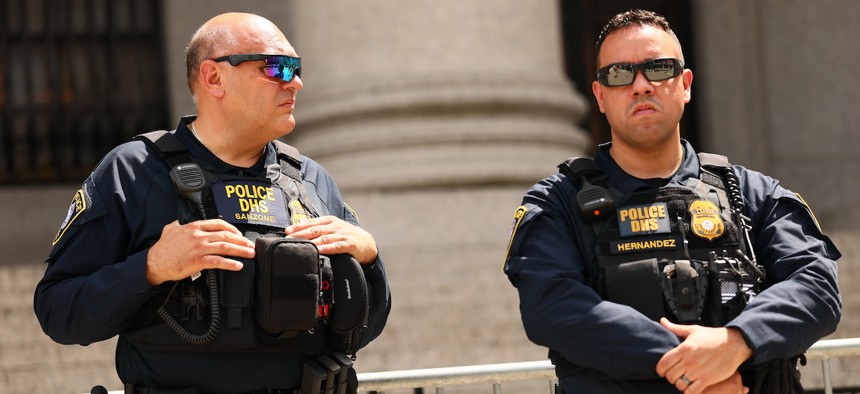
The paychecks will cover back pay dating to Feb. 14, when DHS funding lapsed. Michael M. Santiago/Getty Images




DHS employees to begin receiving paychecks this week
The Homeland Security Department is still shut down but Trump has ordered immediate back pay anyway.

Updated April 8 at 4:03 p.m.
Homeland Security Department employees are set to be paid by either the end of the week or, for some workers, by April 16, ending an impasse that has led them to go nearly two months without any compensation.
The paychecks will cover back pay dating to Feb. 14, when DHS funding lapsed. The department has operated under a shutdown ever since, with more than 100,000 employees either furloughed or working and not receiving immediate pay. Both groups of workers will soon receive paychecks after President Trump signed a memorandum ordering DHS to use previously appropriated funds to immediately pay the employees.
Trump previously ordered all Transportation Security Administration employees to receive immediate pay in an effort to address long wait times at airports that had resulted from a surge of employees calling out.
In a memo sent to all employees over the weekend, DHS said the workers would be paid between April 10 and April 16, depending on their financial institution. Trump’s order does not end the shutdown, however. Furloughed employees—only around 8% of the department—will remain on furlough. DHS also told employees not to submit their hours for their next paychecks until they receive further guidance.
One DHS employee who has been working without pay said there has been a "mad dash" for staff to complete there time cards in time. The announcement came as a relief to many workers who have been struggling to make ends meet.
“I've also been living off of my tax refund and only paying for what is absolutely necessary,” the employee said.
Many employees at DHS, such as most of those at Immigration and Customs Enforcement and Customs and Border Protection, have been paid on time since the shutdown’s onset because their offices are fee funded or are tapping into the One Big Beautiful Bill Act.
In his memo, Trump said he was declaring an “emergency situation compromising the nation’s security” and directed DHS to “use funds that have a reasonable and logical nexus to the functions of DHS to provide each and every employee of DHS with the compensation and benefits that would have accrued to them” but for the shutdown. Trump had said he would sign that memo because the employees’ “families have suffered for too long.”
Lawmakers appeared to reach a deal to fund most of DHS last week, while Republicans would seek to approve spending for ICE and CBP through a separate process. The Senate passed the measure unanimously while on recess, but the House—which was expected to do the same—never brought the bill up for consideration. Congress is set to return next week. Democrats had held out on funding all of DHS as they sought reforms to ICE and CBP practices.
“We remain hopeful that Congress will fund the department and allow us to reopen soon and get everyone back to work,” DHS said in its message to staff. “For those who have continued working, with and without pay, your dedication to the department and the American people, ensuring we remain mission-ready, is truly remarkable.”
In his first email to staff, newly sworn-in DHS Secretary Markwayne Mullin also expressed his gratitude to employees and said he “won’t rest” until DHS is fully funded.
“While the department remains shut down, this memorandum allows us to prioritize DHS’s most valuable national security asset,” Mullin said of the president’s action, “the men and women of this department who serve to keep this country safe.”
Correction: This story has been updated to correct a typo and reflect that DHS employees went nearly two months without pay.
If you have a tip that can contribute to our reporting, Eric Katz can be securely contacted at erickatz.28 on Signal.
NEXT STORY: OPM leans into 'well care' as it reshapes federal health plans for 2027