

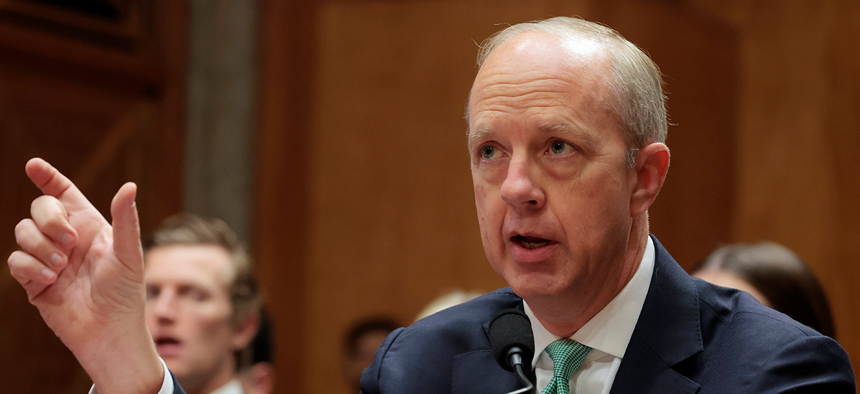
President Donald Trump nominated Eric Ueland, a top budget official and close ally of Office of Management and Budget Director Russ Vought, to lead the Government Accountability Office. Anna Moneymaker/Getty Images



Trump’s GAO pick was a done deal before Congress got a say
A Senate committee aide told Government Executive that Eric Ueland’s nomination bypassed a bipartisan process for Congress to help pick the head of its own watchdog office.
The Trump administration moved ahead with its pick to head the Government Accountability Office before a bipartisan commission had an opportunity to recommend candidates, prompting criticism from lawmakers, former agency leaders and federal employee groups.
President Donald Trump on Monday nominated Eric Ueland, a top budget official and close ally of Office of Management and Budget Director Russ Vought, to serve as GAO’s comptroller general.
A growing group of Republican and Democratic lawmakers, current and former GAO officials, former agency watchdogs and federal employee unions are criticizing the Trump administration for largely sidelining Congress in the selection process.
If confirmed by the Senate, Ueland, who currently serves as OMB’s deputy director, would serve as comptroller general for a 15-year term.
Ueland is scheduled to appear before the Senate Homeland Security and Governmental Affairs Committee for a confirmation hearing on Thursday morning, along with nine other nominees for a variety of governmentwide posts.
Under the 1980 General Accounting Office Act, a commission of 10 senior lawmakers from both parties in the House and Senate is supposed to recommend at least three candidates to the president.
The last time lawmakers vetted candidates for GAO’s top job in 2010, the congressional commission spent more than a year on its search. But last week, members of the bipartisan commission were given 24-hours’ notice to come up with names.
Republicans also question the rushed process
An aide for the Senate Homeland Security and Governmental Affairs Committee minority told Government Executive that Ueland’s nomination process was “preordained.”
According to the aide, GAO was informed around noon on Veterans Day that Ueland would be the nominee to be comptroller general and received his ethics paperwork before the congressional commission was given the opportunity to provide the names of other candidates.
The aide said staffers for HSGAC Chairman Rand Paul, R-Ky, who oversees the congressional commission, reached out to Democrats about an hour and a half after GAO received Ueland’s ethics paperwork, and were told to submit any other names for consideration by 8 a.m. the next morning.
“It was very clear it was always going to be Ueland,” the aide said. “Ueland was the nominee before Paul even made this request.”
A GAO spokesperson referred questions to the White House. The White House and HSGAC did not immediately respond to requests for comment.
The other names the Republicans submitted were Brian DeBusk of Tennessee and Roland Foster of Pennsylvania. None of the candidates were interviewed by the committee.
“No Democratic members of the commission signed off on these names going to the White House,” the HSGAC aide said.
Democratic lawmakers have denounced the fast-track process as a “sham” that largely left congressional commission. The HSGAC aide said Democrats on the commission “take great exception to calling it a process at all.”
“The White House had already decided they were nominating Ueland,” the aide said.
Senate Republicans – including several who are retiring or lost reelection – have also raised concerns about the process that led to Ueland’s nomination.
Paul told Politico on Monday night that the White House asked him to put Ueland’s name forward for the role. Paul held off on making a public endorsement of Ueland’s nomination, but told Politico that “it’s important to find someone who’s honest and objective.”
Retiring Sen. Thom Tillis, R-N.C., told Roll Call on Monday that he’s “not a fan” of Ueland’s nomination for GAO’s top job. Tillis stopped short of opposing Ueland, but told Roll Call that his nomination "deserves individual consideration" instead of being taken up in a group with several other nominees.
Sen. Susan Collins, R-Maine, who lost a reelection bid in this year’s midterms, told Punchbowl News on Monday that “I don’t know if it’s a bipartisan pick.”
A spokesperson for Sen. John Curtis, R-Utah, said in a statement that Curtis “has concerns that the nomination is too partisan, particularly given how independent and long-term the appointment of the Comptroller General is.”
Eric Fejer, Curtis’ press secretary, gave no indication on how Curtis is going to vote on Ueland’s nomination.
“The GAO’s credibility depends on its willingness to hold administrations of both parties accountable, even when doing so is politically inconvenient. He also has concerns about how the process has played out, including the rushed manner in which the Homeland Security and Governmental Affairs Committee has noticed the nomination,” Fejer said.
Outgoing Sen. John Cornyn, R-Texas, said at the Atlantic Summit on Tuesday that he also hasn’t yet decided which way he would vote on Ueland’s nomination.
“Eric Ueland is a good man. He's an honorable person,” Cornyn said. “I think some people think he's going to be Russ Vought 2.0. I don't think he will be. I think he'll be his own man. And we'll see how the confirmation process goes because there's been some controversy,” Cornyn said.
Benjamin Emmel, president of the GAO Employees Organization, which represents about 2,500 of the watchdog agency’s employees, said the union is advocating for Congress to “halt this process and make sure that it includes all the statutory members in a consensus-building, considered, rigorous, deliberative approach.”
Emmel said that the union’s concerns “are not with any individual nominee,” but instead with steps not being followed. GAO employees, he said, pride themselves on providing nonpartisan oversight to Congress, and that if there is any doubt in how a nominee was selected, “it really reduces the usefulness and utility that GAO provides.”
“We see ourselves and operate as part of the legislative branch, answering directly to Congress. And so that's who we do our work for. And that's how we see ourselves and how we're legally structured. I think there's been a number of concerns that have been raised with the appointment process. I expect those concerns to stick around or to grow, given the way this appointment process has been rushed,” he said.
Emmel said GAO has reduced its headcount by hundreds of employees through voluntary departures and early retirements.
“Our budget has been flat and obviously the agency's costs continue to increase. GAO's been able to manage that through voluntary departures and hasn't needed to resort to any more drastic measures,” he said.
Former GAO leaders urge Senate to halt confirmation
In an op-ed posted Tuesday, former GAO Comptrollers General Gene Dodaro and David Walker – along with Steve Hanke, a professor of applied economics at Johns Hopkins University who served on President Ronald Reagan’s Council of Economic Advisers – wrote that Paul and Trump “have not followed the statutory requirements for the appointment of the Comptroller General,” and that Thursday’s confirmation hearing “should be canceled."
“With regard to potential candidates, any Comptroller General should be a highly qualified executive with relevant past experience who will operate in a professional, objective, fact-based, non-partisan, non-ideological, and non-personal manner,” they wrote. “The Comptroller General must be independent from the Executive Branch, which the GAO audits, investigates, and evaluates on behalf of the Congress and the American people. In addition, any Comptroller General must have broad bipartisan support.”
Ueland's OMB ties raise conflict-of-interest concerns
Matthew Biggs, president of the International Federation of Professional & Technical Engineers, said there’s a “laundry list of problems with this nomination.”
“The first thing that comes to mind is the conflict of interest with his role at OMB,” Biggs said. “If he's confirmed, God forbid, he'll be leading the investigative arm of Congress that's going to be investigating his role in illegal impoundments.”
If confirmed by the Senate, Ueland would lead an agency responsible for monitoring cases of impoundment, where agencies withhold funding enacted by Congress. As of July 2025, GAO had opened at least 46 impoundment investigations and found in some cases that agencies had violated the Impoundment Control Act.
Biggs said putting an OMB official in charge of GAO would “do huge damage to the oversight abilities of Congress to perform oversight on the executive branch.”
“It’s like putting the fox in to guard the henhouse. It doesn't matter whether you're Republican or Democrat here, this is too important of a position within the legislative branch to be rushing through a partisan like Ueland. The Senate should wait until next year to go through the normal process," he said.
The American Federation of Government Employees is also calling on senators to oppose Ueland as GAO’s comptroller general.
In a Nov. 18 letter to HSGAC leadership, AFGE Legislative Director Daniel Horowitz wrote that the union “is deeply concerned that the Senate appears intent on ignoring the law governing the selection of the comptroller general and confirming Mr. Ueland in the waning days of the 119th Congress.”
“If Mr. Ueland is indeed the most qualified candidate to serve as the ninth comptroller general for the next 15 years, Congressional leaders should follow the law and allow the selection process to prove it. Failure to obey the law and confirm Mr. Ueland after a hasty pro forma hearing would guarantee that as comptroller general, Mr. Ueland would operate with a permanent credibility deficit that would call into question all of GAO’s work for years to come,” Horowitz wrote.
The Partnership for Public Service and the Project on Government Oversight have also raised concerns about the rushed process to confirm Ueland.
A group of 20 former agency inspectors general, in a letter to HSGAC leadership, cited Ueland’s “irreconcilable conflicts of interest” and “subversion of the statutory bipartisan selection process” as reasons to oppose his nomination.
“Confirming a sitting White House political official through a rushed, unilateral process would inflict lasting damage on one of Congress's most vital institutional checks,” they wrote.
If you have a tip that can contribute to our reporting, Jory Heckman can be securely contacted at jheckman.29 on Signal.
NEXT STORY: Ueland’s GAO nomination puts Congress’s power of the purse to the test