

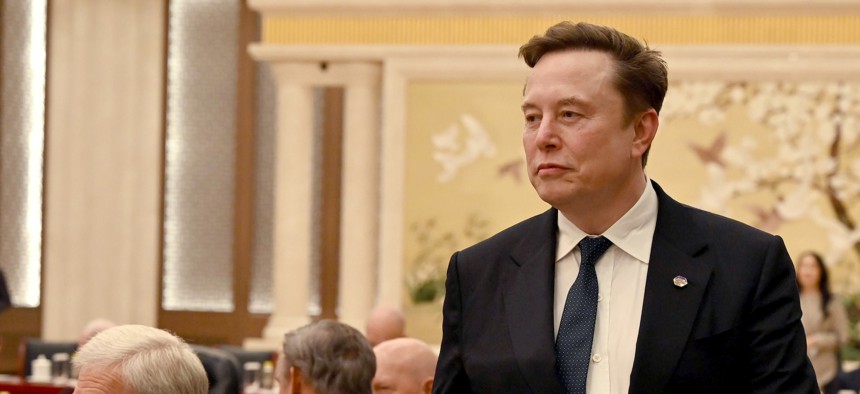
Elon Musk, the former Department of Government Efficiency head, is part of a business delegation during a visit by President Donald Trump to China on May 14. Johannes Neudecker / picture alliance / Getty Images




Musk should testify about overstated savings from DHS contract cancellations, Democrats argue
The Government Accountability Office reported that contract terminations pushed by the Department of Government Efficiency yielded a net of $92 million — much less than the Homeland Security Department’s public report of as much as $10.5 billion in potential savings.

Two House Democrats last week requested that Elon Musk and other Department of Government Efficiency officials testify under oath after a new watchdog report found that the cost-cutting initiative overstated its savings from Homeland Security Department contract cancellations.
“Elon Musk and DOGE tried to sell the American people a lie: that firing federal workers and gutting public services would make government more efficient and save taxpayers billions,” said Reps. Bennie G. Thompson, D-Miss., the ranking member of the House Homeland Security Committee, and James Walkinshaw, D-Va., in a statement. “Instead, they inflicted lasting damage, indiscriminately cancelled contracts and fired essential personnel.”
The Government Accountability Office reported that DHS fully or partially terminated 438 contracts between Jan. 20 and Sept. 30, 2025, as a result of DOGE’s mandate to reduce agency spending, including on contracts. Auditors found that, as a result, the department deobligated more than $249 million but also obligated $157 million in new costs to settle the canceled agreements with contractors and for continued work under partially terminated contracts.
While that results in a net of about $92 million in savings, DHS reported that the 2025 contract terminations could generate more than $10.5 billion in reduced spending. Unlike GAO’s analysis, which looked at how much money was deobligated, the department’s methodology relied on the maximum amount that could’ve been spent under the canceled contracts.
In addition to criticizing DHS’ analysis, the auditors found that 95% of the $10.5 billion in potential cost savings is attributable to 30 terminated IT contracts. But the department, in some cases, is using other contracts to obtain those services.
“According to the Office of the Chief Procurement Officer, in fiscal year 2025, DHS obligated over $1.7 billion through existing government-wide contracts to meet these [IT] requirements,” they wrote. “Thus, $1.7 billion of potential costs under these contracts were not avoided but incurred through other contracts.”
Thompson and Walkinshaw argued that Musk and other DOGE officials should testify in a hearing about the contract terminations, including who approved the DHS estimates and how the cancellations may have impacted department functions.
A DHS spokesperson said in a statement to Government Executive that officials have "reviewed thousands of contracts, ended hundreds that were no longer mission-critical and redirected resources to higher-priority operational needs. That is responsible stewardship: identifying wasteful or lower-priority spending, ending unnecessary contracts and ensuring taxpayer dollars support DHS’s most critical operations."
Last month, GAO issued a report that found multiple errors with how DOGE calculated its savings. For example, about $34.6 billion of the $61 billion estimated to have been generated from terminated contracts either came from contracts that were never canceled or there wasn’t evidence that the contracts were terminated.
If you have a tip that can contribute to our reporting, Sean Michael Newhouse can be reached securely at seanthenewsboy.45 on Signal.