

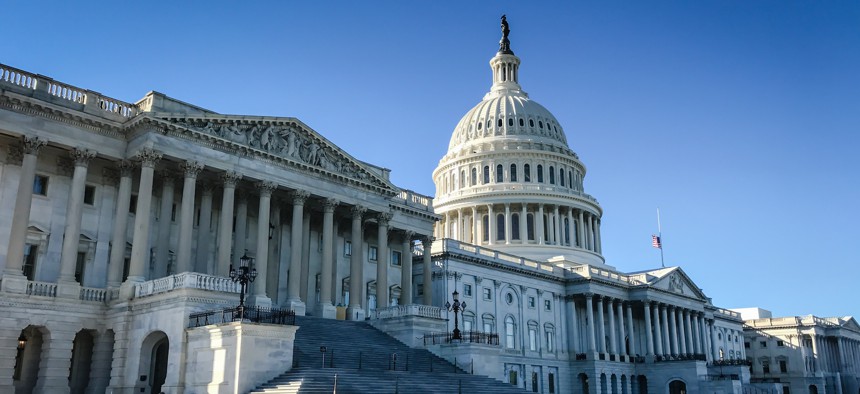
A panel of current and former agency inspectors general on Wednesday discussed recommendations for actions that Congress could take to strengthen IG independence. mbell / Getty Images




Inspectors general are facing an identity crisis. Here’s how some former IGs would preserve the watchdogs’ independence
A panel of former leaders of the Council of the Inspectors General on Integrity and Efficiency made several recommendations for reforming the group, which has been targeted by the Trump administration.

As President Donald Trump installs individuals with political histories into inspector general positions, which historically have been nonpartisan agency watchdog roles, a panel of current and former oversight officials on Wednesday discussed what actions lawmakers could take to protect IG independence moving forward. But the speakers acknowledged that many of their recommendations have tradeoffs and weaknesses.
“I don't know what the answer is,” said Mark Lee Greenblatt, the former IG at the Interior Department who was removed in a mass firing of the watchdogs at the start of the president’s second term. “It is a very, very hard call. I think you can adopt some measures; the question is whether Congress is interested in them.”
Greenblatt said at the Government Oversight and Accountability Symposium, which was hosted by George Washington University’s Trachtenberg School of Public Policy and Public Administration, that a recent Supreme Court decision that expanded the president’s ability to fire officials who previously had removal protections complicates any attempt to set up new guardrails. He mused that sequestration, or automatic funding cuts, if a president improperly fires an IG could align with the justices’ ruling. But he noted that may create a perverse incentive for removing a watchdog.
“The problem is that maybe the president wants to cut the budget of that agency, and this is a great backdoor way to do it,” he said.
Greenblatt also pointed to a blog by Fernando Laguarda, an American University law professor, that argued IGs still could be protected from removal under a different recent Supreme Court decision that temporarily blocked Trump’s attempted firing of Federal Reserve Governor Lisa Cook.
Allison Lerner, the former IG at the National Science Foundation, recommended on Wednesday that Congress set up a dedicated appropriation for the Council of the Inspectors General on Integrity and Efficiency. Currently, the central watchdog group receives its funding through contributions from participating IG offices.
The Office of Management and Budget blocked CIGIE from receiving funding for about a month-and-a-half in 2025, arguing that IGs “have become corrupt, partisan and in some cases, have lied to the public.” The White House backtracked, however, after pushback from Senate Republicans.
But Lerner, who previously led CIGIE, said that her recommendation pre-dates the latest conflict with the administration.
“By taking a tiny percentage of every OIG's budget and having that shifted over to CIGIE to fund its operations, in practice that's been truly challenging to manage,” she said. “I'm concerned that it may become even more challenging if people decide that they simply don't want to transfer that money over to CIGIE.”
Greenblatt also recommended that Congress should codify CIGIE’s practice of reviewing possible IG nominees. Tammy Hull, the IG for the U.S. Postal Service and acting CIGIE chair from January 2025 through April 2026, told the audience that the review panel no longer provides input on presidentially appointed IGs but does for those selected by agencies.
There are more than 70 federal IGs; about half are nominated by the president and confirmed by the Senate while the other half are appointed by an agency head.
CIGIE also runs the Integrity Committee, which oversees investigations into allegations of wrongdoing against an IG or other senior OIG staffers. Lerner contended that the current process “looks like IGs pitted against IGs” and recommended transferring that responsibility to the Office of Special Counsel, which supervises investigations that are prompted by whistleblower complaints.
“Since I've retired, I have time when I'm walking the dog to think about things like the Integrity Committee. My most recent thought was that it might make sense to put the Integrity Committee into the Office of Special Counsel,” she said. “The OSC conducts administrative investigations that are very similar to the investigations that the Integrity Committee does.”
Greenblatt agreed with removing the Integrity Committee from CIGIE but also cautioned that the OSC could be led by a partisan-minded individual. The current special counsel is Charles Baldis, a former GOP Senate staffer. In 2025, Trump removed the incumbent special counsel — Hampton Dellinger, who was appointed by former President Joe Biden — before the end of his five-year term.
House Republicans in July advanced out of committee the Restoring Integrity and Efficiency to Inspector General Oversight Act (H.R. 9725) that would abolish CIGIE. Supporters of the bill pointed to a June report from the Government Accountability Office that found the Integrity Committee frequently fell short of its own process requirements during investigations.
Speakers also stressed the importance of improving IG engagement with the public, particularly with respect to pushing agencies to implement their recommendations.
“We have a comms problem,” Hull said. “I think we have relied on our 20th century brains that say ‘We issue these 25 to 30 page reports. [People] will read them. They will do the right thing.’ The world we live in is not that world.”
Greenblatt touted Lucy Lang, the New York state IG, who frequently promotes her office’s work on social media and even wrote a comic book that uses dog characters to explain what an IG does.
“We need to get in the modern era. We're not issuing 50-page reports and just throwing that out to the world. Zero people will read that,” Greenblatt said. “You have to make it consumable for the average American. You have to make them understand why this matters to them. We're not speaking just to the agency. We're not speaking just to Congress. We have to speak to the American people and have them understand why we are doing this.”
If you have a tip that can contribute to our reporting, Sean Michael Newhouse can be reached securely at seanthenewsboy.45 on Signal.